





Spain’s climate allows outdoor living in a way that northern Europe simply cannot. A well-designed outdoor space in Madrid or any Spanish coastal city is a genuine room: used for breakfast, dinner, morning coffee, evening drinks, weekend lunches with friends. The potential is enormous. The comparison between how different climates shape residential design is explored in our guide to designing homes for both summer and year-round living.
But the number of Spanish terraces, gardens, and patios that are genuinely used every day for most of the year, versus the number that exist primarily in listing photographs and are practically abandoned in July because the sun is too intense or there is nowhere comfortable to sit, is telling.
The difference is design.
The Two Seasons That Spanish Outdoor Space Needs to Handle
Spanish outdoor space faces two distinct challenges.
Summer: temperatures regularly exceeding 35 to 38 degrees Celsius in Madrid and much of inland and southern Spain. Direct sun on a stone or tile terrace makes surfaces too hot to walk on barefoot. Without shade, sitting outside between 11am and 7pm in July is genuinely uncomfortable.
Winter: Madrid winters are colder than many people anticipate. January temperatures regularly drop below 5 degrees at night and stay below 15 during the day. An outdoor space that only works in a narrow band of ideal temperatures has a usable season of maybe 3 months.
Design for both conditions and the outdoor space becomes usable for 8 to 10 months of the year. Design for only one and you have an underperforming asset.
Shade: The Most Important Outdoor Design Decision
Shade is to outdoor space in Spain what insulation is to indoor space in Sweden. Without it, the space does not work.
The options:
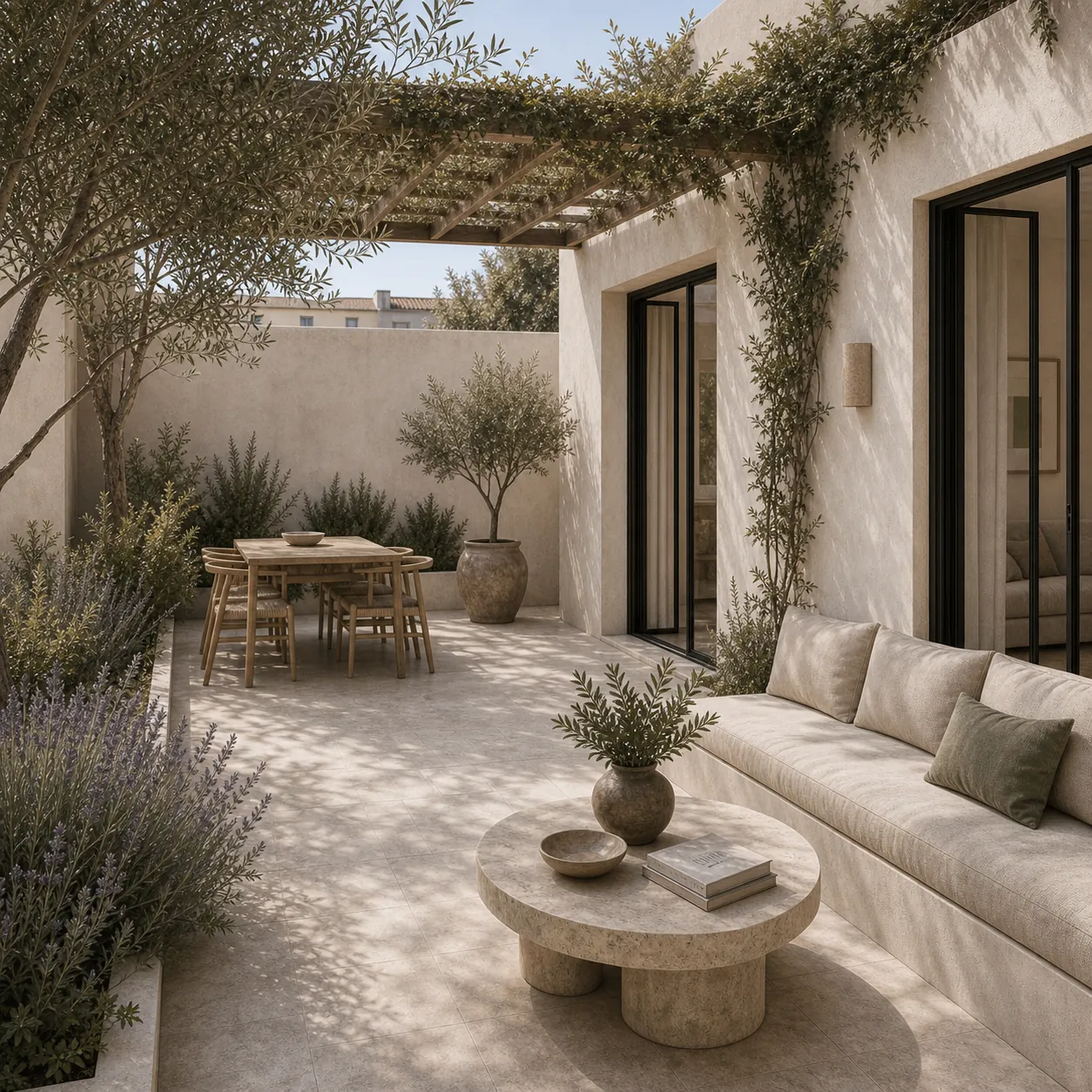
Fixed pergola with a solid or louvred roof: the most architectural solution. A well-designed pergola with a sliding or adjustable louvre roof can be opened for sun in winter and closed for shade in summer. These work beautifully in Spanish climates and add permanent architectural value to the property. If you are considering adding a pergola as an extension to your existing structure, our guide to adding a terrace, extension, or garden room covers the permit requirements.
Retractable awning: more flexible, less expensive than a pergola, and allows the space to be fully open when wanted. The limitation is wind: most retractable awnings cannot be extended in winds above 35 to 40 km/h. In coastal locations, this limits their utility on windy days.
Shade sail: excellent value, visually light, and very effective. Works best when anchored at multiple points and tilted to provide shade at the specific time of day when the space is most used.
Plant-based shade: a vine-covered pergola is the traditional Mediterranean solution, used for centuries for good reason. It provides dense shade in summer when the vine is in leaf and allows winter sun through when the vine is bare, perfectly calibrated to the climate. This is one of the many examples of climate-responsive architecture that Mediterranean tradition has refined over centuries.
Wind Protection: The Underestimated Comfort Factor
Wind is often the reason outdoor spaces are not used even on comfortable days.
In Madrid and coastal areas, wind from the north and west is the primary winter discomfort factor. A terrace open to the prevailing wind direction is cold and uncomfortable at temperatures that would be pleasant in a sheltered spot.
Glass wind screens, masonry or rendered walls at strategic points, or planted hedges provide wind protection without blocking light. The key is knowing which direction the prevailing wind comes from for your specific location.
Even a partial wind break, a 1.5m glass panel on the north side of a terrace, dramatically improves the usability of the space in cooler months.
The Outdoor Kitchen and Dining Situation
Outdoor cooking and eating is one of the most valued uses of outdoor space in Spain, and one of the most under-designed.
A proper outdoor kitchen position requires: a weather-protected zone for the cooking equipment (a simple roof overhang is usually sufficient), a gas connection for a plancha or grill if gas is preferred over charcoal, adequate surface area for food preparation next to the cooking area, and proximity to the indoor kitchen so that service between the two is not an obstacle course.
The dining area should be positioned in the shade zone, not in full sun (nobody wants to eat lunch in direct July sun), and sized for the table and chairs you actually want to use, including the space to pull chairs out and move around the table.
Surface Materials That Work in the Spanish Climate
Terrace surfaces need to handle direct sun, rain, and temperature cycling without cracking, fading, or becoming dangerously slippery when wet.
Natural stone (limestone, sandstone, granite) is excellent if correctly specified for outdoor use. Not all stones suitable for interior use are suitable outside. Limestone in particular needs to be a low-absorption grade for Spanish outdoor use.
Porcelain tile in large format: the current standard for contemporary Spanish terraces. Extremely durable, available in finishes that mimic stone convincingly, non-slip when correctly specified (check the slip resistance rating for outdoor use). Large format reduces grout joints, which improves maintenance.
Timber decking: used widely and looks good, but requires regular maintenance to avoid grey weathering, and can become slippery in wet conditions if not appropriately treated or designed with drainage gaps.
Exposed concrete: very contemporary, low maintenance when sealed correctly, but gets very hot in direct summer sun. Best used in shaded areas or with a light-coloured surface treatment.
Planning an outdoor space renovation in Spain and want a design that will actually be used every day? Tell us about your space using the form below and we will respond within 48 hours.