





The kitchen is consistently one of the two or three highest-return renovation investments in residential properties across all price levels. It is also one of the projects where the gap between what clients expect and what the process actually involves is widest.
This guide covers the full picture: the permit situation, the design decisions, the cost reality, and the contractor management issues that are specific to kitchen renovation in Spain. For the full renovation cost picture, see our Madrid renovation guide for 2026.
Permits for Kitchen Renovation in Spain
The permit situation depends on what you are actually doing.
A kitchen renovation that is purely cosmetic, new tiles, new appliances, new worktops, no structural work, no changes to the load-bearing walls, no modifications to the building’s shared services, typically qualifies as an Obra Menor or comunicación previa in most Spanish municipalities. This means a simplified notification rather than a full permit application, with a much shorter lead time.
A kitchen renovation that opens up a wall, modifies the building’s shared drainage or gas supply, or changes the kitchen’s ventilation route through the building’s common areas requires an Obra Mayor in most cases. This triggers the full permit process with associated timelines of 2 to 6 months. See our complete guide to building permits in Madrid for a full breakdown.
One specific issue in apartment buildings: kitchen ventilation. Many older Madrid apartments have shared ventilation shafts (conductos de ventilación) that serve multiple apartments. Modifying the connection to these shafts, or adding a new kitchen extractor where there was none, may require comunidad approval as well as a permit. Your architect needs to check this before designing the extraction route. The rules governing communal decisions are explained in our guide to Spanish horizontal property law.
Layout: The Decisions That Matter Most
The kitchen layout determines how well the space functions regardless of the quality of the materials and fittings. Bad layout with expensive finishes produces an expensive, badly functioning kitchen. Good layout with modest finishes produces a kitchen that is satisfying to use.
The key layout principle: the work triangle (hob, sink, refrigerator) should be efficient. These are the three points you move between repeatedly during cooking. If they are too far apart, the kitchen is tiring to use. If they are poorly sequenced, food preparation requires constant cross-movement.
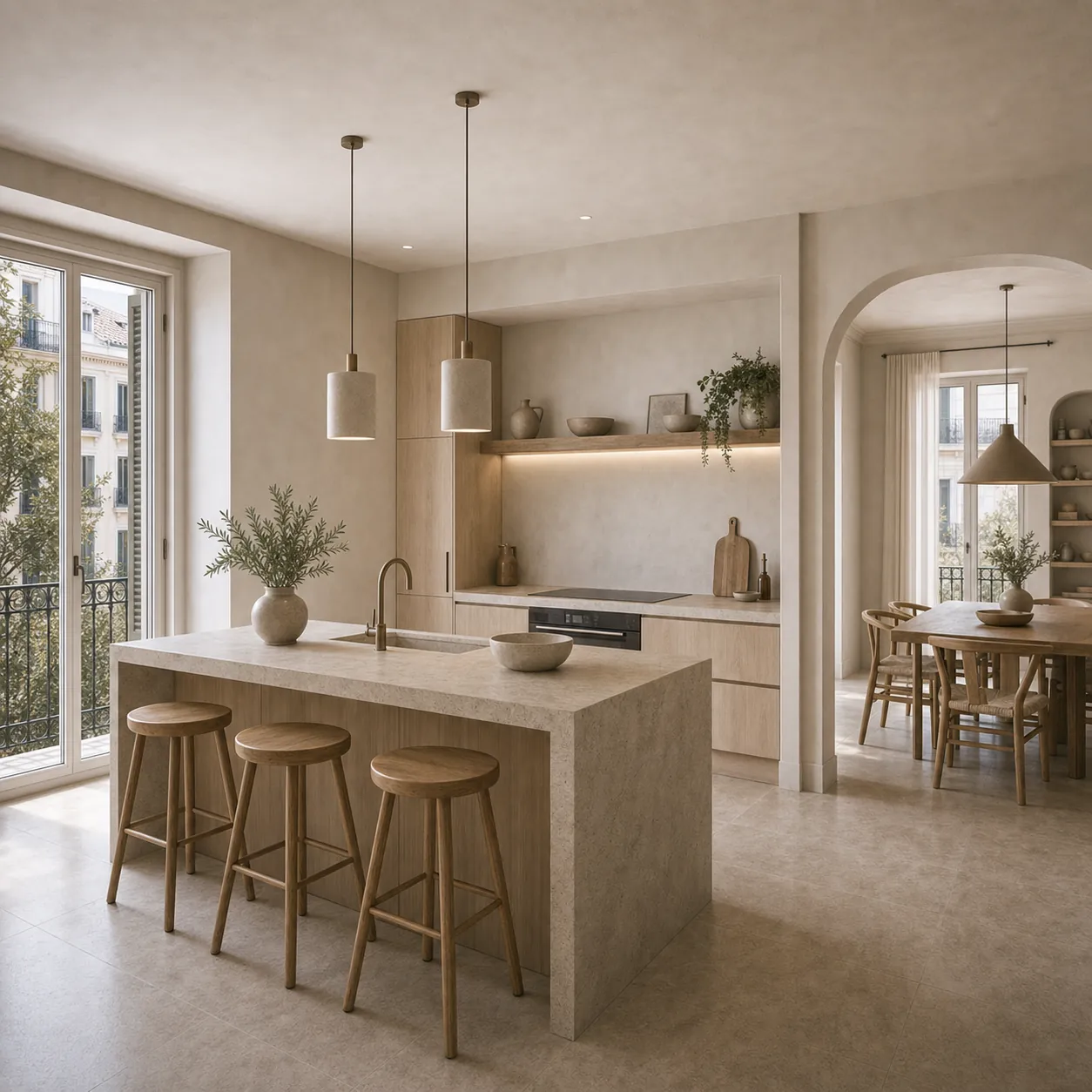
In the typical Madrid apartment, the kitchen is often a separate enclosed room, sometimes quite narrow. The most impactful renovation decision for these spaces is often whether to open the kitchen to the adjacent living or dining area. This increases perceived space, improves light, and creates a more sociable cooking environment. It also usually requires an Obra Mayor permit and structural engineering if any walls being removed are load-bearing. Our guide to open-plan apartment renovation in Madrid covers this decision in full.
For kitchens that remain enclosed, U-shaped or galley layouts are the most efficient for the typical narrow kitchen footprint. Avoid corner solutions that create inaccessible dead zones.
What Kitchen Renovation Actually Costs in Spain
These are honest 2025/2026 figures for apartments in Madrid and other major Spanish cities:
Basic renovation (new fronts and worktops, same layout, no structural work): 5,000 to 12,000 euros including materials and labour.
Mid-range full renovation (new everything, same layout, standard appliances): 12,000 to 22,000 euros.
High-quality full renovation (layout changes, quality appliances, quality materials, structural work): 22,000 to 45,000 euros.
Premium renovation with bespoke cabinetry, high-end appliances, and design coordination: 45,000 euros and above.
These figures include the cabinetry, worktops, appliances, tiling, plumbing, electrical works within the kitchen, and labour. They do not include architect fees if technical project documentation is required for an Obra Mayor permit.
The main variables driving cost upward: structural works to open the kitchen to the adjacent space, premium appliance brands (a Gaggenau or Miele kitchen costs significantly more than an AEG or Bosch one), stone worktops versus laminate or compact laminate alternatives, bespoke versus off-the-shelf cabinetry, and the specific tile choice (standard format tiles are significantly cheaper than large-format or handmade tiles).
Materials That Work in Madrid Kitchens
Worktops: compact laminate (Dekton, Silestone) offers excellent durability at mid-range price. Natural stone (marble, quartzite) is visually excellent but requires more maintenance and carries premium cost. Both are appropriate for Madrid’s dry climate.
Cabinet fronts: lacquered fronts in matte finishes are the current standard for contemporary kitchens and are durable. Timber veneer fronts bring warmth but require more care in humid conditions (near the sink particularly). Avoid gloss lacquer in high-use kitchens: it shows every mark.
Floor: the kitchen floor should be a hard, non-porous surface. Large-format ceramic or porcelain tiles that continue from the adjacent living area create visual continuity and are easy to maintain. Avoid natural stone without sealing in kitchen areas, as unsealed stone absorbs oils and food residues.
Splashback: glazed ceramic tile remains excellent for splashback areas, durable, easy to clean, and available in an enormous range of aesthetics. Full-height stone splashback matching the worktop is visually strong but requires precise cutting and sealing. Glass splashback panels are practical but require a clean substrate behind.
Planning a kitchen renovation in Spain and want an architect’s input on the layout and design? Tell us about your kitchen using the form below and we will respond within 48 hours.