






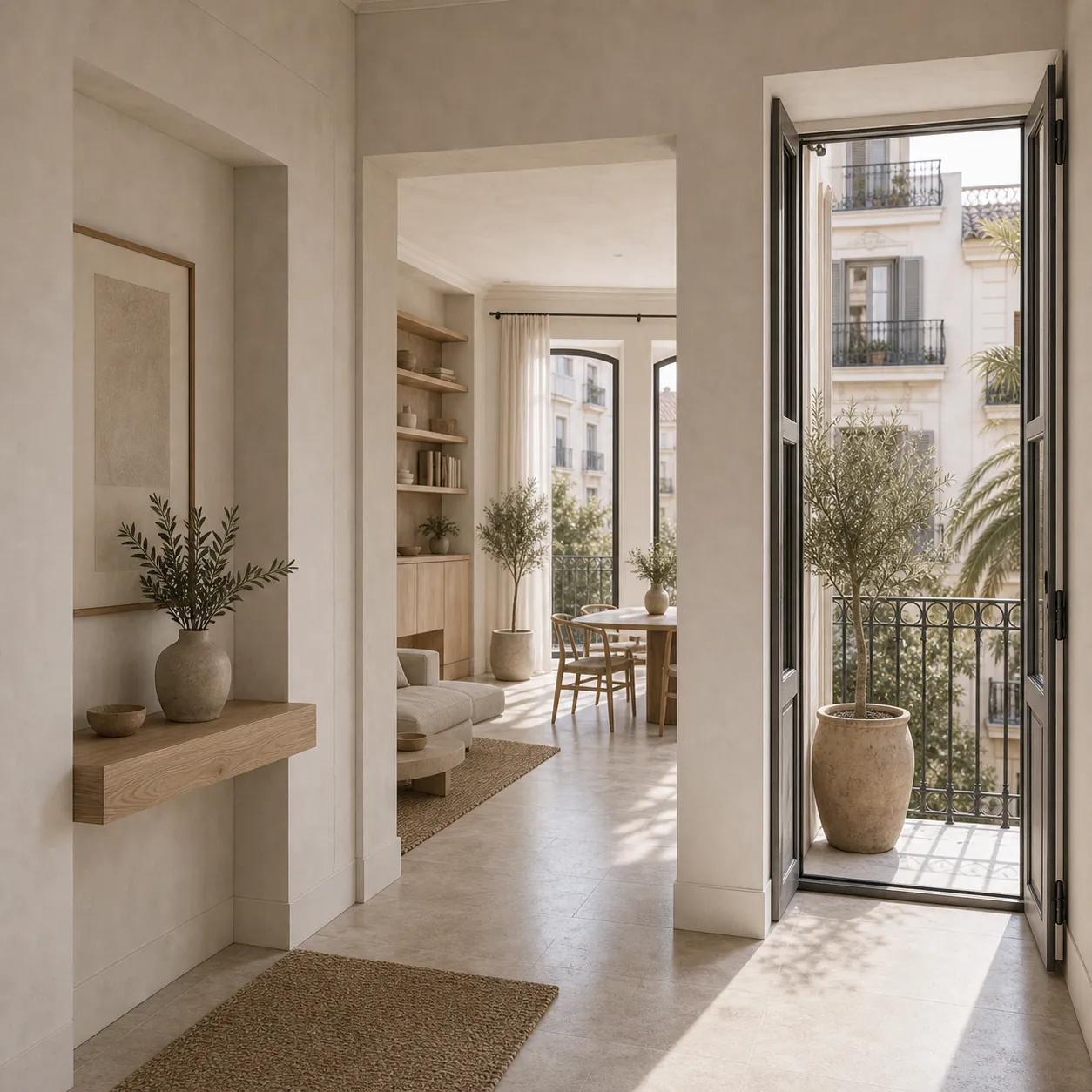
Relocating to Spain, most often to Madrid or one of the major coastal cities, is a decision made by thousands of Swedes and Greeks every year.
The reasons vary: work opportunities, climate, lifestyle, a partner, or simply a desire for something different. What people often do not anticipate is how different the housing culture, construction quality expectations, and renovation norms are from what they know at home.
This article is for people who are serious about settling in Spain and who want to approach their housing choices with realistic expectations. The purchase process itself is covered in our guide to buying property in Madrid as a foreigner.
What Spanish Housing Looks Like Compared to Swedish Standards
If you are coming from Sweden, the first impression of Spanish apartment stock is usually a mix of appreciation and surprise.
Appreciation because the ceiling heights are often generous, 3 meters or higher in older buildings, and because the building materials have a solidity and character that Sweden’s post-war construction often lacks.
Surprise because the energy performance, insulation, and systems quality in unrenovated Spanish apartments are frequently far below what a Swedish buyer considers baseline acceptable.
In Sweden, building code requirements for thermal insulation, window performance, and ventilation have been progressively tightening since the energy crises of the 1970s. A typical Swedish apartment built after 1990 is well-insulated, tightly sealed, mechanically ventilated, and comfortable in both summer and winter with modest energy consumption. What that standard looks like in detail is explained in our guide to energy-efficient homes in Sweden and the Nordic building standard.
A typical Madrid apartment from the same era may have single-glazed windows, no insulation in the walls, and a heating system consisting of individual electric radiators.
This gap creates a real quality-of-life adjustment if you buy an unrenovated Spanish apartment expecting it to function like a Swedish one. It also creates renovation opportunity, because improving a Spanish apartment to Swedish functional standards, combined with the inherent character advantages of the Spanish building stock, produces genuinely excellent results. Our Madrid renovation guide covers what this improvement process typically involves and costs.
For Swedish buyers, the key mental shift is: budget for systems renovation, not just cosmetic renovation. New windows, a proper heating and cooling system, and some improvement to wall insulation will make a bigger difference to your daily comfort than new kitchen cabinets.
What Spanish Housing Looks Like Compared to Greek Standards
For Greeks relocating to Spain, the comparison is different.
The climates are broadly similar, Mediterranean in character, though Madrid’s continental location makes its winters colder and its summers hotter than Athens. The construction cultures share some similarities: reinforced concrete frame construction from the post-war era, a tradition of ceramic tile in wet areas, balconies as a standard feature, and a Mediterranean relationship to outdoor space.
The differences are in density, neighborhood structure, and urban quality. Madrid’s urban planning is more coherent than Athens. The city has clear neighborhood identities, well-maintained public space, reliable infrastructure, and a transport network that Athens is still developing. For Greeks used to Athens’ somewhat chaotic urban fabric, Madrid often feels more organized and livable.
Spanish apartments tend to be slightly better energy performers than their Greek equivalents from the same era, though still poor by northern European standards. The communal building systems that Spanish property law requires often ensure better maintenance of common elements than Greek polykatoikia, where maintenance culture is more variable. How the Spanish comunidad system works is explained in our guide to Spanish horizontal property law.
For Greek buyers, the permit and renovation process in Spain will feel somewhat familiar. There are bureaucratic processes to navigate, professional licensing matters, and working with a reliable contractor is non-trivial. The specific regulations are different but the general landscape is recognizable.
What to Look For When House-Hunting in Madrid as a Northern European
Natural light is non-negotiable. Not every Madrid apartment has good light. For buyers coming from Sweden, where every available lumen is valued, this is particularly important. Look specifically at the building’s orientation, which rooms face the street versus the interior courtyard, and whether the floor plan allows light to travel to the back of the apartment. Our guide to designing homes around light explains the key decisions.
The community matters. The comunidad de propietarios has a real impact on your ownership experience. Before buying, request the last three years of community meeting minutes. Look for signs of deferred maintenance, pending extraordinary works assessments, neighbor conflicts, or financial stress in the community’s reserves.
Building age as a proxy for systems condition. Buildings from before the 1970s in Madrid almost certainly have original electrical and plumbing installations that need complete replacement. This is not a reason not to buy, but it is a cost that needs to be in the renovation budget.
Noise. Madrid is a genuinely noisy city by Swedish standards. Street noise, interior courtyard acoustics, and neighbor sound transmission through older walls and floors are real quality-of-life factors. Testing the apartment at different times of day is worth the effort.
The Role of the Home When Relocating to a New Country
For anyone relocating across countries and cultures, the home becomes more than a practical shelter. It is where you reconstruct a sense of stability and identity in an unfamiliar context. Getting it right, creating a space that genuinely supports how you live rather than one that just functions at a basic level, matters more in this context than in a stable long-term home.
The best investment of time and money in the first year after relocating is usually in the home itself.
Not necessarily a full renovation immediately. You may not yet know the apartment well enough to design it for how you will actually live in it. But at minimum, addressing the systems failures that make daily life uncomfortable and beginning to configure the space for your actual needs rather than the previous occupant’s is worth prioritizing. How design decisions affect wellbeing and daily life is especially relevant when setting up a home in a new country.
A staged approach often works well: immediate improvements in year one, a more considered renovation in year two or three once you know how you actually use the space.
Relocating to Spain from Sweden, Greece, or elsewhere and thinking about your housing situation? Tell us about your plans using the form below and we will respond within 48 hours.