






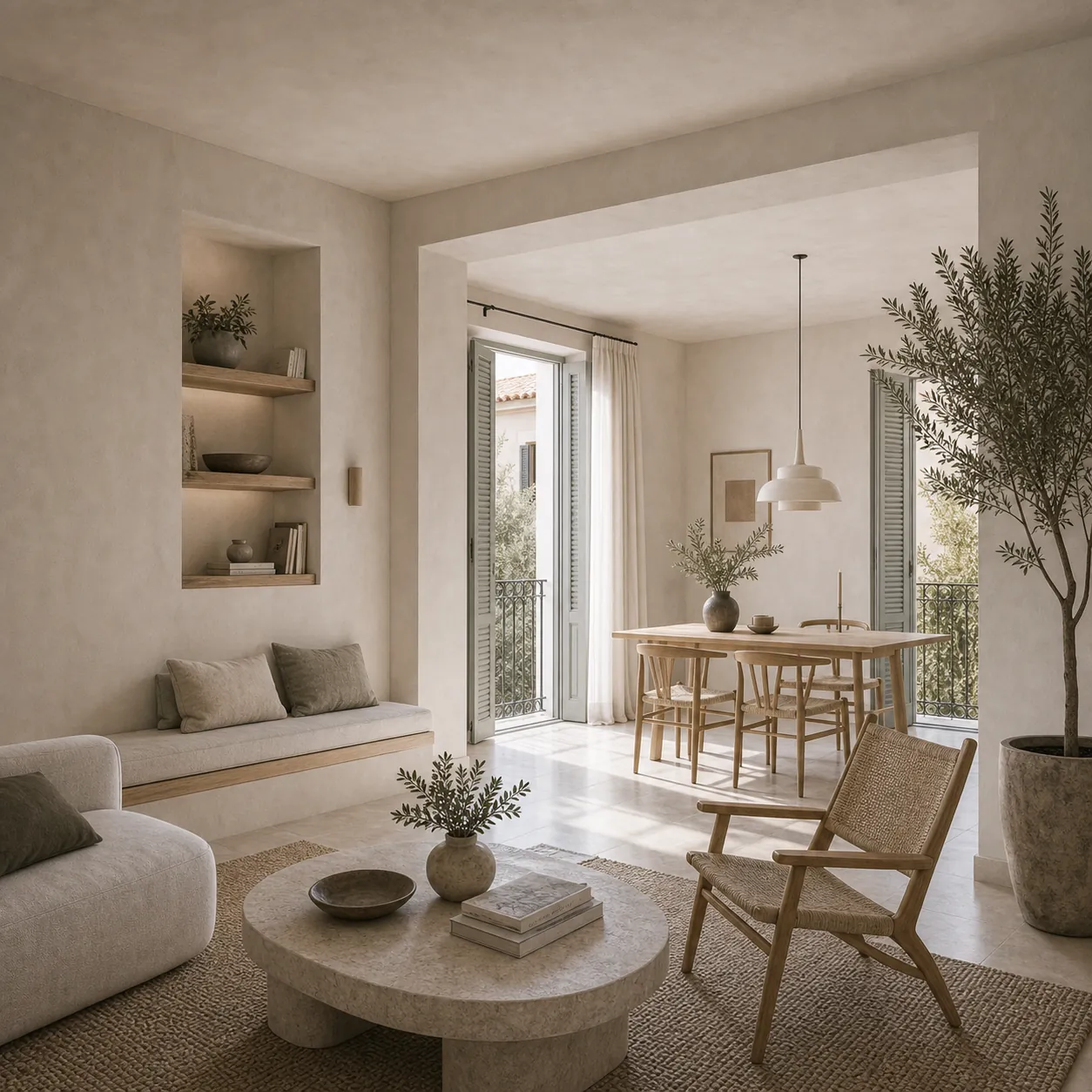
Swedish design has been globally influential for decades. This methodology sits at the heart of how Wolfblanc applies Nordic thinking to projects in Spain and Greece.
IKEA made it democratically accessible. The work of Swedish architects has been consistently respected internationally. Swedish residential interiors set a visual standard that has shaped expectations in design media worldwide.
But Swedish design is more than a visual style. It is a methodology. And that methodology turns out to be surprisingly applicable to residential architecture in Spain and Greece, for reasons that have nothing to do with aesthetics and everything to do with problem-solving.
What Swedish Residential Design Is Actually Built to Solve
Swedish residential design developed in specific conditions.
Stockholm’s winters give roughly 6 hours of usable daylight in December. Urban density in Swedish cities means apartments that are compact by southern European standards. Swedish building culture has long had high expectations for functional performance: spaces that work efficiently, systems that are reliable, and materials that endure rather than impress temporarily.
The design responses to these conditions are not climate-specific. They are universally useful. Maximizing every available lumen of natural light. Extracting maximum functional value from limited floor area. Choosing materials for longevity over surface glamour. Designing storage that disappears into architecture. These skills transfer directly.
The Madrid apartment with its dark interior rooms and inadequate storage has the same structural problem as a Stockholm apartment in January: not enough light, not enough organized space, and a gap between how the space looks and how it functions. The Swedish solution to that problem works as well in Salamanca as it does in Södermalm. How this plays out specifically in Madrid is explored in our piece on Scandinavian interior design in Madrid homes.
Natural Light: The Central Obsession That Translates Everywhere
Swedish residential design is fundamentally organized around light management.
In Sweden, this starts from scarcity, the challenge of capturing and distributing every available photon during winter. The discipline this produces is just as useful in Madrid or Athens, where the challenge is different (too much direct sun rather than not enough diffuse light) but the underlying spatial skill is the same.
Swedish architects think about light throughout the day and across seasons. They consider how light enters a room, how it moves across surfaces, how reflective finishes extend it into darker corners, and how artificial lighting compensates when natural light is insufficient. Our dedicated guide on how to design any home around light covers these decisions in full.
In a typical Madrid apartment renovation, applying Swedish light methodology means: pale reflective surface finishes throughout, glass internal partitions where solid walls previously blocked light from travelling between rooms, strategic mirrors at angles that bounce light into corridors, and a layered artificial lighting scheme that makes every room functional at any time of day.
In a Greek island renovation, it means understanding how to filter and diffuse intense Aegean summer light rather than letting it create glare and heat gain, using overhangs, louvres, and translucent rather than transparent glazing in certain positions, while ensuring the same house remains well-lit during the mild winter months.
Compact Space Planning: Making Every Square Meter Work
Sweden has spent a long time designing housing in cities where apartment sizes are constrained by cost and density. The result is a design tradition that is exceptionally good at making compact spaces function generously.
Built-in storage that uses every cubic centimeter. Furniture designed to serve multiple functions. Layouts that eliminate wasted circulation. Kitchens that manage a complete cooking operation in 8 to 10 square meters without feeling cramped.
This transfers directly to southern European apartments. A 65-square-meter apartment in Chamberí or Koukaki is not fundamentally different from a 65-square-meter apartment in Stockholm, and the Swedish design solutions to compact urban living apply equally well. The decision of whether to open up the layout further is covered in our guide to open-plan renovation in Madrid apartments.
The specific tools: floor-to-ceiling cabinetry that creates storage without dominating the visual field, convertible furniture where a second function needs to fit in limited space, open layouts that make adjacent rooms visually longer and allow them to borrow each other’s light, and the discipline to remove things that do not earn their floor area.
Material Honesty: The Long-Term Value of Choosing Well
Swedish material culture values authenticity over surface impression. Solid wood rather than veneer. Stone and concrete where their specific qualities are appropriate. Materials chosen for how they age rather than how they look when new.
In Mediterranean renovation contexts, this perspective is genuinely useful. The Mediterranean region has a tradition of quality natural materials, marble, terracotta, limestone, oak, that aligns with Swedish material thinking. The problem in many renovation projects is that these materials get specified at the concept stage but are then value-engineered out in favor of cheaper imitations when budgets are reviewed.
Solid oak flooring that costs twice as much as laminate lasts five times as long, improves with age rather than degrading, and adds rather than subtracts from resale value. This is a long-term economic argument as well as an aesthetic one.
Designing for How People Actually Live, Not How Spaces Are Supposed to Look
Perhaps the most valuable aspect of Swedish design thinking for southern European renovation is its insistence on designing for how people actually live, rather than for how spaces are expected to appear.
This means asking during the design process: how is this kitchen actually used? Where do bags and coats actually land when people come through the door? Where does homework happen in practice versus where is it supposed to happen? What does the household’s morning routine involve and does the bathroom configuration support it?
The answers to these questions shape spaces differently from those designed around visual impact. They produce homes that people genuinely enjoy living in, which are also, reliably, the homes that hold their value best. This is the same thinking that informs our approach to wellbeing-by-design — architecture that actively supports how people feel and function daily.
Interested in how a Nordic design methodology would work for your home in Spain or Greece? Tell us about your project using the form below and we will respond within 48 hours.