






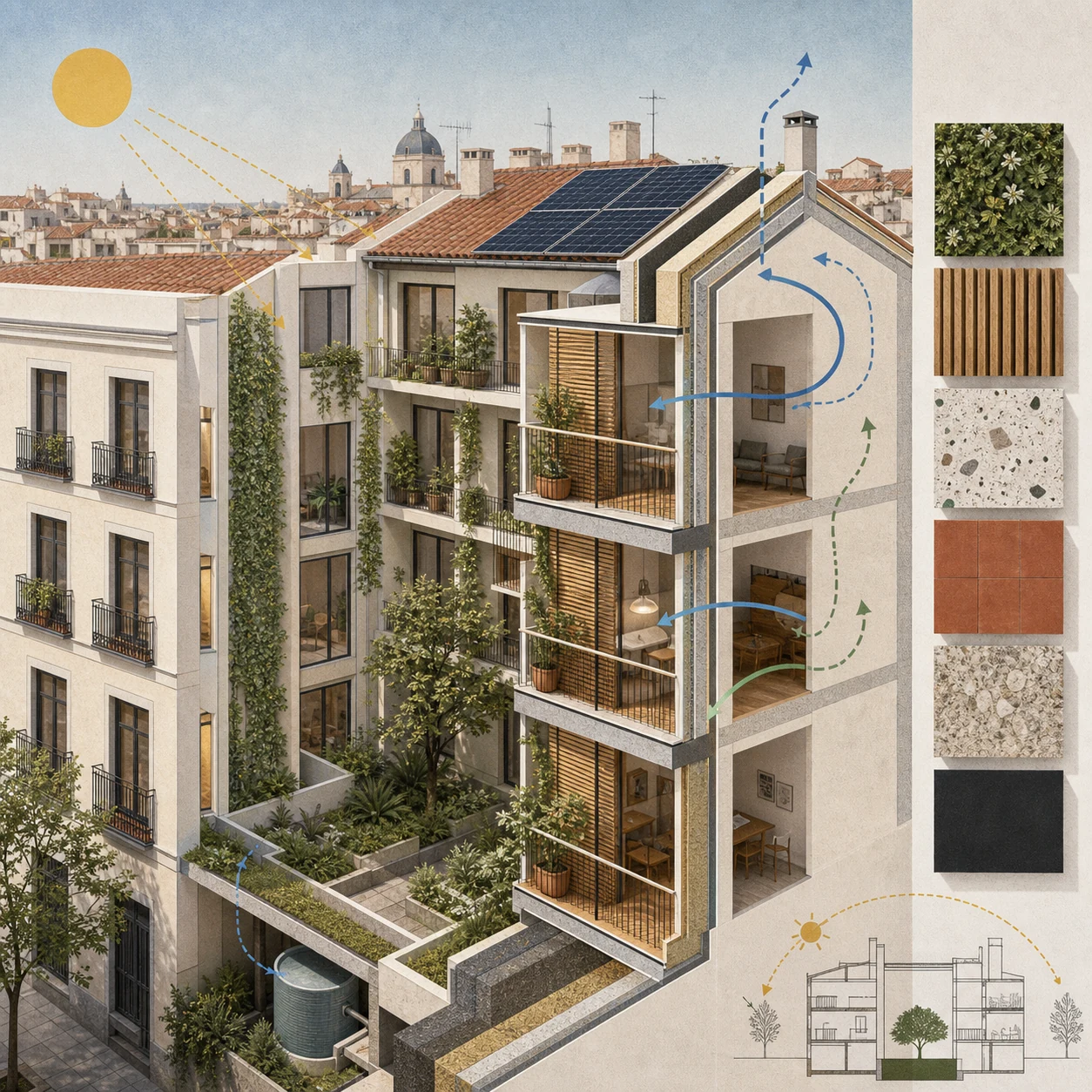
Sustainability has become one of the most overused words in architecture.
Every studio claims to be doing it and it is rarely defined clearly enough to be useful.
This article takes a different approach. Rather than talking about principles, it talks about specific measures you can take in a Madrid residential project, what they actually cost, what they deliver in terms of comfort and energy performance, and where the line is between meaningful investment and marketing language. For the broader philosophy behind how we approach sustainability at Wolfblanc, see our piece on designing with purpose: Wolfblanc’s approach to sustainability.
Why Madrid’s Climate Makes Sustainability Both Easier and Harder
Madrid has a continental Mediterranean climate: hot summers, cold winters, and relatively low humidity. Average summer temperatures regularly exceed 35°C in July and August, and winter nights routinely drop below freezing.
The good news is that passive design strategies, design decisions that reduce energy consumption without active mechanical systems, are very effective in Madrid’s climate. The thermal mass of Madrid’s older masonry buildings naturally moderates temperature swings. Proper shading of south and west-facing glazing can dramatically reduce summer cooling loads. Natural ventilation through cross-ventilation can make summer nights genuinely comfortable without air conditioning running continuously. Our guide to climate-responsive architecture across Spain, Greece, and Sweden explains these strategies in depth.
The challenge is that Spain’s building stock has significant accumulated underperformance. The average Madrid apartment from mid-century construction has essentially no thermal insulation, single-glazed windows with poor air sealing, and an outdated heating and cooling system. Addressing this during renovation requires investment but also represents the largest available opportunity for meaningful improvement.
The Sustainable Renovation Measures That Actually Matter in Madrid
Window replacement is one of the highest-return sustainability investments in terms of comfort improvement. Original single-glazed windows in Madrid apartments are a major source of heat loss in winter and solar heat gain in summer. Replacing them with double or triple-glazed units with thermally broken frames typically costs EUR 400 to EUR 800 per square meter of glazed area. In a protected building, exterior window profiles may need to match the originals, which is achievable with modern thermally broken frames in traditional profiles.
Heat pump systems deliver significantly more energy per unit of electricity than resistance heating or traditional boiler systems. An air-to-water heat pump combined with underfloor heating and ceiling cooling is current best practice for a completely renovated Madrid apartment. The capital cost is higher than a conventional system but operating costs are lower and comfort levels are genuinely better.
Mechanical ventilation with heat recovery. In well-insulated buildings, controlled ventilation is essential for air quality. MVHR systems supply fresh air while recovering heat from extracted air, maintaining air quality without the energy loss of simple extract ventilation. The impact on indoor air quality directly affects health and wellbeing — our guide to wellbeing by design explains the health dimension of these decisions.
Thermal bridging treatment. Before or alongside windows, addressing thermal bridges, places where poorly insulated structural elements create pathways for heat to flow in or out, significantly improves real-world performance. This is often overlooked in southern European renovation practice.
What the WELL Building Standard Adds to a Madrid Renovation
The WELL Building Standard is a performance framework for buildings that affect human health and wellbeing, assessing a building across categories including air quality, water, light, thermal comfort, sound, and mental wellbeing. Wolfblanc’s WELL Accredited Professional status means this framework is embedded in our design process.
Working within the WELL framework as a design reference, even without formal certification, adds specific attention to areas that genuinely improve daily living. Indoor air quality, specifying low-VOC finishes, paints, and adhesives, has a real impact on the indoor environment during and after construction. Designing lighting with color quality and control in mind improves how people feel throughout the day.
These are not difficult to implement and add relatively little cost when integrated from the start of a renovation project.
Where to Focus When the Sustainability Budget Is Limited
If sustainability is a priority but the budget is constrained, this sequence typically delivers the best results for a Madrid residential renovation:
Window replacement first. Biggest comfort impact relative to cost. Then heating and cooling system upgrade, since a good heat pump paired with underfloor heating transforms winter and summer comfort. Then ventilation if the building is being significantly air-sealed. Then additional insulation where it is accessible without disproportionate disruption.
Materials choices, recycled content, sustainably sourced timber, low-carbon alternatives, matter for overall carbon footprint but have a more diffuse effect on daily living experience. They are worth prioritizing if the budget allows, but they are not the first place to start. For a full picture of what a Madrid renovation costs and where the budget should be allocated, see our Madrid renovation guide.
The Honest Return on Investment for Sustainable Renovation in Madrid
Sustainability measures require upfront investment. Payback periods vary by measure and depend on energy price trajectories.
The returns that are most reliable are comfort returns. A significantly more thermally comfortable apartment is something you feel every day regardless of energy price fluctuations. The financial paybacks through reduced energy bills require a longer time horizon.
There is also a market return. As EU energy regulations for the rental sector develop, properties with strong energy performance will increasingly differentiate from those without. Properties with poor energy ratings face growing regulatory headwinds that will affect rental income and resale value. This is not an immediate arbitrage but it is a real medium-term consideration for any investment property in Madrid. The broader investment case for design decisions in Madrid is covered in our guide to Madrid real estate investment and architecture ROI.
Want to understand what sustainable renovation would actually involve for your Madrid property, including costs, measures, and realistic benefits? Tell us about your project using the form below and we will get back to you within 48 hours.