






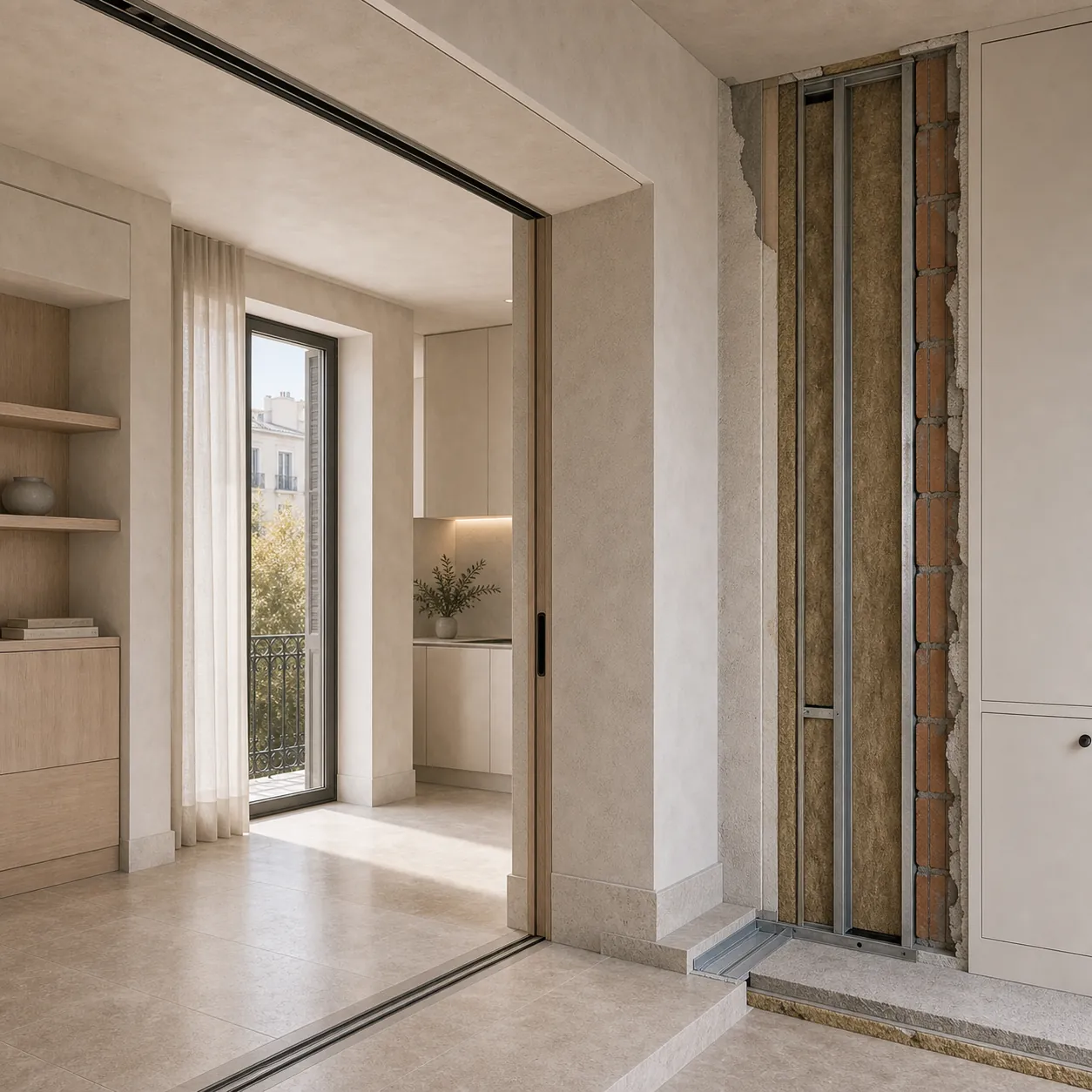
BIM (Building Information Modelling) gets talked about a lot in architecture and construction circles and very little in conversations with residential clients. This is partly because it sounds technical and partly because its benefits are not always visible in the final product.
But the effects of working with or without BIM on a renovation or new build project are very visible in the process: in budget predictability, in coordination quality, in whether the building gets built as designed, and in how many problems are caught before construction rather than during it.
This article explains what BIM actually is, what it means for your project in practical terms, and why Wolfblanc uses it as a standard part of our process. It is a core component of how we deliver every project from first contact through to handover.
What BIM Actually Means
BIM is not just a 3D model of a building. That is the part that is visible in design presentations and walkthroughs, but it is the surface of a much more structured system.
A BIM model is a database-linked three-dimensional model in which every element of the building, each wall, door, window, structural element, piece of pipework, electrical circuit, has associated information. Its dimensions, its material specification, its relationship to adjacent elements, its cost, and its construction sequence.
When you change anything in a BIM model, the information updates throughout the entire model. Change the thickness of a wall and the room dimensions around it update. Change a window specification and the associated energy calculation updates. Move a bathroom and the plumbing routing adjusts.
This is fundamentally different from working with 2D drawings where changes in one place need to be manually updated everywhere they appear, a process that is slow, error-prone, and almost inevitably leaves inconsistencies that surface as problems during construction.
What BIM Changes About the Design Process
For clients, the most visible effect of BIM is the quality of the visualisation and documentation they receive.
A BIM-generated floor plan and a manually drafted one look similar on paper. But the BIM floor plan is guaranteed to be internally consistent: the dimensions add up, the wall thicknesses are correct throughout, and the plan, section, and elevation all show the same building.
The 3D views that come from a BIM model are derived directly from the same model that generates the technical drawings. This means that what you see in a 3D walkthrough is the same building that the contractor will receive in the construction documents. The gap between “what we thought we were getting” and “what was actually designed” is closed.
For complex spaces, kitchen layouts, staircase configurations, bathroom designs where the geometry is tight, BIM allows the architect to check spatial feasibility in three dimensions during design, rather than discovering a clearance problem when the contractor is on site wondering why the dishwasher door cannot open.
What BIM Changes About Construction Cost Accuracy
This is the benefit that matters most to investors and clients managing tight budgets.
A contractor pricing a well-documented BIM project receives a complete, internally consistent set of drawings and specifications. The quantities of every material are calculable directly from the model. The scope is unambiguous. The contractor can price what is actually there rather than estimating around gaps and ambiguities in the documentation.
Contractors price uncertainty. When documentation is vague or inconsistent, contractors add contingency to their quotes to protect themselves from the unknown. On a renovation project of 200,000 euros, the difference in pricing between a well-documented BIM project and a poorly documented traditional project can easily be 15,000 to 30,000 euros in contractor contingency that you pay regardless of whether the problems it was priced for actually occur.
The second effect is change orders. Change orders are the mechanism by which renovation budgets blow out. When a contractor encounters an ambiguity or inconsistency in the documentation during construction, they submit a variation claim, which typically comes at a premium over the rates in the original contract. BIM documentation, by being complete and consistent, dramatically reduces the frequency of legitimate ambiguities that generate change orders. For a clear picture of what renovation costs look like overall, see our Madrid renovation guide.
What BIM Changes About Coordination Between Disciplines
A complex renovation project involves an architect, a structural engineer, an MEP engineer, and sometimes a specialist for energy modelling or acoustic design. In traditional practice, these disciplines produce separate drawings and models that are coordinated by hand, usually at specific review meetings.
In BIM practice, the disciplines work in linked models where changes made by one discipline are visible to all others. A structural beam that the engineer has repositioned is immediately visible in the architect’s model. A plumbing riser that passes through a structural element can be flagged automatically before the building is constructed.
This matters particularly for renovation projects in older buildings where the existing structure was not built to the precision of a modern building. In a BIM renovation model, the existing structure is documented in the model and the new works are designed around it. Clashes between new services and existing structure are caught in the model, not on site. The most expensive renovation mistakes — the ones that require demolition and rebuilding after the fact — are almost always coordination failures of exactly this kind.
What BIM Changes About Remote Project Management
For international clients managing projects remotely, BIM has a specific benefit: complete documentation.
A project run from BIM produces a full digital model of the building as designed, as built, and as-installed. This model can be accessed remotely, walked through virtually, and used to verify that what has been built matches what was designed. For a client in Stockholm reviewing progress on a renovation in Madrid, this is a qualitatively different level of visibility than receiving a set of PDF drawings and some site photographs.
The model also serves as a reference for future works. If the property is renovated again in ten years, the BIM model shows exactly where the services run, how the structure is configured, and what specifications were used throughout. This information, which is typically lost after a traditionally documented renovation, is preserved in a form that any future architect can use. This transparency is central to how Wolfblanc works across Spain, Sweden, and Greece.
BIM as a Standard, Not a Premium
Wolfblanc uses BIM methodology as a standard part of the design process for all projects above a modest threshold of complexity. It is not a premium service option. It is how we work, because the quality of outcome it produces for clients justifies the investment in the process.
The indirect savings to clients through better contractor pricing, fewer change orders, and better coordination outcomes consistently exceed the modest additional time required to work in BIM rather than in traditional documentation. For the clients it matters most to, investors managing budgets remotely and clients with complex projects in regulated buildings, these are not small differences. How those investment decisions translate to real returns is explored in our guide to Madrid real estate investment and architecture ROI.
Interested in what a BIM-documented project would mean for your renovation or new build? Tell us about your project using the form below and we will respond within 48 hours.