






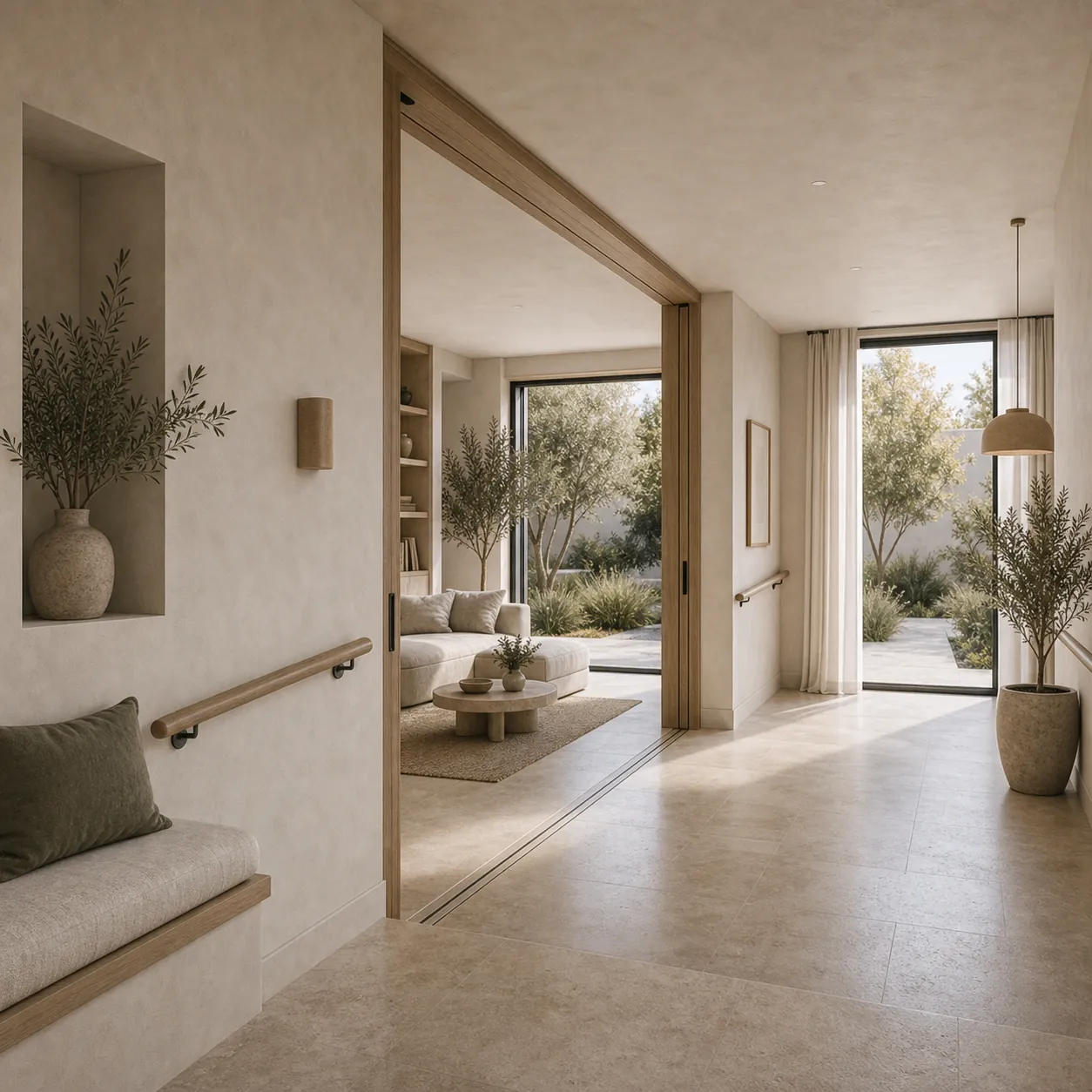
Most people design their homes for who they are now. This is understandable, but it tends to produce homes that require expensive adaptation later, or that stop working as well as their owners’ lives change.
A better approach is to design for the full arc of how you are likely to use a home. Not every room needs to work for every scenario, but the bones of the house should accommodate change without requiring demolition to achieve it. How architecture directly affects health and comfort over time is explored in our guide to wellbeing by design.
This is not exclusively a question of accessibility for older residents. It is a question of good design.
Level Access: The Foundation of a Home That Works for Everyone
The single most impactful decision for a home that ages well is whether the primary living areas and at least one bedroom and full bathroom are on the same level as the entrance, with no steps between them.
Steps are fine in parts of a house where they serve the design. They are fine between floors where a lift can be added later if needed. But a principal entrance that requires climbing steps, a kitchen on a different level from the living room, a master bedroom accessible only by stairs, these are features that become genuinely limiting as mobility changes, whether from aging, injury, or other circumstances.
In new build projects, level access throughout the ground floor can be achieved at essentially zero additional cost if it is designed in from the start. In renovation projects, level access sometimes requires addressing threshold steps, adjusting floor levels, or rethinking the circulation route through the house. It is almost always worth doing. Our guide to renovate or build from scratch in Spain covers the factors that influence this decision.
Door and Corridor Widths That Actually Allow for Change
Standard internal doors in Spain and much of southern Europe are often 70 to 75cm wide. A wheelchair requires at least 80cm of clear passage, and 90cm is significantly more comfortable.
This is not to say every room in every house needs to be designed for wheelchair access. It is to say that specifying 80cm clear width for the bedroom, bathroom, and kitchen doors of the ground floor zone adds nothing to the construction cost when done at specification stage and adds significant value if it is ever needed.
Corridor widths follow the same logic. A 90cm corridor is the minimum for comfortable wheelchair passage; 120cm is better for allowing passage and door opening simultaneously. In open-plan areas, this is not a significant constraint. In more cellular layouts, it is worth building into the floor plan. Our guide to open-plan renovation in Madrid apartments covers when and how to open up layouts.
Bathroom Design for a Home That Adapts
The bathroom is where the gap between a home that ages well and one that does not is most visible.
A shower with a 4cm step into it cannot easily be made accessible without demolishing the shower tray and rebuilding the floor. A bathroom with a fixed bath and no separate shower requires significant modification if bathing becomes difficult. A bathroom where the only toilet has no adjacent wall on which to fit a grab rail requires structural intervention to add support later.
None of these are dramatic design constraints to avoid. Specifying a level-access (zero threshold) shower from the outset, with a floor drain that handles water without needing a tray, costs the same as a standard shower if designed in from the start. Choosing a layout where the toilet has a wall on at least one side is a basic spatial decision. Installing blocking (a reinforced timber or steel plate within the wall construction) behind the shower walls and beside the toilet, ready for future grab rail installation, costs around 200 to 400 euros and makes future accessibility adaptation a two-hour job rather than a week-long renovation. What a full bathroom renovation costs and what to consider is covered in our guide to bathroom renovation in Spain.
Kitchen Design That Adapts Without Being Rebuilt
Standard kitchen design assumes full mobility. Countertops at a fixed height of around 90cm. Overhead storage accessible by reaching above shoulder height. A kitchen layout that requires moving around constantly.
A kitchen designed to age well has: at least one section of countertop at a lower height (around 80cm) or designed so the base units can be easily replaced with open knee-space if needed in future. The overhead storage is limited to items used infrequently, with daily-use items at accessible heights. The appliances, particularly the oven and microwave, are positioned at a height that does not require bending to the floor or reaching overhead.
In a normal kitchen design, these adjustments are not visual compromises. A kitchen with a varied counter height and considered storage zoning is arguably better designed than one with uniform countertops at a single height. What makes a kitchen renovation worth the investment is covered in our guide to kitchen renovation in Spain.
Storage as a Quality-of-Life Investment at Every Stage
One of the most consistent sources of dissatisfaction in homes that have been lived in for some years is storage. Not enough of it, in the wrong places, not designed for how the household actually accumulates things over time.
Storage designed well from the start is one of the clearest long-term quality-of-life investments in any home. Floor-to-ceiling cabinetry in entrance halls and bedrooms, a dedicated utility room for cleaning equipment and laundry if floor area allows, kitchen storage that extends to ceiling height for seasonal items, outdoor storage accessible from the garden for tools and bicycles.
Storage that is visible and convenient is used. Storage that requires effort to access is not. The difference is layout and design, not volume.
Outdoor Spaces That Stay Usable
The outdoor spaces of a home, terraces, gardens, balconies, are often the most enjoyed parts. They are also the most likely to become unusable as mobility changes.
A terrace accessed by a 15cm step that feels completely manageable at 40 becomes a genuine barrier at 70. A garden that requires navigating gravel paths is not accessible to anyone with a walker or wheelchair.
Designing outdoor spaces with level or near-level access from the interior, hard-surfaced paths wide enough for comfortable passage, and at least one seating area that is reachable without navigating steps or loose surfaces, does not make them feel institutional. It makes them genuinely usable for more of the year and more of your life. How to get the most from outdoor space in Spain is covered in our guide to outdoor space design in Spain.
Planning a home or renovation and want to think through how to design it for the long term? Tell us about your project using the form below and we will respond within 48 hours.