






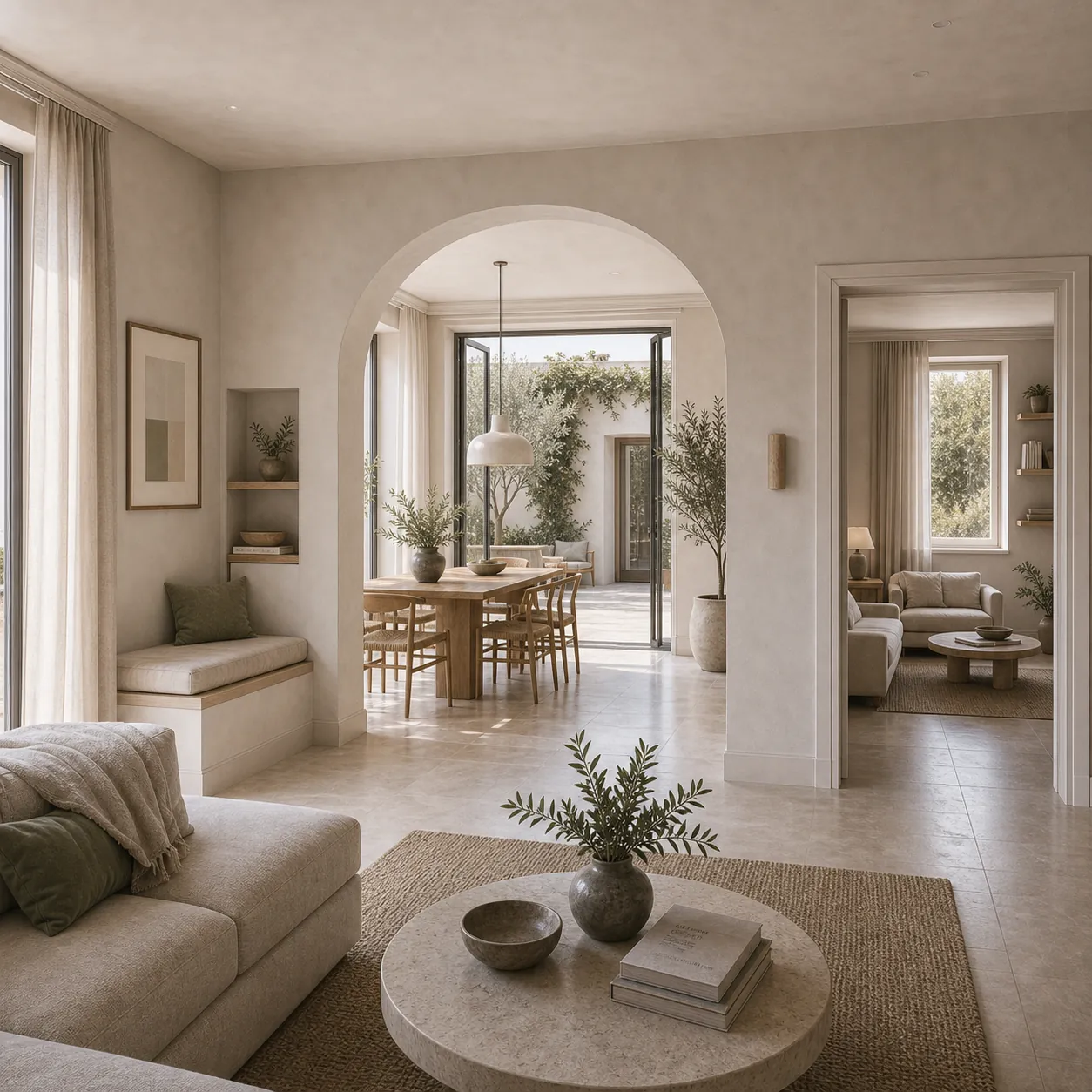
Multi-generational living has been the norm for most of human history. It stopped being common in northern Europe for a few decades in the mid-to-late 20th century, replaced by the nuclear family model. Now it is coming back, for a combination of economic, social, and practical reasons.
In Spain, Greece, and Sweden, the pattern plays out slightly differently. In Spain and Greece, multi-generational living never really went away. It remained culturally normal in many families. In Sweden, the move toward multi-generational arrangements is more recent and more driven by economic pressures, particularly housing costs in Stockholm and other major cities.
What all of these contexts share is a design challenge: how do you create a home that genuinely works for two or three generations living together, without either sacrificing the privacy and independence of the individuals, or creating a house that feels like a compromise for everyone?
The Central Design Problem
The tension in multi-generational design is between togetherness and independence.
Too much shared space and the different generations, with their different schedules, noise levels, and preferences, end up constantly in each other’s way. Grandparents who need quiet at 9pm and grandchildren who are loud at 9am are not a good combination in an open-plan house with no acoustic separation.
Too much separation and you have not really created a multi-generational home. You have created two adjacent apartments, which may or may not actually function as a family unit depending on whether the connection between them is designed to facilitate daily interaction or just occasional visits.
The best multi-generational designs create clear independent zones with flexible points of connection. Each generation has genuine privacy. But the shared spaces, the kitchen that can expand to host a family Sunday lunch, the garden accessible from multiple entrances, the connecting door that can be open daily or closed for months at a time, are designed to be genuinely used rather than just theoretically available. For broader context on how architecture affects daily life quality, see our article on wellbeing by design.
The Independent Annex Model
The clearest architectural solution for multi-generational living where two generations want significant independence is the separate annex or garden apartment. A main house plus a self-contained secondary unit on the same plot.
This model works well when the generations have genuinely different lifestyles and schedules, when the older generation has mobility considerations that benefit from a single-level unit specifically designed for accessibility, and when the family’s financial structure involves one generation owning the plot and another building or occupying the secondary unit.
In Spain, the permit route for this depends on the municipality’s planning regulations. Many Spanish municipalities allow a secondary dwelling (vivienda secundaria) on a plot above a certain size, but the specific size threshold and the permitted relationship between the two units varies. Your architect needs to check the local urban planning regulations (PGOU or equivalent) before you design based on this assumption. For a full overview of how Madrid’s permit system works, see our guide to Madrid building permits.
In Sweden, the regulations around attefallsåtgärder (small building measures that can be done without full building permit) allow a complementary dwelling up to a certain floor area on most single-family plots.
The Internal Separation Model
Where the plot size or planning regulations do not allow a separate annex, or where the family wants more physical connection, internal separation within a single building is the alternative.
The key design elements in this model:
Acoustic separation between the different zone’s floors, walls, and ceilings. This is often underinvested. In a concrete-framed building, impact sound transmission through floors is the most significant acoustic issue. Specifying acoustic underlays, floating floor systems, and acoustic insulation in the floor/ceiling construction between zones is essential.
Separate entrances. Even if the two zones share the overall building, separate entrance doors, one main entrance and one secondary entrance, give each generation genuine independence of movement. Nobody has to pass through the other’s space to reach their own front door.
Independent utilities where budget allows. Separate electricity meters, separate heating controls, possibly separate water meters, allow each zone to be genuinely independent. This is particularly important if the arrangement may eventually involve the two units being rented or sold separately. For more on how property division works legally in Spain, see our article on dividing a property into two units in Spain.
A designed point of connection. Whether it is a connecting door between the two zones, a shared outdoor terrace, or a shared kitchen/dining extension that can be opened for Sunday lunch and closed otherwise, there should be a deliberate architectural feature that facilitates the shared life, not just a wall with a hole in it.
Designing for Aging in Place
In most multi-generational living arrangements, one generation is older, and there is a reasonable chance that their mobility and accessibility needs will change over time.
Designing for aging in place from the outset means: level access throughout the older generation’s zone (no steps, level thresholds), corridors and doorways wide enough for a wheelchair or walking aid, a bathroom configured for easy adaptation to a wet room with a shower seat, electrical sockets and switches at heights that work for people with limited reach or mobility, and a bedroom on the same level as the main living areas. For a detailed look at this topic, see our article on designing a home that ages well.
These are not dramatic requirements. They do not make a space feel clinical or institutional if they are built into the design from the beginning. But retrofitting them later, particularly the level access and bathroom configuration, can be very expensive and disruptive.
The Noise Reality
Acoustic separation gets mentioned in multi-generational design briefs but rarely gets the attention it deserves in the actual construction specification.
A concrete floor with ceramic tile on top and no acoustic treatment transmits footstep impact sound clearly between levels. Grandchildren running in the living room above a grandparent’s bedroom is a straightforward and foreseeable problem that a floating floor system resolves. Not installing one because it adds cost is a false economy in a house that is specifically designed for multi-generational living.
Similarly, the bedrooms of different generations should not share party walls without acoustic insulation, and the shared living areas should be positioned so that noise from social gatherings does not directly transmit into the quiet zones of any generation.
When Multi-Generational Design Works Best
It works best when the design has been thought through from the start of the project, not added as an afterthought. Converting a standard single-family house to multi-generational use after the fact is always more expensive and always produces more compromises than designing for it from day one.
It works best when the specific needs, preferences, and likely life trajectory of both generations are genuinely understood. Not a generic multi-generational template, but a design that responds to these particular people and how they actually want to live.
And it works best when the design is honest about the tensions it needs to resolve rather than trying to paper over them with open-plan optimism. If you are planning a project in Spain and want to understand the full process involved, our guide on working with an architect in Spain explains what to expect from first contact to handover.
Thinking about a multi-generational home project and want an architect’s input on the design options? Tell us about your family’s situation using the form below and we will respond within 48 hours.