


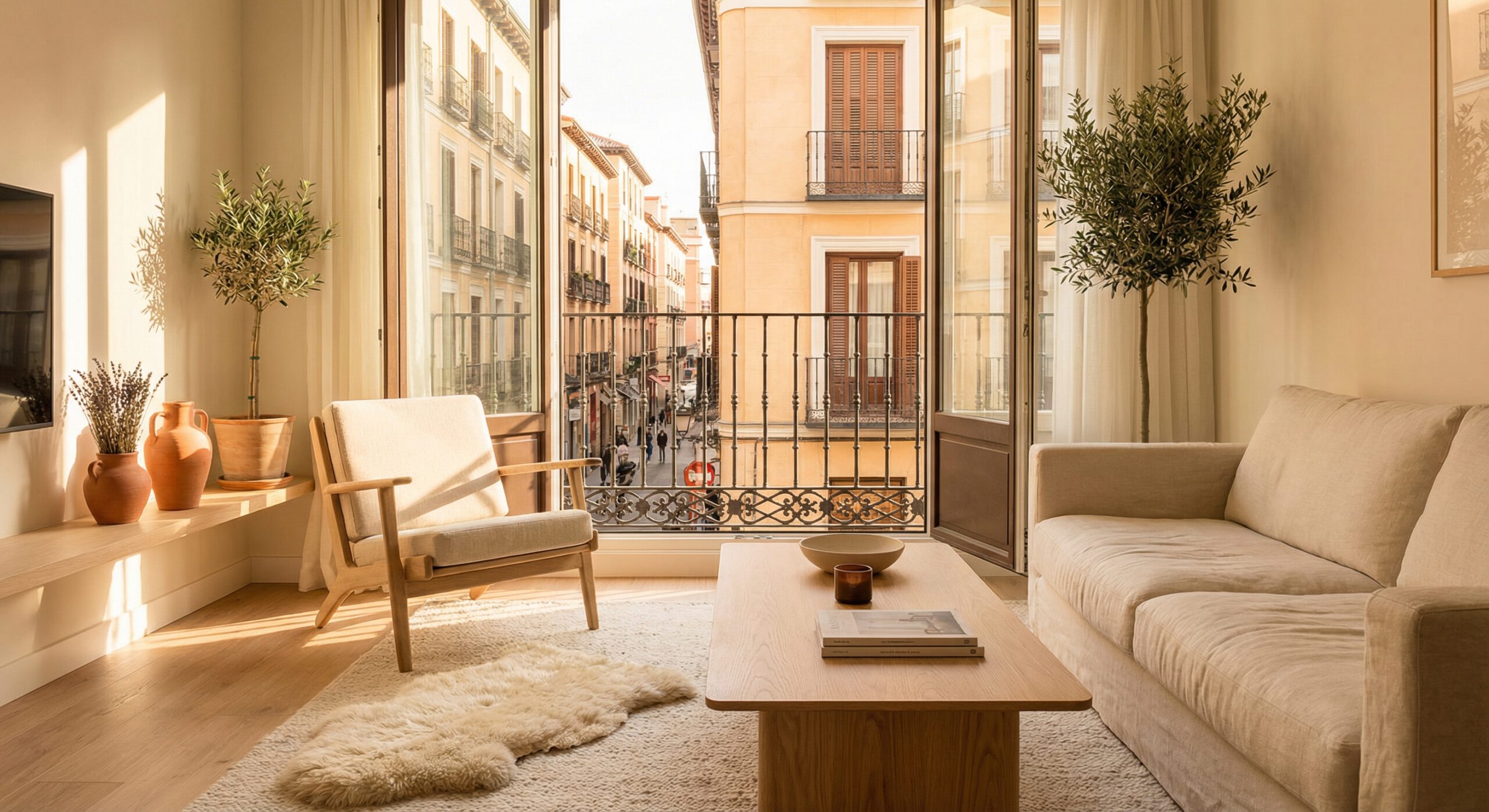
When people hear “Scandinavian design in Madrid,” the first reaction is often skepticism.
Nordic aesthetics, pale wood, restrained palettes, a focus on light, seem like they belong in Stockholm or Copenhagen, not in a city defined by warm stone, terracotta, and Mediterranean sun.
In practice, the two traditions have more overlap than the surface difference suggests. And when they are brought together with care, the result works extraordinarily well in Madrid’s residential context. This is not about importing a style wholesale. It is about applying a design methodology. The broader argument for why this methodology travels well is explored in our piece on Scandinavian design principles applied to homes in Spain and Greece.
What Scandinavian Design Is Actually Solving For
Scandinavian design developed in a specific context: long winters with limited daylight, small apartments in dense cities, a cultural preference for utility over decoration, and a belief that everyday objects and spaces should be made well.
The goal was always to create environments that are genuinely comfortable to live in, not just impressive to photograph. This same goal is at the core of how we think about wellbeing by design — architecture that actively supports how people feel and function.
The principles that came from this context are not climate-specific. They apply wherever people want their homes to function well and feel calm. Maximize whatever natural light is available. Eliminate unnecessary complexity. Choose materials for durability and natural character rather than for trend. Design storage that disappears rather than dominates. Prioritize the experience of the person living in the space over the effect on a visitor.
How Nordic Design Logic Solves Real Problems in Madrid Apartments
Madrid’s residential stock presents consistent challenges that Nordic design methodology addresses directly.
Light penetration is the main one. The typical Madrid apartment, especially in central neighborhoods, has rooms facing interior courtyards, long corridors with no natural light, and deep floor plans where daylight from street-facing windows barely reaches the back of the apartment.
Nordic design’s focus on maximizing and distributing available light is exactly the right response. Glass internal partitions, pale reflective surfaces, strategic mirrors, and the elimination of dark corridors in favor of open circulation. These are the tools, and they work well in Madrid. Our dedicated guide to how to design any home around light covers each of these tools in detail.
Compact spaces are another overlap. Madrid’s apartments are rarely large by northern European standards. The Scandinavian tradition of designing for compact living, integrated built-in storage, furniture that serves multiple functions, layouts that feel generous despite limited square meters, translates directly to a 65-square-meter Madrid flat. When considering whether to remove walls to gain space, our guide to open-plan renovation in Madrid apartments walks through the decisions.
Material honesty is the third connection. Nordic design’s preference for honest materials, natural wood, concrete, stone, treated simply, produces results that do not go out of style and actually improve with age.
Where Mediterranean Character Stays in the Conversation
The Nordic approach works in Madrid not by erasing the local context but by adapting to it.
Madrid’s light is warmer and more intense than Scandinavia’s. The very pale, cool palettes that work in a Swedish apartment can feel slightly flat in Madrid’s climate. The adjustment is not dramatic. It is the difference between cold white and warm white, between a blond ash floor and a slightly more golden oak. Materials and finishes need to be calibrated for how they look under Mediterranean sun, not Baltic winter light.
The cultural relationship with outdoor space is also different. In Madrid, the terrace, balcony, or interior courtyard is part of how people actually live, used for significant parts of the year. A good Madrid renovation creates strong connections between interior and exterior, makes transitions between inside and outside feel natural, and treats the outdoor area as a real room rather than an afterthought. How to make the most of outdoor space in Spain is covered in our guide to outdoor space design in Spain.
Traditional Spanish materials, ceramic tiles in particular, are not at odds with a Nordic-influenced approach. The hydraulic tiles common in Madrid’s older apartments pair extraordinarily well with pale walls and clean joinery. The combination reads as place-specific and contemporary at the same time.
Practical Scandinavian Design Applications in Madrid Renovation Projects
Open-plan reconfiguration. The traditional Madrid apartment layout, with its chain of closed rooms connected by a central corridor, was designed for a different way of living. Opening the kitchen to the living and dining area, using glass elements to let light flow through secondary rooms, and creating a connected social space is standard practice in Nordic design and increasingly what Madrid residents and international buyers want.
Built-in storage throughout. Floor-to-ceiling cabinetry in entrance halls and bedrooms, integrated wardrobe systems, kitchen storage that extends to the ceiling. Nordic-influenced cabinetry in Madrid renovation projects consistently performs well in both function and resale value.
Bathroom design. The transition from the typical mid-century Madrid bathroom to something that feels genuinely spa-like is one of the highest-return renovation investments. Large-format tiles, floating vanity units, frameless glass showers, and a restrained palette transform these spaces completely. Our guide to bathroom renovation in Spain covers costs and design decisions.
Layered lighting design. Rather than a single central fixture per room, layered lighting with ambient base levels, task lighting at work and cooking surfaces, and accent lighting for architectural elements makes spaces feel warmer and more functional across different times of day.
What a Nordic-Mediterranean Madrid Renovation Actually Feels Like
A well-executed Nordic-Mediterranean renovation in Madrid produces a home that feels calm rather than cold, warm rather than cluttered, and genuinely functional rather than just photo-ready.
It maximizes what Madrid’s buildings do best, the ceiling heights, the material quality of older construction, the potential for connection with outdoor space, and addresses what they typically lack in terms of light distribution, storage, and contemporary utility.
This is not a style choice. It is a way of thinking about how people actually live and what the space needs to do to serve them well. How those decisions affect resale value and rental yield is explored in our guide to Madrid real estate investment and architecture ROI.
Interested in what a Nordic-Mediterranean approach could do for your Madrid apartment or home? Tell us about your project using the form below and we will respond within 48 hours.