


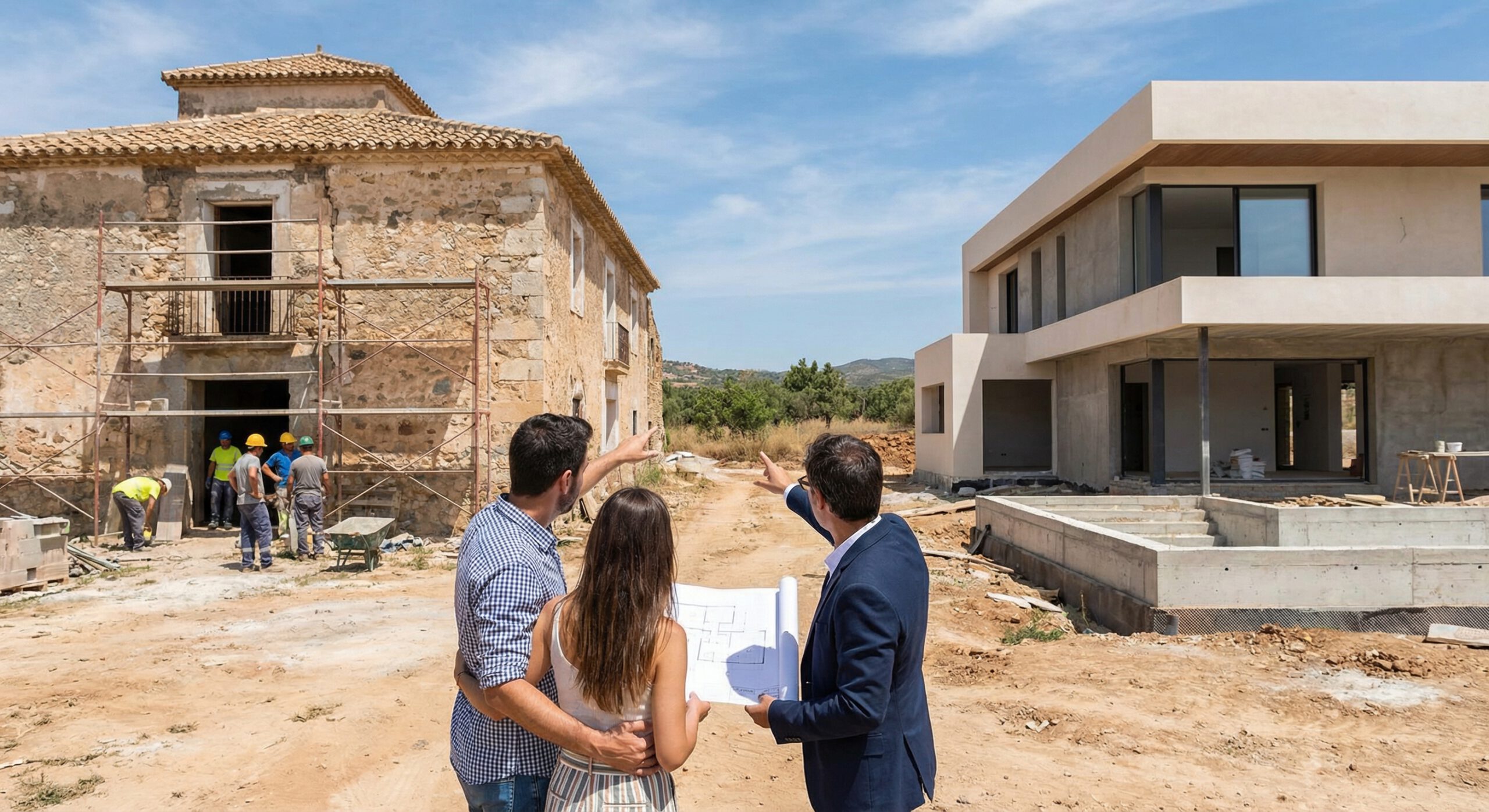
This is one of the most common questions we get from clients who have found an existing property but are not sure whether to work with what is there or start fresh on a cleared site.
It is also one of the questions with the most genuinely variable answers, because the right call depends heavily on the specific property, the specific site, and what you are trying to achieve.
Here is how to think through it properly.
The Case for Renovating an Existing Property in Spain
The single biggest argument for renovation is location. In Spain’s established urban neighborhoods and coastal areas, the best-positioned properties are almost always existing buildings, not empty plots. A 100-year-old apartment in Madrid’s Salamanca or an old stone house in a historic Andalusian village sits in a context that a new build on a suburban plot simply cannot replicate.
Character is the second argument. Original tile floors, thick masonry walls, decorative ceilings, generous ceiling heights. These are not things you can replicate cheaply in new construction, and in many cases you cannot replicate them at all. For buyers considering a listed property, our guide to renovating a protected historic building in Madrid covers what the heritage rules actually require.
The third argument is cost, though this one is more complicated than it looks.
A renovation project, if the structure is sound, can be significantly cheaper than building from scratch because you are not starting from zero on the structural shell. You are inheriting walls, a roof, a floor structure. On a well-chosen existing building, that can represent 30 to 40% of the total construction cost before you even start on finishes.
The catch: this calculation changes dramatically if the existing building has serious structural problems, significant moisture damage, illegal extensions that need to be resolved legally, or systems so outdated that a complete replacement is inevitable. In these cases, the cost advantage of renovation can evaporate quickly. Our article on renovation mistakes that cost more to fix than the original work covers the patterns to watch for.
The Case for Building from Scratch in Spain
A new build gives you complete control. The layout is exactly what you design it to be, not what you can achieve within the constraints of an existing structure. The thermal envelope meets current standards from day one. The systems, electrical, plumbing, HVAC, ventilation, are new and will last decades without replacement. The energy certification will be significantly better than any renovation short of a Passive House-level retrofit.
New builds in Spain also tend to have more predictable construction costs. With renovation, hidden conditions, a load-bearing wall in an unexpected location, buried service pipes that are in worse condition than expected, a floor structure that turns out to be weaker than it looked, are a constant source of budget surprises. A new build on a cleared site has fewer unknowns. For a detailed cost breakdown, see our honest guide to the true cost of building a house in Spain.
The obvious limitation is that in established urban areas, cleared sites are either unavailable or very expensive. The new build option is most realistic in suburban areas, new development zones, or rural plots. In city centers, you are typically choosing between existing buildings.
The Permit Process: Key Differences Between Renovation and New Build
The permit route differs significantly between renovation and new build in Spain.
A new build requires a Licencia de Obra Mayor from the outset. The technical project needs to include structural calculations from scratch, full MEP design, energy compliance justification, and often a more detailed urban planning compliance analysis. Timeline from project submission to license grant: typically 4 to 8 months in most Spanish municipalities, sometimes longer in areas with high permit backlogs. For a full breakdown of permit types, see our guide to Madrid building permits.
A renovation can involve either an Obra Mayor or an Obra Menor depending on scope. A renovation that is entirely interior and non-structural may qualify for an Obra Menor, which has a significantly shorter permit timeline. A renovation that involves structural work, façade changes, or heritage elements follows the same Obra Mayor route as a new build.
One complexity that renovation projects sometimes encounter and new builds do not: the legal status of the existing building. In Spain, particularly for rural properties or older buildings, there can be legacy issues with unauthorized extensions (fuera de ordenación), agricultural land classification complications, or incomplete prior permits. Resolving these before you can proceed with your own renovation adds time and cost that is not present in a clean new build scenario. Our article on buying rural property in Spain covers land classification issues in detail.
Cost Comparison: What Actually Happens in Practice
Comparing renovation and new build costs directly is difficult because the projects are rarely equivalent. But here are honest reference points for Spain in 2025/2026:
New build residential construction in mainland Spanish cities: 1,400 to 2,200 euros per square meter for a quality result, including structure, envelope, systems, and finishes. This does not include land, architecture fees, or taxes.
Standard renovation (non-structural, cosmetic to mid-level): 600 to 1,100 euros per square meter.
Complete renovation including structural work, full systems replacement, and quality finishes: 1,100 to 1,800 euros per square meter. At the upper end, this overlaps with new build costs.
The renovation advantage is most clear in the middle range: properties that need updating but are structurally sound, with systems that have some life left or are manageable to replace incrementally. The advantage disappears when the renovation scope expands to include structural remediation, full systems replacement, and significant layout reconfiguration.
The Decision Framework
Ask these questions in sequence:
Is the location and character of the existing property irreplaceable? If yes, renovation is strongly favored regardless of other factors.
Is the structural condition acceptable? Get a structural assessment from an architect or structural engineer before committing. If the answer is poor or uncertain, factor in the cost of structural remediation before comparing options.
What is the legal status of the existing building? Request a nota simple from the land registry and check for any outstanding permit issues before buying.
What is your tolerance for uncertainty? Renovation projects on older buildings have more scope for unexpected conditions than new builds. If you need high budget predictability, factor this in.
What is your timeline? If you need to be living in or renting out the property within 18 months, a new build in most Spanish cities is not realistic. A manageable renovation often is. For more on the full architecture process in Spain, see our guide on what to expect when working with an architect in Spain.
Have a specific site or property in Spain and want an honest assessment of which route makes more sense? Tell us about your situation using the form below and we will respond within 48 hours.