


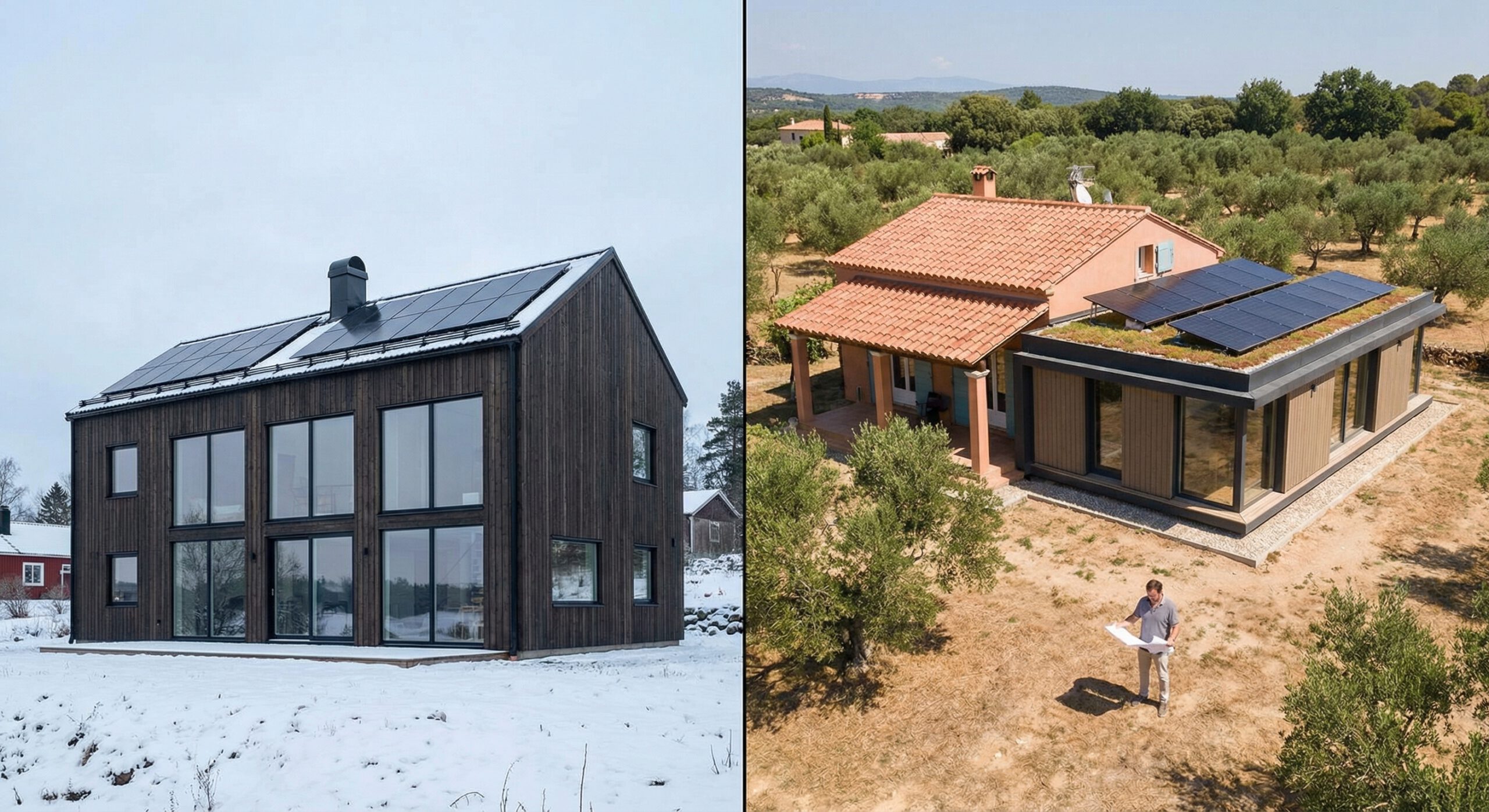
Sweden is not the first place that comes to mind when you think about comfortable Mediterranean living. But when it comes to building and renovation performance standards, Sweden has spent fifty years developing a level of expertise that the rest of Europe is only now beginning to catch up with. This is one of the core reasons Wolfblanc’s cross-country practice applies Nordic methodology to projects in Spain and Greece.
Understanding what the Nordic standard looks like in concrete technical terms is useful for anyone thinking seriously about energy performance in their home project, wherever it is located.
Why Sweden Pushed So Hard on Building Energy
The context matters.
Sweden’s response to the 1973 energy crisis was among the most aggressive in the world. Faced with high oil dependency and cold winters, Sweden invested heavily in building energy performance research, insulation standards, and heating system efficiency.
The result was a building code that progressively raised the bar on residential energy performance, and a construction industry that learned, over decades, how to actually deliver on it.
By the time the EU began developing its Energy Performance of Buildings Directive and the concept of Nearly Zero Energy Buildings, Sweden was already building at standards well beyond what most of Europe considered achievable. Swedish Passive Houses had been delivered at commercial scale. Mechanical ventilation with heat recovery was standard in new construction. Thermal bridges were being carefully modelled and eliminated as a routine design task.
This is not just regulation. It is embedded professional culture. Swedish architects, engineers, and contractors think about energy performance as a normal part of what they do, not as a specialist add-on. It is one of the reasons the Scandinavian design methodology translates so effectively when applied to southern European projects.
The Swedish Energy Performance Standard in Numbers
Swedish building code (Boverkets Byggregler, BBR) sets primary energy use limits for residential buildings that are among the most demanding in Europe.
For new construction in Stockholm’s climate zone, primary energy use should not exceed roughly 70 kWh per square meter per year. By comparison, the EU average for existing residential buildings is closer to 200 kWh per square meter per year.
What this means in practice:
Insulation. Swedish residential construction routinely uses 250mm to 350mm of insulation in roof and wall constructions. A typical mid-century Madrid or Athens apartment has essentially zero insulation in its walls. The difference in heating and cooling loads is enormous.
Windows. Standard Swedish residential windows are triple-glazed, with low-emissivity coatings and thermally broken frames. U-values of 0.8 to 1.0 W/m2K are common. Spanish and Greek building standards require much less. Much of the existing building stock has single-glazed windows that perform at 5.0 to 6.0 W/m2K or worse.
Air tightness. Swedish building code requires airtightness testing for new construction. This is why MVHR (mechanical ventilation with heat recovery) is standard in Sweden. A tight building needs controlled ventilation to maintain air quality. This directly supports better indoor air quality and wellbeing outcomes.
Thermal bridging. Thermal bridges, places where poorly insulated structural elements penetrate the building envelope, are modelled and minimised as a routine design task in Sweden. In southern European practice, thermal bridging is often simply ignored, contributing significantly to real-world underperformance.
Swedish Heating Systems: What Works and Why
Swedish residential heating has shifted dramatically over the past two decades away from oil and direct electricity toward heat pump systems, district heating, and wood pellet systems.
Ground source heat pumps (bergvärme), which extract heat from boreholes drilled into the bedrock, are common in Swedish detached houses and offer excellent performance in the Swedish climate. Air source heat pumps are more common in apartments and smaller properties. Combined with underfloor heating systems, these produce very comfortable and energy-efficient results.
District heating (fjärrvärme) covers a significant share of Swedish urban multi-unit residential buildings, with heat supplied from centralised plants through underground pipe networks. For apartment dwellers, this means essentially no maintenance on the heating system. It is part of the building infrastructure rather than the individual apartment. For a broader picture of the Swedish property market and what renovation involves there, see our guide to buying property in Sweden as a foreigner.
What Southern European Renovation Projects Can Learn from Sweden
The direct transfer of Swedish standards to Spanish or Greek contexts is not one-to-one. The climates are different, and the specific measures need to be calibrated for Mediterranean conditions. But the methodology and the ambition translate.
Start from the building envelope. The Swedish sequence, insulate well, make it tight, then ventilate properly, is correct regardless of climate. Trying to compensate for a leaky, uninsulated building with an expensive heating or cooling system is the wrong order. Our guide to sustainable renovation in Madrid translates these principles into specific measures for Spanish buildings.
Take thermal bridges seriously. In Spain and Greece, thermal bridge treatment is underemphasised compared to what the energy numbers actually require. Around windows, at slab edges, at structural penetrations, these are where the real energy losses often concentrate.
Invest in window quality. Upgrading from single-glazed or old double-glazed windows to high-performance triple-glazed units with thermally broken frames is one of the highest-return envelope investments in both northern and southern climates. In Sweden, to retain heat. In Greece or Spain, to control solar heat gain and reduce summer cooling loads.
Think about mechanical ventilation. As buildings become more airtight through renovation improvements, natural ventilation through gaps becomes insufficient for air quality. Controlled ventilation is needed. MVHR systems have a role in Mediterranean climates as well as northern ones.
Set measurable performance targets. Sweden’s regulatory framework works partly because energy performance is measured and verified, not just specified. Applying similar rigour to renovation projects, setting a target energy performance and checking that the design actually achieves it through calculation, produces better results than hoping the measures add up. This is also where BIM-based design coordination adds significant value in accurately predicting and verifying performance outcomes.
Interested in bringing Nordic-level energy performance standards to your home project in Spain, Greece, or Sweden? Tell us about your project using the form below and we will respond within 48 hours.