


Greece has been attracting international property buyers for decades.
The combination of climate, landscape, culture, and relatively affordable property prices has made it one of Europe’s most active markets for foreign residential investment. But renovating in Greece, particularly for buyers who are not based there and do not speak Greek, comes with specific challenges worth understanding before you commit.
This is the honest version of that story. For an overview of Athens neighborhoods and where the renovation opportunity sits, see our guide to architecture in Athens and renovation opportunities for buyers.
Why the Greek Renovation Process Is Different from What You Might Expect
Greece has genuine bureaucratic complexity. Not uniquely so by Mediterranean standards, but the combination of overlapping regulatory bodies, a construction culture that developed differently from northern Europe, and a legal framework that has gone through significant change means that buyers arriving with assumptions shaped by their home country encounter surprises.
The good news is that the challenges are manageable with the right professional support.
The frustrations that foreign buyers most often report, delays, permit complications, contractor reliability issues, are almost always more severe when buyers try to navigate the system without experienced local architecture and legal professionals. Our guide to renovation mistakes that cost the most to fix covers the recurring patterns across all three countries.
The most important thing to understand upfront: in Greece, only architects registered with the Technical Chamber of Greece (TEE-TCG) can legally sign building permits and technical documentation. This is non-negotiable. If someone offering design services cannot produce a TEE registration number, they cannot legally stamp your project.
The Greek Building Permit System: What You Actually Need
Greece’s building permit system sits under the Ministry of Environment and Energy, administered through regional services (YPDOM). The process has been significantly digitized in recent years through the e-Adeies platform, which allows electronic submission of permit applications.
Building Permit (Oikodomiki Adeia) is required for new construction, significant structural changes, extensions, additions, or any work that meaningfully alters the building’s footprint, volume, or structure. This requires a complete technical project stamped by licensed architects and engineers, and goes through a full YPDOM review. Timelines vary by region and project complexity, typically 3 to 8 months in major urban areas.
Small-Scale Works Approval covers minor renovations that do not affect structure, exterior appearance, or common building elements. This includes interior partition modifications, bathroom and kitchen renovations, and basic systems updates. Faster process than a full building permit.
Works Notification applies to truly minor works such as maintenance, painting, and minor repairs. A simple notification rather than formal approval.
An important complexity in Greece: illegal building extensions and modifications (afthairetes) are common in the existing property stock, particularly for properties built before the 1980s. Greece has run multiple legalization programs over the years and many properties carry partially legalized unauthorized works. Before buying any existing property in Greece, thorough legal and technical due diligence is essential to understand the exact legal status of every element of the structure. Unresolved issues can create significant complications for future renovation permits and eventual resale.
Types of Properties International Buyers Typically Buy in Greece
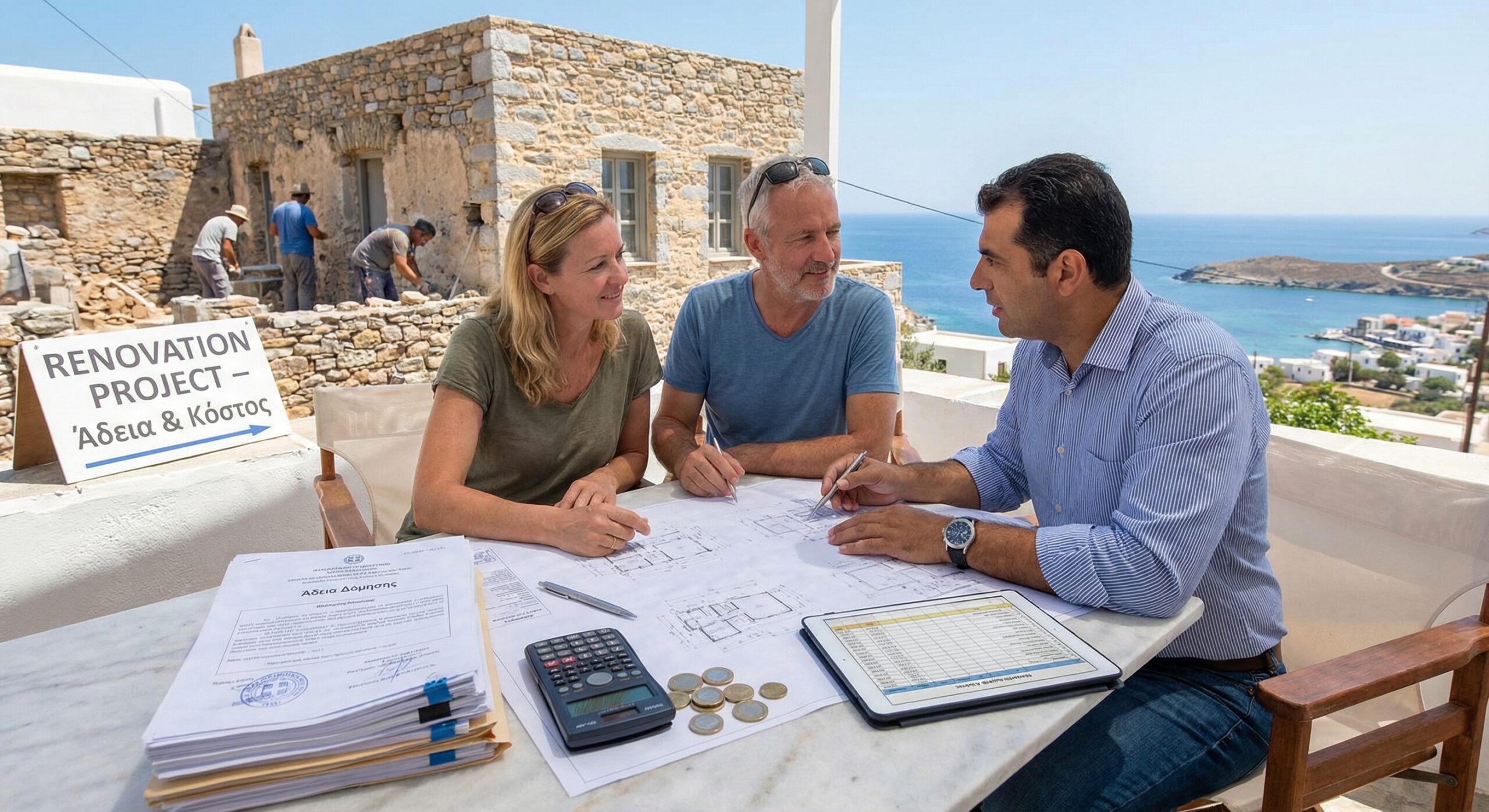
Island properties are the most romantically compelling category. Traditional island houses in good locations have strong rental income potential. But they come with specific challenges: remoteness from mainland supply chains means materials take longer and cost more to deliver, local contractor availability on smaller islands is limited during the summer season, and in some cases strict architectural controls restrict what you can do to the exterior of traditional buildings. The full picture of what island renovation involves is in our dedicated guide to Greek island property renovation.
Athens urban apartments have seen a significant renovation wave in neighborhoods like Kolonaki, Koukaki, Pangrati, Mets, and Exarcheia. The city’s polykatoikia apartment blocks, typically from the 1950s to 1970s, offer large floor plans, solid construction, and strong rental performance in the right neighborhoods.
Mainland rural properties, older village houses, farmhouses, and historic stone structures in the Peloponnese, Epirus, and northern Greece, appeal to buyers looking for character and seclusion. These often come with complex legal status questions that require careful pre-purchase investigation.
Thessaloniki, Greece’s second city, is increasingly on the international buyer radar. Strong university-driven rental market, solid architectural stock of late 19th and early 20th-century buildings, lower prices than Athens, and improving infrastructure.
Design Considerations for Greek Properties
Climate response. Greek climate varies more than outsiders often realize. Athens is hot and dry in summer and genuinely cold in winter. The islands have their own microclimates. Traditional Greek architecture, thick masonry walls, small windows on east and west elevations, covered outdoor spaces, and strategic orientation, encoded responses to this climate that remain relevant. Renovations that work with these principles rather than replacing them with generic European standards tend to perform better and feel more appropriate. Our guide to climate-responsive architecture across Spain, Greece, and Sweden explains the principles in depth.
The relationship to outdoor space. In Greek residential culture, outdoor spaces are genuine extensions of the living area used for large parts of the year. Designing the indoor-outdoor relationship thoughtfully is one of the highest-impact decisions in any Greek renovation.
Traditional materials. Cycladic plaster, Greek marble, local stone, terracotta. These materials give traditional Greek architecture its specific character. Incorporating them thoughtfully into a contemporary renovation produces results that feel genuinely place-specific rather than generically Mediterranean. This is also commercially relevant for rental properties where character and authenticity are significant differentiators.
Finding and Working with an Architect Registered in Greece
For international buyers, working with an architect who holds Greek professional registration (TEE-TCG) and who also understands your language and cultural context is the clearest path through the regulatory process.
Communication with YPDOM, preparation of technical documentation in Greek, coordination with local engineers, and management of the permit process all require someone who knows the system from the inside. How the architect-client process works in practice is explained in our guide to working with an architect from first contact to handover.
The permit timeline in Greece is real and should be built into any project planning. In major cities, straightforward permits can move in 3 to 4 months. More complex applications routinely take 6 to 12 months. Island projects sometimes move faster in local YPDOM offices, but material and contractor logistics are more complex.
Have a property in Greece or thinking about buying one? Tell us about your project using the form below and we will respond within 48 hours.