





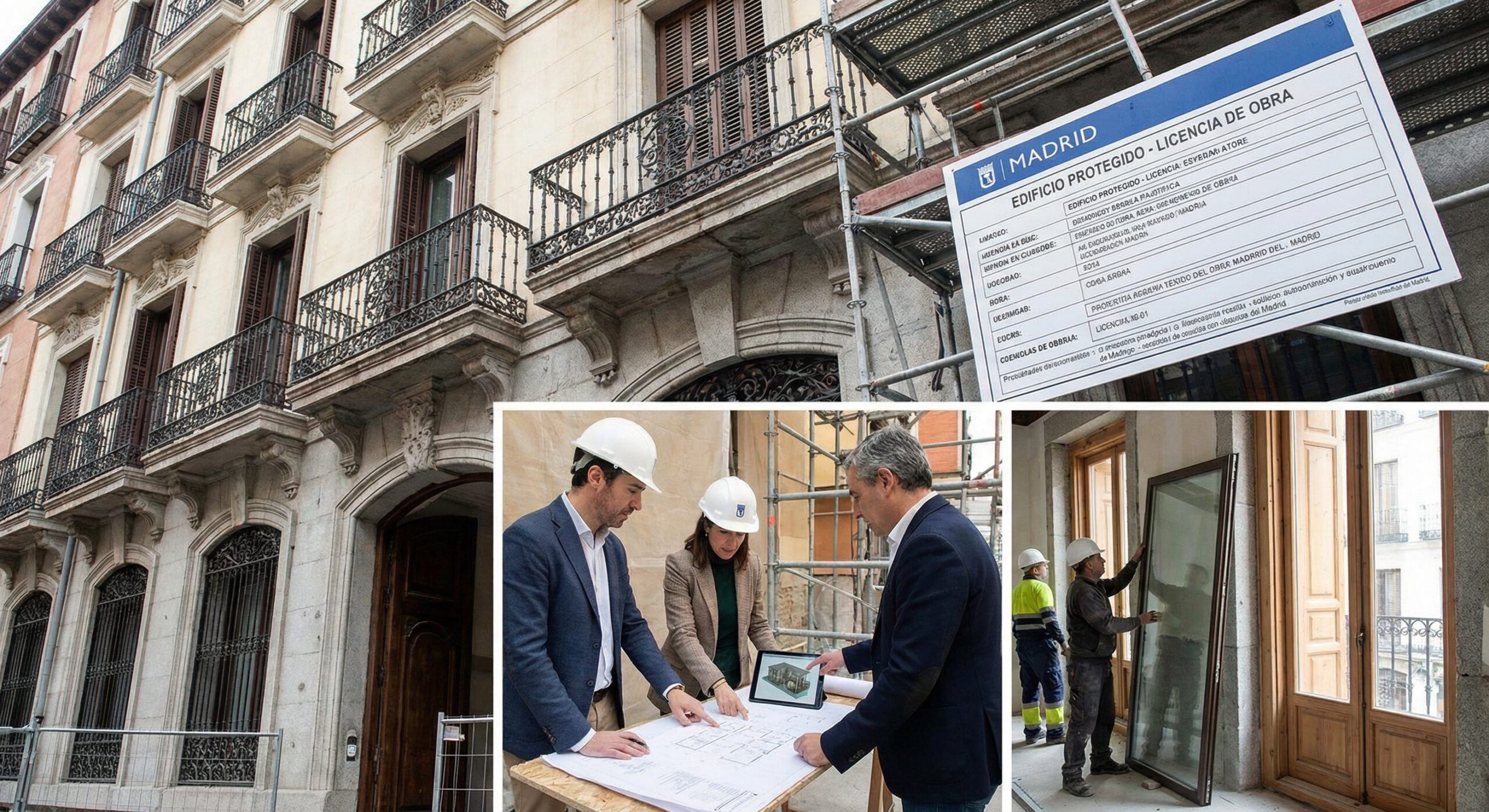
Madrid’s older neighborhoods contain some of the most beautiful residential buildings in Spain.
The 19th-century fincas of Salamanca, the early 20th-century blocks of Malasaña, the classic apartment buildings of Chamberí. These are the properties that attract buyers who want genuine character. They are also the projects that require the most careful navigation of Madrid’s regulatory system.
This guide covers what heritage protection actually means in practical terms, what you can and cannot do in a protected building, how the permit process works, and how to renovate in a way that respects the building while making it genuinely comfortable for today. For the broader permit landscape in Madrid, see our guide to Madrid building permits explained.
Understanding Madrid’s Three Heritage Protection Levels
Not all historic buildings in Madrid are protected equally. The city’s urban planning framework applies different protection levels depending on a building’s historic, architectural, or environmental significance.
Nivel 1, integral protection, covers the most significant buildings. The exterior, interior layout, structural elements, and key decorative features are all subject to strict conservation requirements. Changes are minimal and require detailed justification.
Nivel 2, structural protection, protects the facade, structural elements, and main architectural configuration but allows more freedom with interior layouts and finishes. Most classic buildings in Salamanca and Chamberí fall here.
Nivel 3, environmental protection, focuses on the building’s contribution to the neighborhood streetscape rather than its specific interior. More intervention is allowed while still requiring sensitivity to the exterior appearance.
Before planning anything, you need to know which level applies to your building. Your architect checks this in Madrid’s General Urban Plan (PGOU) and coordinates with the Ayuntamiento’s heritage department. Do not assume based on the neighborhood because individual buildings vary significantly. If you’re still evaluating properties, our guide to buying property in Madrid as a foreigner explains what due diligence to do before signing.
What You Can and Cannot Change in a Heritage-Protected Madrid Building
The specific rules depend on the protection level, but these general principles apply across most protected residential buildings in Madrid.
What is typically preserved: the street facade including original windows, balconies, ironwork railings, and ornamental stucco or stone elements. Even replacing a single window with a different profile can require prior authorization and may be refused. The main staircase and entrance hall are often considered defining architectural elements. Original structural elements including columns, load-bearing walls, and historically significant decorative ceilings.
What is typically permitted: interior partition walls that are not original to the building’s historic configuration can usually be modified, subject to structural review. New electrical, plumbing, and HVAC systems can be installed throughout provided they do not damage protected elements. Flooring can be changed in most interior areas, though original hydraulic tile sometimes carries its own protection. Kitchen and bathroom layouts can typically be reconfigured.
What is typically restricted or prohibited: adding balconies, modifying the facade profile, changing window dimensions facing the street, removing or permanently concealing original decorative elements on protected interior areas, installing exterior air conditioning units visible from the street.
The Heritage Permit Process in Madrid: Step by Step
Renovating a protected building in Madrid involves an additional review layer beyond the standard Licencia de Obras.
Depending on the protection level, your project may need to go through the city’s heritage department and in some cases regional bodies as well. Your architect prepares a detailed project that includes a heritage justification document explaining how the proposed intervention respects the protected elements and why any modifications are appropriate.
For Nivel 1 buildings, a preliminary consultation with heritage technicians before formal submission is practically mandatory. Submitting a complete application and having it refused costs time and money. An experienced Madrid architect will have informal conversations with heritage officials early in the process to understand what will and will not be approved. How this early-stage work fits into the overall project process is explained in our guide to working with an architect in Spain.
Permit timelines for protected buildings are longer than standard renovations. Expect 3 to 5 months for a complex application, sometimes more if the heritage review requires additional documentation.
One common and expensive mistake: beginning any demolition or structural work before heritage permits are fully granted. Even if your contractor is ready, starting work on a protected building before authorization creates serious legal exposure and can result in mandatory restoration orders. Our guide to renovation mistakes that cost the most to fix covers this and other patterns that consistently catch clients out.
Design Strategies That Work in Madrid’s Historic Buildings
Constraints are not the enemy of good design. The buildings that are most protected are also the ones with the finest spatial qualities, high ceilings, generous proportions, and original material character that modern construction cannot replicate. Working with these rather than against them produces better results.
Preserve and highlight original elements. Madrid’s 19th-century buildings often have decorative plaster ceiling rosettes, original tiled floors, period wooden doors, and ornamental ironwork that were considered unfashionable decades ago but now add genuine value. Cleaning and restoring these elements typically costs less than removing them and adds far more to resale value.
Use honest contrast. A well-established approach in contemporary heritage renovation is to make clearly modern interventions that do not pretend to be historic. New cabinetry in a clean contemporary palette against an original plaster ceiling reads as an honest dialogue between past and present, which is both more interesting and more defensible with heritage authorities than poorly replicated period details. This design philosophy connects to the Scandinavian approach to material honesty that informs Wolfblanc’s work.
Plan lighting around the building’s existing light patterns. Many protected apartments have rooms that feel dark. The solution is rarely to fight the heritage rules. It is to use glass internal partitions, high-gloss surfaces that reflect available light, and carefully positioned artificial lighting that supplements without dominating. Our guide to designing homes around light covers these strategies.
Address thermal comfort seriously. Heritage buildings were not designed for contemporary thermal standards, and retrofitting insulation or modern HVAC into a protected building requires expertise. Installing underfloor heating without considering the effect on original tile floors, or adding insulation that traps moisture in old masonry, creates problems that are expensive to fix. There are good solutions but they require knowledge of how historic buildings actually behave.
Why Well-Renovated Heritage Properties in Madrid Hold Their Value
Properties in Madrid’s protected historic buildings consistently command a premium in both the sales and rental markets.
The locations are almost always excellent. The construction quality of Madrid’s 19th and early 20th-century buildings, solid brick masonry, generous ceiling heights, robust structural frames, tends to outlast mid-century concrete construction. And the character is irreplaceable.
A well-executed renovation of a protected apartment in Salamanca or Chamberí delivers something a new-build cannot: genuine historic presence with contemporary comfort. For the international buyers and tenants who represent a significant share of Madrid’s premium residential market, this combination has consistent appeal. How those design decisions translate into rental yield and resale value is explained in our guide to Madrid real estate investment and architecture ROI.
Working with a protected building in Madrid and not sure how to start? Wolfblanc has guided numerous heritage renovation projects through Madrid’s permit process. Tell us about your property using the form below and we will get back to you within 48 hours.