


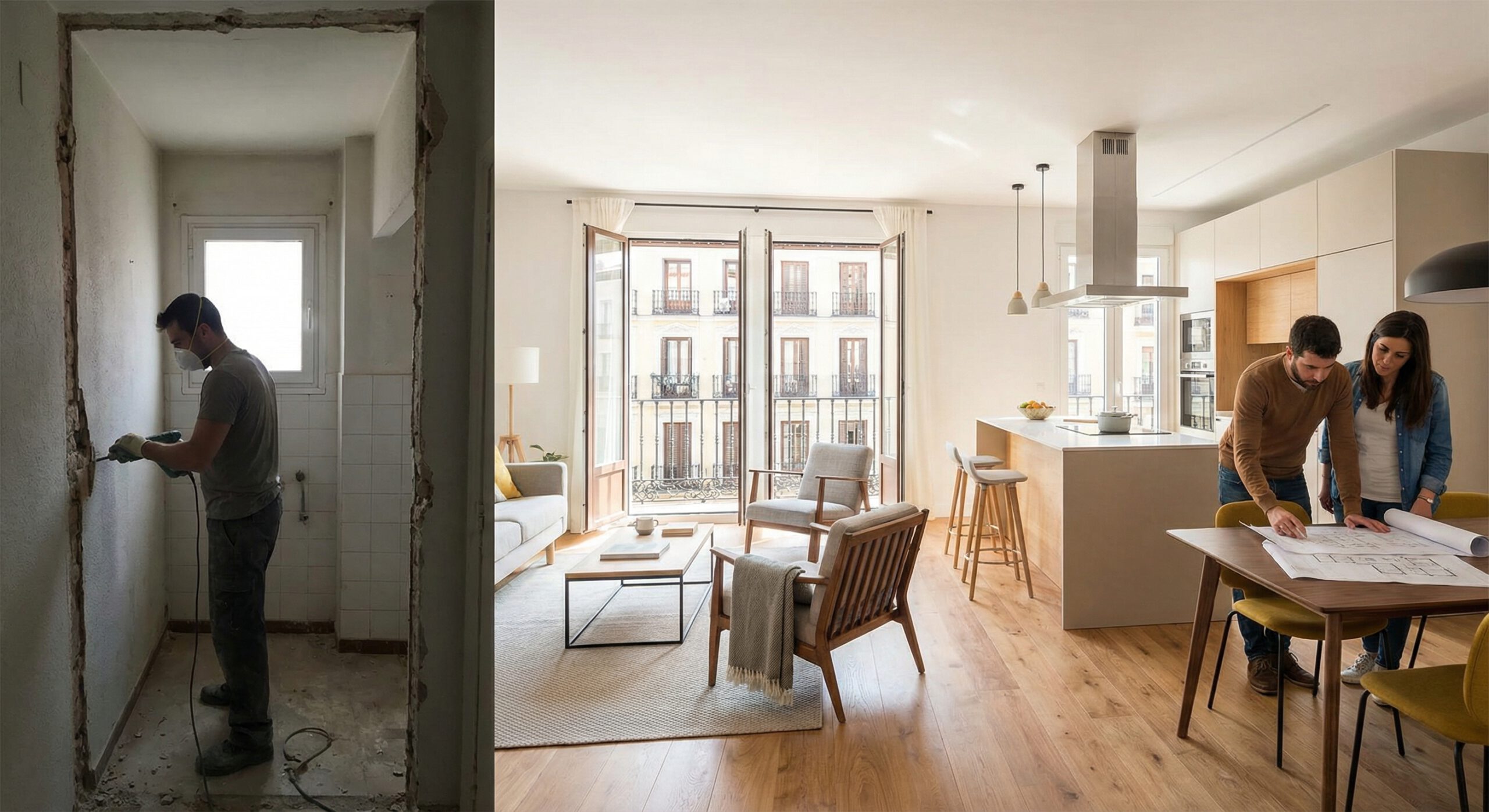
The request comes up in almost every residential renovation consultation.
“Can we open up the kitchen?” or “Can we remove this wall?” The short answer is almost always yes. The better question is whether you should, and if so, how.
Open-plan living is popular for good reasons. It makes smaller apartments feel larger. It creates more social cooking and dining configurations. It lets light from street-facing windows travel deeper into the apartment. But badly executed open-plan renovations create their own set of problems, and they exist in quantity. This is a practical guide to making the right call — for broader Madrid renovation context, see our Madrid renovation guide.
Why Open-Plan Living Works So Well in Madrid Apartments
The traditional Madrid apartment layout developed over a century ago for a way of life that looked very different from how people live today.
Separate formal dining rooms used three times a year. Enclosed kitchens designed for full-time household staff. Corridors connecting a chain of rooms that each had a single dedicated function.
Today’s households are smaller, more informal, working from home part of the time, and cooking as a social activity. They are badly served by this configuration. The formal dining room sits unused most of the year. The corridor consumes floor area nobody benefits from. The enclosed kitchen isolates the person cooking from everyone else.
Opening these spaces up addresses real functional problems. And it works particularly well in Madrid’s building stock because the ceiling heights in older apartments, typically 3.0 to 3.5 meters, give genuinely generous proportions to open spaces that would feel oppressive at the 2.5-meter heights common in newer construction. Our guide on how to design a home around light explores how open layouts help distribute natural light through the apartment.
What You Need to Check Before Removing Any Wall in Madrid
Not every wall in a Madrid apartment can be removed without consequences. This is the most important thing to establish before any design decisions.
Load-bearing walls. Madrid’s older buildings use a range of structural systems. Some are solid brick masonry with load-bearing party walls. Some have concrete frames with infill walls. Some have hybrid systems. A wall that looks like an interior partition may actually be carrying part of the building’s load. Removing it without proper structural assessment and appropriate reinforcement will cause structural damage. This requires a structural engineer before anything else.
Wet walls. Walls containing plumbing backed onto kitchens and bathrooms can be relocated, but it requires planning. Moving a kitchen to an entirely new location involves rerouting drain lines, water supply, and potentially gas supply. Achievable, but it adds meaningfully to budget and complexity.
Community approval. Even for interior walls within your apartment, structural modifications in Spanish multi-unit buildings typically require formal notification to the building community and may require their approval. Your architect handles this as part of the permit process. The relevant rules are set by the Spanish horizontal property law.
The Main Open-Plan Configurations and When Each Makes Sense
Full kitchen to living-dining opening. The most common intervention. Options range from a complete opening with no barrier between kitchen and living space, to a peninsula or kitchen island that defines the boundary without closing it, to a partial-height wall with a pass-through that preserves some acoustic separation.
Which configuration is right depends on the specific apartment. If the kitchen is small and cooking smells and noise are a concern, a partial opening with a peninsula and good extraction often works better than a full opening. If the kitchen is generous and the goal is maximum social openness, a full open configuration with a high-performance extraction system is the right call. Our guide to kitchen renovation in Spain covers the specific design decisions in more detail.
Corridor elimination. In apartments where a significant amount of floor area is dedicated to a central corridor connecting bedrooms and living spaces, redistributing this space to adjacent rooms can meaningfully improve how the apartment functions. The visual difference between a well-proportioned living room and a smaller one with a large central corridor is significant, even though the total floor area is the same.
When Open-Plan Is the Wrong Answer for a Madrid Apartment
Acoustic isolation for families. If the apartment houses children who need to sleep at different times, or adults working from home while others are in the living area, open-plan configurations make acoustic separation impossible to achieve. A family with young children often benefits from keeping the primary living and kitchen space connected while maintaining genuine sound separation from bedrooms and study areas. How to make working from home genuinely functional is explored in our guide to designing a home office that actually works.
Very small apartments. Counter-intuitively, apartments below around 50 square meters do not always benefit from being opened up. Without the floor area to create genuinely distinct zones within a single space, removing walls can produce a room that functions as neither kitchen, dining room, nor living room properly. Space-defining furniture and careful zoning through flooring materials sometimes do more for a small Madrid apartment than removing walls.
Serious cooking use. If the apartment will be used for intensive cooking, an open kitchen means cooking smells and sounds throughout the living space. High-performance extraction helps considerably, but an enclosed kitchen with a large pass-through window is sometimes genuinely the better solution for a dedicated cook.
Material and Design Choices That Make Open-Plan Spaces Work
When spaces are opened up, the visual continuity of the floor becomes much more important.
A change of flooring material is the most common way to define zones within an open space, different tile in the kitchen zone, wood in the living area, for example. Alternatively, a completely continuous floor material throughout creates a unified sense of space that can feel more generous.
Kitchen furniture designed as a piece of the room rather than as a separate functional area, with cabinet fronts that match wall paneling elsewhere and materials that connect to the rest of the interior, produces better results than a kitchen that looks like it was inserted into a living room. The best open-plan renovations feel like one room with a cooking zone, not a kitchen that someone opened a wall into.
Ceiling design matters more in open spaces. In a single large room, any changes in height, direction, or treatment become features rather than neutral backgrounds. Using ceiling design to define zones, a linear element above the dining table, a material change over the kitchen, can help organize a generous open space without closing it down. How these design principles connect to broader Scandinavian design methodology is explored in our piece on Nordic principles in Spanish homes.
Planning to open up your Madrid apartment and want expert input on what is structurally possible and what would actually work best for how you live? Tell us about your project using the form below and we will respond within 48 hours.