


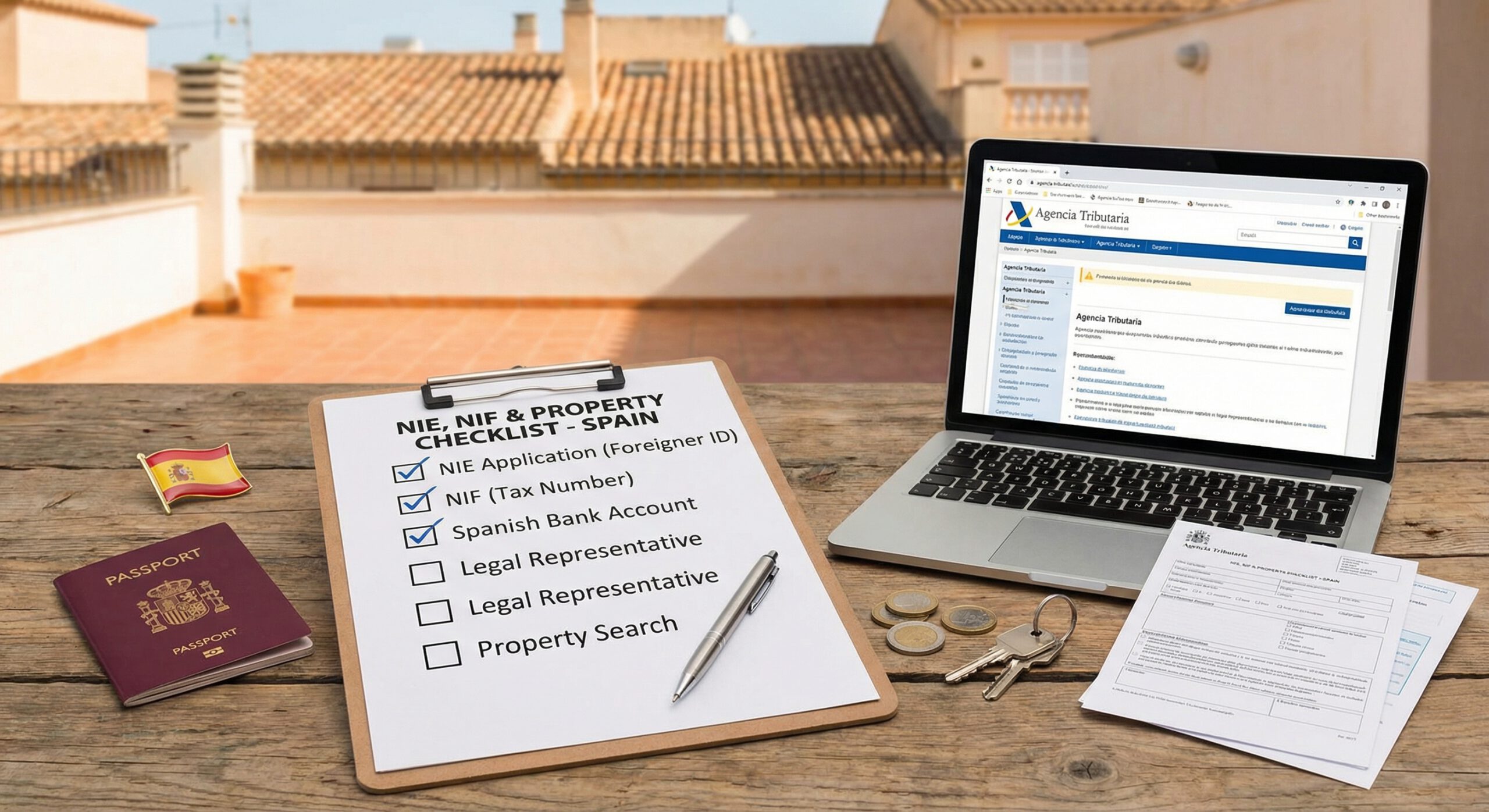
Spain has a well-established process for foreign nationals buying property, and most of it is straightforward once you know what is required. The problems typically come from not knowing what needs to be in place before the signing date, which creates last-minute scrambles that delay completion or complicate the transaction.
This is a practical checklist. It is not legal or financial advice. A qualified Spanish property lawyer and tax advisor should be part of your purchase team. For a broader picture of what buying property in Spain as a foreigner involves from an architect’s perspective, see our dedicated guide.
Step 1: Obtain a NIE Number
The NIE (Número de Identidad de Extranjero) is the tax identification number for foreign nationals in Spain. You cannot buy property, open a bank account, or sign a contract in Spain without one.
How to get it: NIE applications can be submitted at the Spanish Consulate in your home country (often the easiest route if you are not yet in Spain) or at the Oficina de Extranjeros or National Police station in Spain.
What you need: a completed application form (Modelo EX-15), valid passport, proof of the reason for needing the NIE (a signed purchase agreement for property works well), and a fee payment (currently under 15 euros).
Timeline: allow 3 to 6 weeks if applying from abroad. In-person applications in Spain can sometimes be faster but appointment availability varies significantly by city.
You can start this process before you have found a specific property. Having your NIE ready speeds up the transaction significantly when you find what you want.
Step 2: Open a Spanish Bank Account
A Spanish bank account is practically necessary for a property purchase in Spain. You need it for the transfer of purchase funds, for ongoing management of the property, for paying utility bills and comunidad fees after purchase, and for any renovation payments. Understanding your obligations as an apartment owner is covered in our guide to the Spanish horizontal property law and comunidad de propietarios.
Most major Spanish banks (BBVA, Santander, Caixabank, Sabadell) offer non-resident accounts for foreign nationals. You can typically open an account with your passport, NIE, and proof of address in your home country.
Some banks now allow the initial account opening to be completed remotely, with documentation submitted digitally. The process has improved significantly in recent years.
Step 3: Engage a Spanish Property Lawyer
A property lawyer (abogado) is not legally required in Spain for a property transaction. But for a foreign buyer, engaging one is strongly recommended.
Your lawyer will: check the legal status of the property in the Land Registry (nota simple), verify that there are no outstanding debts, charges, or encumbrances on the property, review the purchase contract before you sign, handle due diligence on the comunidad, manage the completion process and the post-completion registration, and provide advice on the tax implications of the purchase.
For non-EU buyers in particular, the lawyer should also advise on any residency implications of the purchase. If you are purchasing with residency in mind, see our guide to the Golden Visa programs in Spain and Greece.
Budget: Spanish property lawyer fees for a purchase typically run 1 to 1.5% of the purchase price plus IVA, or a fixed fee for simpler transactions.
Step 4: Understand the Tax and Cost Structure
The total cost of buying a property in Spain is typically 10 to 14% above the agreed purchase price.
The main components:
ITP (Impuesto de Transmisiones Patrimoniales) for second-hand property: varies by region but typically 6 to 10% of the purchase price. This applies to resale properties.
IVA (21% for commercial, 10% for new residential) applies to new builds bought directly from the developer, not to resale.
AJD (Actos Jurídicos Documentados): a stamp duty on the notarial deed, typically 0.5 to 1.5% of the purchase price, varies by region.
Notary fees: typically 0.2 to 0.5% of the purchase price.
Land Registry fees: typically 0.1 to 0.25% of the purchase price.
Lawyer fees: as above.
Mortgage costs: if applicable, additional survey and arrangement fees.
Total: budget 10 to 14% of the purchase price for transaction costs, over and above the price itself.
Step 5: Get the Surveying Right
Spain does not have a mandatory survey culture in the same way that the UK does. Many transactions proceed without an independent survey of the physical condition of the property.
For a foreign buyer considering renovation, this is a risk worth understanding clearly. A property whose structure is not as expected, whose services need complete replacement, or whose legal status has complexities that are not visible in the registry documentation, can cost significantly more to bring to your intended use than the purchase price suggests.
An architect’s pre-purchase assessment of the physical condition and renovation potential of a property, separate from the legal due diligence your lawyer conducts, is worth commissioning for any property where renovation is planned. It is a fraction of the cost of discovering unexpected structural or systems issues after completion. Our guide to working with an architect in Spain explains exactly what that process looks like from first contact through to project delivery.
Planning to buy property in Spain and want an architect’s assessment of a specific property before you commit? Tell us about the property using the form below and we will respond within 48 hours.