





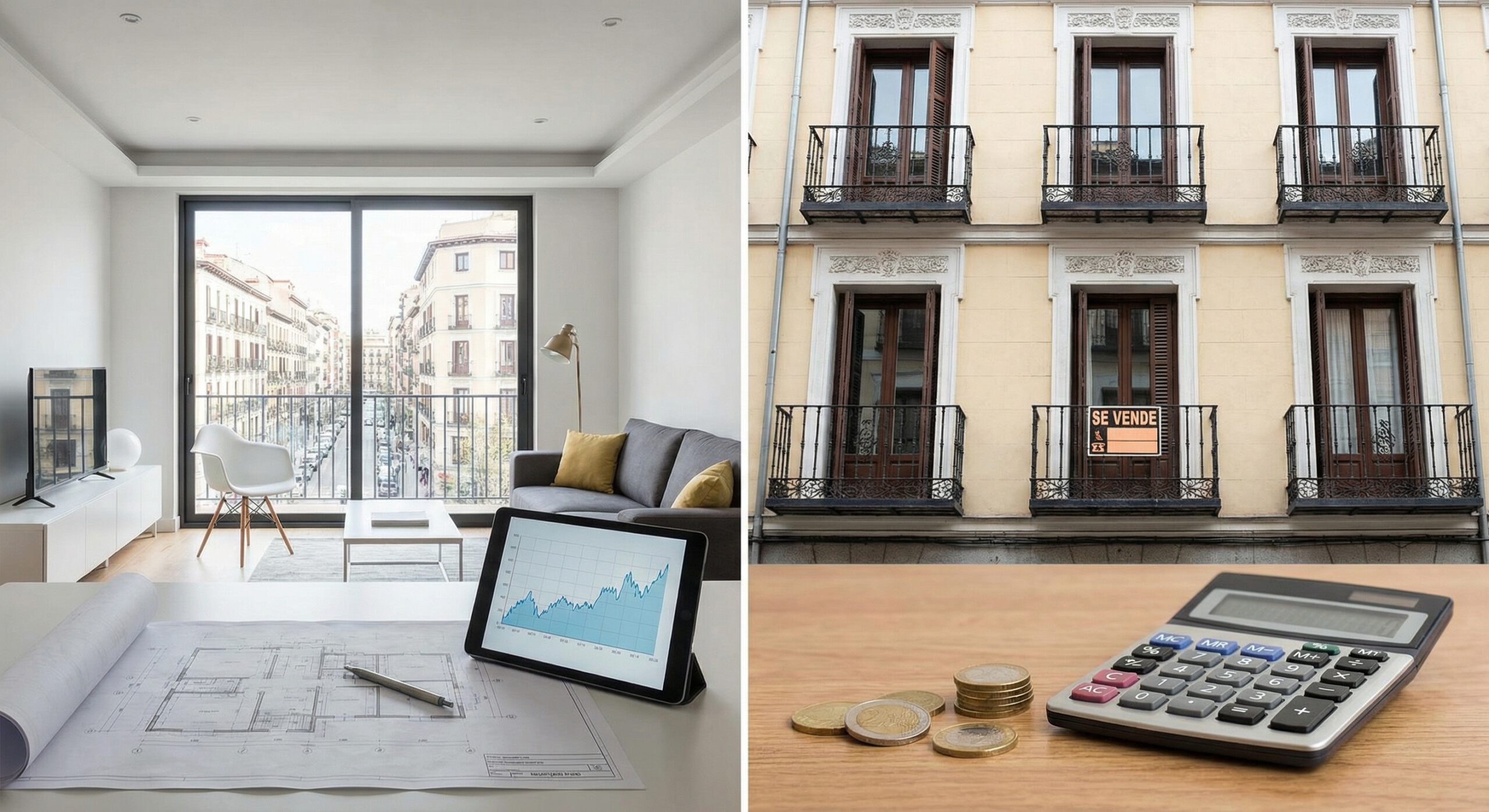
Property investment in Madrid is a numbers game.
Cap rates, yield on cost, gross versus net rental income, resale margins. These are the metrics that matter.
What many investors underestimate is how much architecture and design decisions move those numbers. Not in a vague “good design adds value” way, but in specific, quantifiable terms. A well-designed apartment rents faster, commands higher rents, has lower vacancy rates, and achieves better prices on resale than an equivalent apartment with a mediocre renovation. The differences are not marginal. The Madrid renovation guide covers what a full investment renovation realistically costs.
Why Design Quality Pays Off in the Madrid Rental Market
Madrid’s short-term and medium-term rental market, particularly the segments serving professionals, international residents, and mobile executive tenants, has become significantly more discerning over the past decade.
The supply of renovated apartments has increased substantially, and tenants at the premium end have real choice. In this environment, a well-designed apartment with a thoughtful layout, quality materials, and functioning systems does not just achieve better rents. It also reduces vacancy, attracts longer-term tenants, and generates fewer maintenance-related issues that eat into net yield.
The practical gap between a budget renovation and a quality one in terms of gross rental income can be substantial. In Madrid’s Salamanca district, a well-renovated 2-bedroom apartment of 80 square meters might achieve EUR 2,200 to EUR 2,800 per month in the current market. An equivalent apartment with a generic renovation might achieve EUR 1,500 to EUR 1,900. Over a year, that gap adds up.
Layout: The Highest-Return Design Decision for Madrid Investment Properties
The single most impactful thing you can do for the rental or resale value of a Madrid apartment is rethink the layout if the existing configuration is inefficient.
The most common opportunity: adding a second bathroom. Most Madrid apartments in historic neighborhoods were built with a single bathroom because that was the norm in mid-20th-century Spain. Today’s rental market, particularly at the medium to high end, consistently values a second bathroom very highly.
The construction cost of adding a bathroom ranges from EUR 8,000 to EUR 18,000 depending on complexity. The rental premium is typically EUR 200 to EUR 400 per month in Madrid’s premium neighborhoods. The payback period is under two years in most scenarios. Our guide to bathroom renovation in Spain covers costs and what drives them.
The second significant layout intervention: opening the kitchen. A closed kitchen in an 80-square-meter apartment makes the social spaces feel smaller and the cooking area feel isolated. Opening it to the living and dining area changes the perceived size and social functionality of the apartment significantly. This resonates strongly with the international tenant and buyer profile that drives premium pricing in central Madrid. Our guide to open-plan renovation in Madrid apartments covers when to open up and how to do it well.
The third: corridor reduction. Traditional Madrid apartment layouts often have a disproportionate amount of floor area dedicated to a central corridor. Redistributing this space to living areas, building in integrated storage, or using it to widen kitchens or bathrooms adds meaningful functional value without increasing the apartment’s footprint.
Energy Performance: An Investment Risk That Will Keep Growing
Spain is in the early stages of implementing EU energy efficiency requirements for the rental sector. The direction is clear: energy-poor properties will face increasing restrictions on rental activity, and their market value will reflect that.
Properties rated G or F on Spain’s energy certificate represent a growing risk in any long-term investment portfolio.
The good news is that renovations that improve energy performance are the same investments that also improve the apartment’s comfort and market appeal. Improved insulation, replacement of original single-glazed windows, installation of a heat pump system for heating and cooling, and underfloor heating are not purely defensive costs. An apartment that improves from G or F to C or B through renovation typically achieves a meaningful rental premium because the running costs for the tenant are lower and comfort levels are genuinely better. What specific measures look like and cost in a Madrid context is covered in our guide to sustainable renovation in Madrid.
Materials and Finishes: Finding the Sweet Spot Between Cheap and Excessive
A common mistake in investor renovations is specifying either too cheap or too luxurious. Both hurt returns.
Very cheap finishes, laminate flooring, low-quality kitchen fittings, cheap sanitary ware, require replacement more quickly, damage the property’s market positioning, and attract tenants who treat the property accordingly. The cost saving on materials is typically erased within two or three rental cycles.
Excessively luxury finishes, custom stone throughout, bespoke cabinetry at ultra-premium price points, add cost that the rental market in most Madrid locations simply cannot absorb. The payback through rental premium rarely materializes.
The right zone for an investment property is durable, mid-market quality materials that look good, last well, and photograph well. Large-format ceramic tile in bathrooms, engineered wood flooring in living areas, solid surface or quartz kitchen worktops, branded but not ultra-luxury kitchen appliances. This is the specification range that produces the best return on renovation investment. How light quality affects photography and rental appeal is explained in our guide to architecture and light.
How BIM-Based Architecture Documentation Protects Your Investment Budget
Investors care about budget predictability. Cost overruns on renovation projects are one of the most consistent ways that property investment returns fail to meet projections.
The primary driver of cost overruns is poor construction documentation. When architects produce vague or incomplete drawings, contractors are forced to interpret, and their interpretations are rarely the cheapest option. Ambiguous specifications lead to change orders. Change orders are where project budgets go wrong.
A BIM-driven architecture process produces documentation precise enough that contractors can price accurately and build without guessing. In complex renovation projects, the difference between precise and vague documentation can change the construction cost by 10 to 20% through avoided change orders and rework alone. What BIM is and how it protects clients is explained in our guide to what BIM means for renovation projects.
For investors who are managing multiple properties or who are not physically present in Madrid throughout the renovation, remote project monitoring capability adds another layer of cost and quality control that is genuinely valuable.
Where to Focus When the Renovation Budget Is Limited
Not every project can do everything. If you are working within a defined budget and need to prioritize:
First, structural and systems work. Electrical, plumbing, and HVAC replacement is not glamorous but it makes the apartment function properly and prevents expensive emergency repairs later. This is never optional.
Second, bathroom quality. Tenants and buyers form strong impressions from bathrooms. A well-renovated bathroom on a modest kitchen budget outperforms the reverse in terms of market reception.
Third, floor finishes. Flooring runs through the entire apartment and has a major impact on how the space feels. Cheap flooring undermines the effect of more expensive finishes elsewhere.
Fourth, kitchen functionality. A functional, clean kitchen with decent appliances matters. An expensive designer kitchen in a rental property beyond the premium ultra-luxury segment rarely pays its way. Our guide to kitchen renovation in Spain helps calibrate what to spend and where.
Investing in Madrid property and want a realistic assessment of what your renovation could achieve in terms of yield and value? Tell us about your investment project using the form below and we will get back to you within 48 hours.