


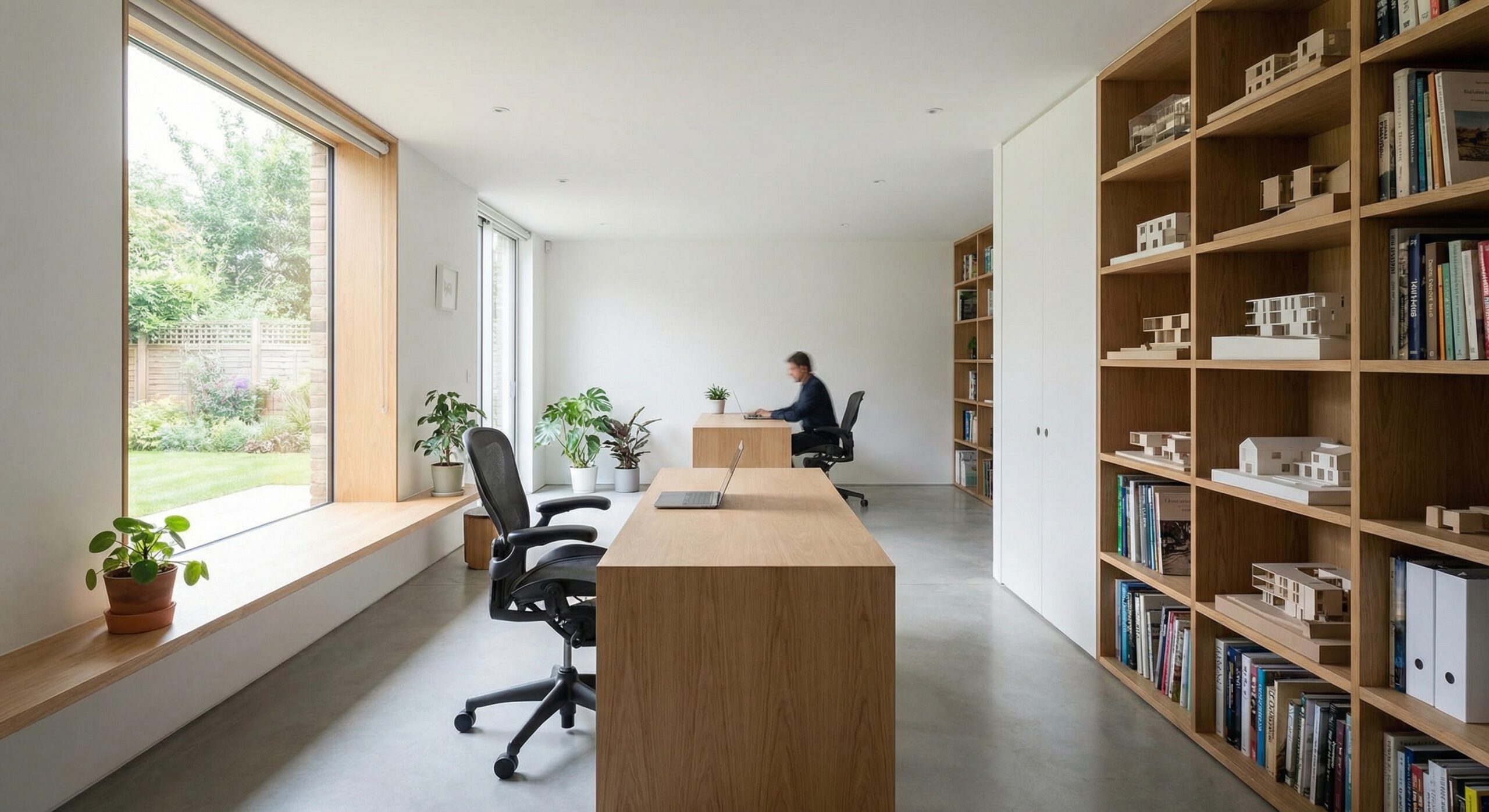
The idea that working from home is a temporary arrangement has been tested thoroughly enough that most people no longer believe it. For many professionals, particularly those who have moved to Spain, Greece, or Sweden specifically because remote work freed them from their previous geography, the home office is a permanent and important room.
Most homes, whether bought or rented, were not designed for this use. Bedrooms are not offices. Kitchen tables are not offices. The part of the living room where the laptop lives is not an office.
Designing a proper workspace within a residential renovation is a specific problem with specific solutions.
Acoustic Separation: The Non-Negotiable
The single most important factor in a home office that enables focused work is acoustic separation from the rest of the home.
This does not require a soundproofed room. It requires enough acoustic separation that the sounds of daily domestic life, a partner on a video call in the next room, children, kitchen sounds, a television, do not constantly interrupt concentration or appear on your own video calls.
The minimum for useful acoustic separation between a home office and adjacent spaces: acoustic insulation in the wall between the office and any adjacent room, with particular attention to the door. Standard hollow-core internal doors allow considerable sound transmission. A solid-core door with good perimeter sealing dramatically reduces this.
If the home office shares a floor or ceiling with another occupied space, acoustic underlay beneath the office floor and acoustic insulation above the ceiling reduce impact and airborne sound in both directions.
The position of the home office within the apartment or house matters too. A room at the quiet end of the building, away from the street, away from the kitchen, with only one shared wall with an occupied space, is acoustically easier to work in than a central room surrounded on all sides by activity.
Light: What the Research Actually Says
Daylight in a workspace is not a luxury preference. It is a documented performance factor. Workers in daylit spaces report better sleep (because their circadian rhythms are correctly set by morning light exposure), better mood, and better sustained concentration than those working under artificial light alone. We cover this in more depth in our guide to how architecture affects health and wellbeing.
For a home office, this translates to: position the workspace to receive natural daylight during working hours, which typically means an east or south-facing orientation. Control direct sun at the work surface, which creates glare and heat, with external shading or adjustable blinds that diffuse rather than block completely. Supplement with artificial task lighting at the work surface for morning or evening working hours.
The colour temperature of artificial lighting affects alertness. Cooler white light (3500 to 4000K) at the work surface supports alertness better than warm white (2700K), which is better suited to relaxation spaces. Having both available on separate circuits, or a tunable-white fixture, allows the workspace to be adapted throughout the day. For a full treatment of how to design any home around natural and artificial light, see our dedicated guide.
The Ergonomics of a Designed Workspace
An ergonomically correct workspace is not expensive to achieve in a renovation project. It requires mainly decisions about desk height, monitor position, seating, and the relationship between these.
The desk surface should be at a height where forearms rest roughly horizontal with relaxed shoulders. For most adults, this is between 70 and 76cm. Adjustable desks that allow both seated and standing work are increasingly common and cost-effective.
Monitor position: top of the screen at or slightly below eye level, screen at arm’s length. A monitor mount that allows precise positioning is a renovation-stage decision, requiring a wall or ceiling backing strong enough to support it.
Power: a dedicated circuit for the workspace, with outlets at desk height and below the desk, avoids the cable management problems that create untidy and potentially unsafe working environments. This is a renovation-stage decision that cannot be easily added later.
Separation from the Rest of the Home
A home office that is entirely open to the main living space does not function as an office, it functions as a corner of the living room with a desk.
The minimum useful separation is a visual separation: walls, or at least partial walls with glass above, that define the workspace as a distinct zone. Glass-to-ceiling partition systems work well because they maintain the visual connection and allow light to pass through while creating a clear psychological and acoustic boundary.
A door that closes is significantly better. Even in open-plan apartments, a home office zone with its own door allows video calls to be taken without capturing domestic activity in the background, allows the psychological switching between work and home that fully open-plan arrangements make difficult, and allows different noise levels to coexist in the same apartment.
In Spain, Greece, and Sweden: Climate-Specific Considerations
In Spain and Greece, summer temperatures mean that a poorly ventilated home office becomes genuinely uncomfortable. A workspace that receives direct western afternoon sun through unshaded glass will be too hot to work in during summer afternoons. Either orient the workspace to avoid west-facing sun, specify external shading, or include air conditioning with a quiet-mode setting. Noisy air conditioning units are a video call problem as well as a comfort one.
In Sweden, the winter light scarcity discussed earlier applies particularly to a workspace. If the workspace receives minimal natural light in winter, the investment in high-quality artificial lighting that supports circadian health becomes more directly important. Our guide to climate-responsive architecture across Spain, Greece, and Sweden covers these regional differences in full.
Renovating a home and want to include a properly designed home office? Tell us about your space using the form below and we will respond within 48 hours.