


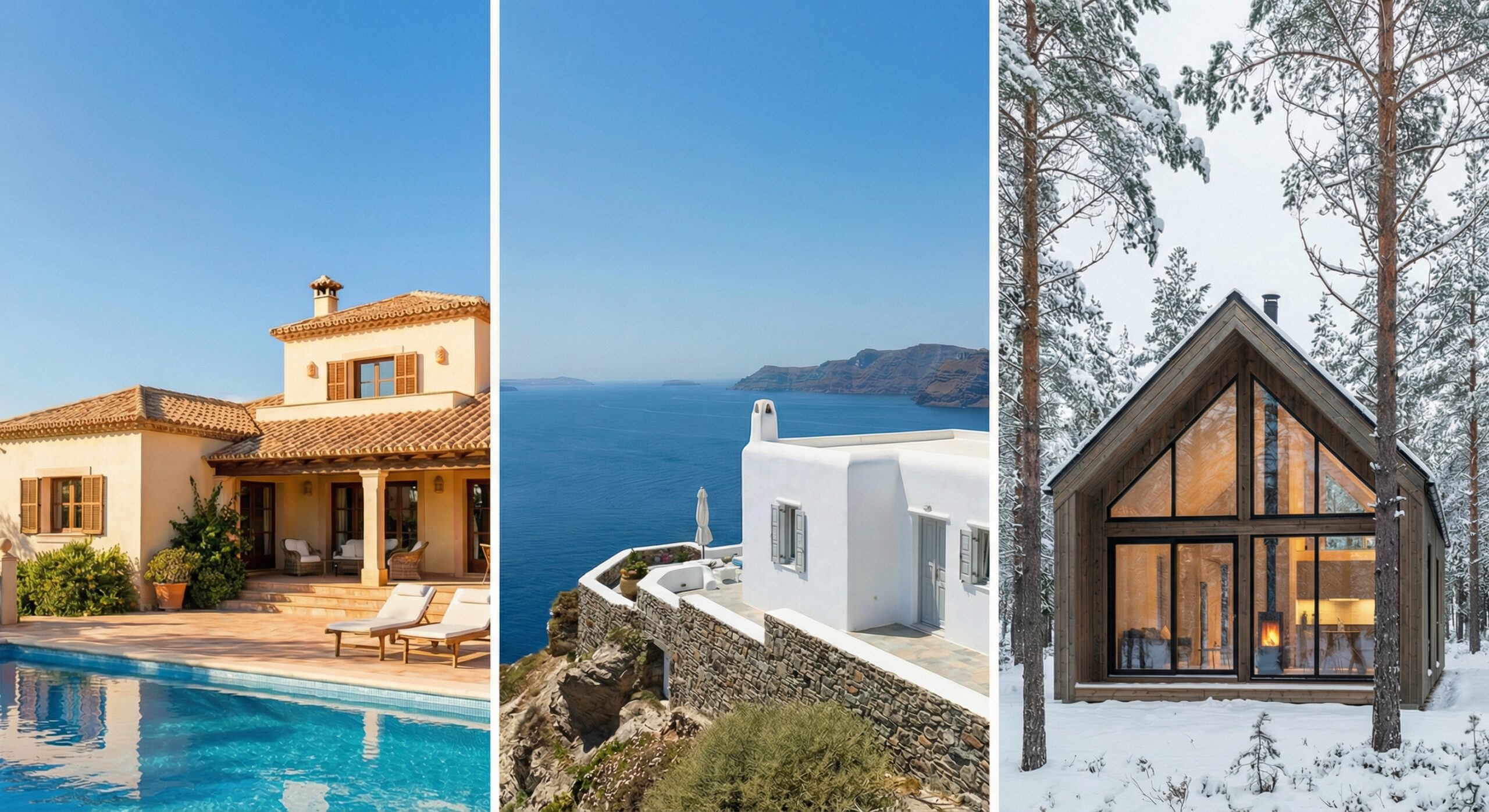
One of the most common briefs in residential architecture across all three countries Wolfblanc works in is the same at its core: a home that is wonderful in summer but does not become miserable in winter. Or the reverse, a home designed for year-round northern living that also offers genuine summer delight rather than just tolerating it.
The design challenge of dual-season living is specific, and getting it wrong is easy. This connects directly to how climate-responsive architecture differs across Spain, Greece, and Sweden — each tradition has developed its own answers to this challenge.
Many holiday homes that are spectacular in August are genuinely cold, dark, and uncomfortable in November. Many year-round homes in Mediterranean countries were designed for heat management and feel drafty and poorly heated in the months of genuine cold.
This is a practical guide to the design thinking that resolves both conditions.
The Mediterranean Summer-Winter Gap: Spain and Greece
Spain and Greece share a climate challenge that most northern European visitors underestimate.
The gap between a Mediterranean summer and a Mediterranean winter is large. Athens reaches 38 degrees Celsius in August and drops below 5 degrees Celsius on winter nights. Madrid’s summer highs regularly exceed 40 degrees and its winters include regular frost.
Traditional Mediterranean architecture managed this gap through thermal mass and passive design. The thick walls that absorbed summer heat also stored warmth in winter, and the same orientation that shaded summer sun captured the lower-angle winter sun.
But traditional design was calibrated for traditional living patterns: spending hot afternoons in darkened rooms, covering terraces with vine-shaded pergolas, sleeping outdoors in summer. Contemporary occupants have different expectations: they want air conditioning for summer peaks, central heating for winter evenings, good artificial light throughout the year, and continuous comfort rather than climate adaptation as a daily practice.
The design challenge is to provide contemporary comfort levels while maintaining as much passive performance as possible, minimising energy loads, and preserving the spatial character that makes Mediterranean living appealing in the first place.
Renovation Strategies for Mediterranean Homes That Work Year-Round
The thermal envelope comes first. A Greek island house with 45cm masonry walls, no insulation, and single-glazed timber windows is warm in summer (because of the thermal mass) and cold in winter (because the windows lose heat constantly). The improvement sequence: add insulation to the outer face of existing masonry, upgrade windows to high-performance double or triple-glazed units that retain the exterior profile required by heritage regulations, address air infiltration around door and window frames.
Design the heating system for the actual winter. Mediterranean winters are mild by northern European standards, but they are not warm. An apartment or house that relies on an electric fan heater or a single wood-burning stove for winter heating is uncomfortable. A properly sized heat pump system, combined with underfloor heating where floors are being replaced anyway, provides reliable winter comfort at reasonable energy cost. Our guide to sustainable renovation in Madrid covers specific energy measures and their costs in detail.
Shading is summer’s insulation. External shading, retractable awnings, fixed louvres, vine-covered pergolas, deep overhangs, dramatically reduces cooling loads. Internal shading helps but is less effective because the solar heat has already entered the glass and is heating the interior air. The most energy-efficient cooling strategy for Mediterranean homes is keeping the sun off the glass in the first place. For detailed guidance on outdoor space design in Spain, see our guide to terraces, gardens, and patios that are genuinely used.
Design the outdoor space for two seasons. A terrace that works only in peak summer is a missed opportunity. Partially covering the outdoor area, providing wind protection on the north and west sides where winter winds are most severe, and including some outdoor heating capability extends the usable season significantly. In Spain and Greece, a well-designed terrace can be used 8 to 10 months of the year rather than just 3 or 4.
The Swedish Summer House: Extending the Season
The Swedish sommarstugan is culturally important in a way that is difficult to overstate. The summer house is where Swedish families spend weeks or months in summer, where children experience something closer to nature, and where the social fabric of extended family and friendship is maintained. It is not a luxury. It is practically a cultural institution.
But Swedish summer houses were often built with very modest winter performance, since they were designed for use only during the brief warm season. As climate patterns shift and as more Swedes consider year-round use of summer properties, the design requirements change.
Insulation and heating for shoulder seasons. Extending a Swedish summer house’s usable season from the traditional June-August to May-October requires bringing insulation up to a reasonable standard and providing a reliable heating source. A modern heat pump is typically the right answer, running on electricity that can come from rooftop solar panels during the sunny months. The Nordic building standard for energy efficiency provides the benchmark for what good thermal performance looks like in the Swedish context.
Passive summer cooling. A well-insulated Swedish summer house with inadequate shading and ventilation can become surprisingly uncomfortable during hot summer days, which are becoming more common. Cross-ventilation through strategically placed windows, external shading on south and west windows, and light-colored roofing all help maintain comfortable summer temperatures without air conditioning.
Water systems for year-round use. Many Swedish summer houses have water systems designed only for frost-free operation in summer. Year-round use requires frost-protected pipes, winterised water supply, and often wastewater system upgrades. This is a practical and regulatory matter, not just a comfort one.
The Dual-Season Home as an Investment Case
For properties that generate rental income across multiple seasons, a Spanish apartment used during Madrid’s autumn and spring cultural calendar, a Greek island house rented from April through October, a Swedish archipelago property rented during the long summer, dual-season performance is a commercial as well as personal priority.
Guests who book in October or April will evaluate the property on the same criteria as summer guests: comfort, functionality, and the quality of the experience. A property that can only honestly claim to be comfortable from June to August has a shorter booking window and lower annual revenue potential than one that is genuinely comfortable from April to October or beyond. For how design choices affect rental income and property value in concrete terms, see our guide to Madrid real estate investment and architecture ROI.
The renovation investment to extend comfort across seasons is typically well below the revenue increase that the extended booking window generates. For investment properties, this is one of the clearest renovation ROI calculations available.
Designing or renovating a home for dual-season use in Spain, Greece, or Sweden? Tell us about your project using the form below and we will respond within 48 hours.