


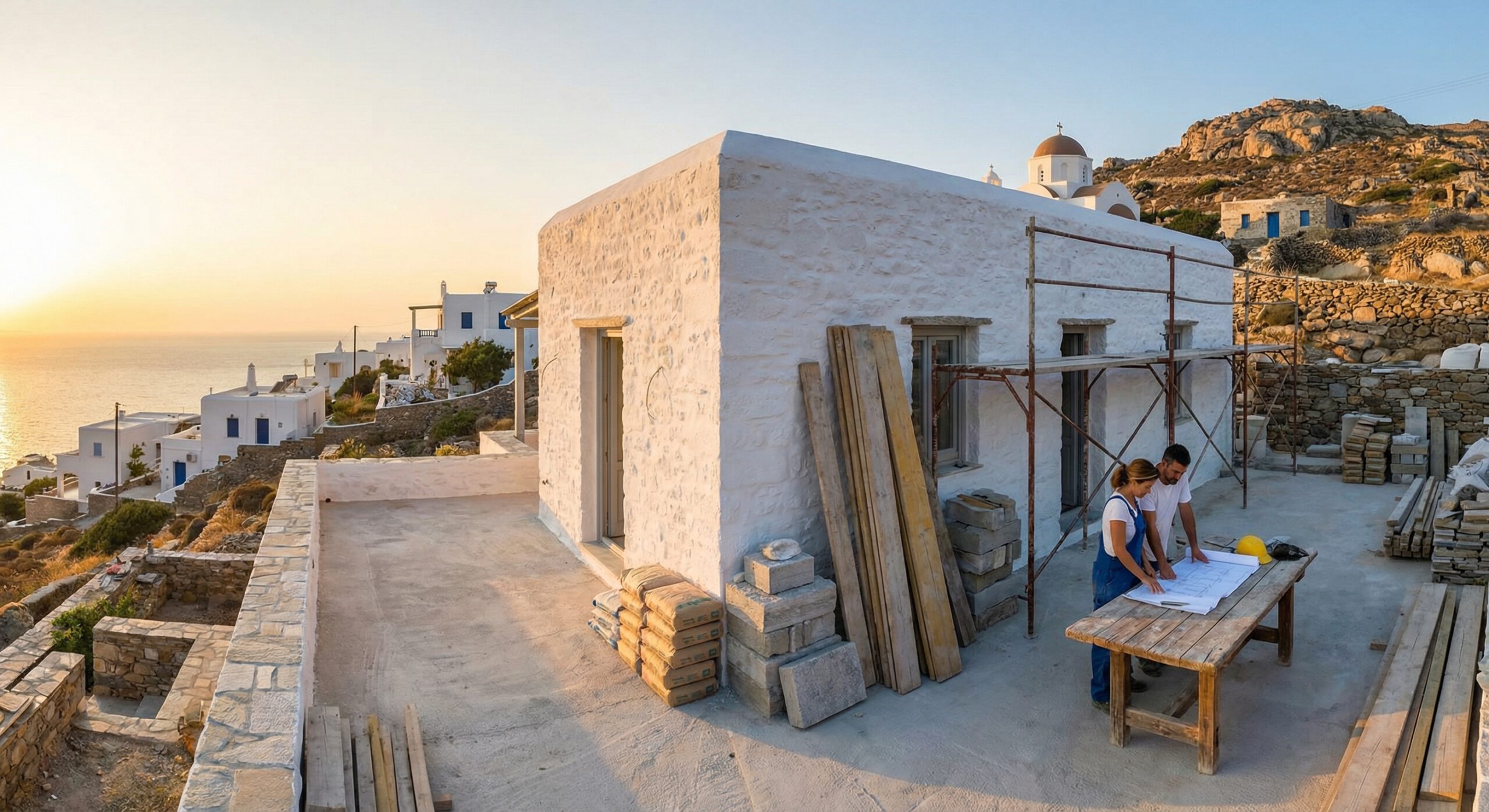
Renovating a property on a Greek island is the kind of project that people dream about for years before doing.
The landscape, the light, the architecture. There is nothing quite like it in Europe. It is also, if you go in without preparation, one of the most operationally complex renovation projects you will encounter. Supply chains are limited, contractors are scarce during the busy season, and regulatory frameworks on the islands can be even more specific than on the mainland. For the broader picture of what renovation in Greece involves, see our guide to renovating property in Greece as a foreign buyer.
This guide is for people who are serious about doing it well.
Traditional Cycladic Architecture: What You Are Working With
The Cycladic architectural tradition, the whitewashed walls, the cubic forms, the blue domes of Santorini and the warren of alleyways in Mykonos, is not just an aesthetic. It developed over centuries as a rational response to the island climate and the specific conditions of building on rocky, wind-exposed terrain with limited material resources.
The thick masonry walls of traditional Cycladic buildings provide genuine thermal mass. They absorb heat during the day and release it slowly at night, moderating the extreme temperature swings of an island summer. The small windows and deep-set openings limit solar heat gain during the hottest hours. The external whitewashing reflects solar radiation. The compact clustering of buildings reduces the exposed surface area of each individual structure.
These principles are not just historically interesting. They are still useful. A renovation that works with them will produce a more comfortable building than one that replaces them with generic European construction thinking. Our guide to climate-responsive architecture explains how these traditional strategies compare with Nordic approaches.
Beyond the Cyclades, different islands have different architectural traditions. The Venetian-influenced architecture of Corfu and the Ionian Islands. The Ottoman-influenced timber-framed buildings of Lesbos. The volcanic stone construction of Santorini’s cave houses (yposkafa). Each context requires design sensitivity to what makes the specific tradition coherent.
Regulatory Controls on Greek Islands: What Makes Them Different
Many Greek islands, particularly those in the Cyclades, apply specific architectural controls that go beyond standard national building regulations. These are typically administered through local planning regulations and in some cases through specific ministerial decrees protecting traditional settlement areas (paradosiakoi oikismoi).
On islands like Mykonos, Santorini, Folegandros, and others with declared traditional settlements, changes to the exterior of buildings within those settlements require approval from both YPDOM and from a Central Archaeological Council committee that evaluates the proposed works against the character of the protected area.
Materials, colors, window profiles, roof configurations. All of these are subject to review.
This process is more demanding than standard permit procedures. It requires an architect who understands the specific regulatory framework of the island in question and has experience navigating the particular approval bodies involved. It is also not a reason to avoid these properties. It is simply a reason to start the process early and allocate realistic timelines.
The Real Logistics of Island Renovation in Greece
This is where island renovation diverges most sharply from urban projects.
On the mainland or in a city like Athens or Madrid, materials arrive quickly, specialist contractors are accessible, and if something is wrong you can get a replacement part the same day. On an island, none of this is true.
Everything that goes into the building needs to be ordered, transported to the port, loaded onto a ferry or cargo ship, and brought to the construction site. This takes time and money. Fragile or bespoke items carry higher risk. Material costs on the islands are typically 20 to 40% higher than equivalent mainland costs for this reason.
Contractor availability is its own challenge. On popular islands, the summer season is completely unavailable for renovation. Contractors are occupied with hospitality and tourist-related work, costs are higher, and disruption to neighboring properties occupied by guests is unacceptable. Renovation seasons on Greek islands are effectively October to March or April. This means a project that would take 4 months in Madrid might require two consecutive winter seasons on a Greek island because of the seasonal constraint.
For clients who want the property operational for the rental season, planning the construction timeline backward from a target opening date is essential. The buffer should be generous. The most expensive renovation mistakes are almost always timeline and budget failures that compound in exactly this kind of constrained context.
Why Remote Project Management Is Especially Critical for Island Projects
The combination of distance from the property, limited local contractor availability, complex material logistics, and seasonal construction windows means that remote project management is both more common and more demanding for island projects than for urban ones.
The architect’s role in holding the construction process together is more critical in this context. A client in Stockholm or London relying on a local builder to self-manage an island renovation without strong architectural oversight is taking on significant risk. Our guide to working with an architect through the full project process explains what that oversight should look like at each stage.
The value of an architect who visits the site regularly, documents progress accurately, manages contractor relationships, and keeps the client genuinely informed is tangible and real on island projects.
For island projects, we recommend at least one client visit during construction at a key milestone, the point when structural work is complete but before finishes begin, to sign off on the spatial result before it is fixed.
The Investment Case for Greek Island Property
Greek island properties, particularly in the most sought-after Cycladic islands, have demonstrated strong price appreciation over time and strong short-term rental income potential during the high season.
A well-renovated villa or traditional house on Mykonos, Paros, Naxos, or Santorini, properly positioned and marketed, can generate meaningful income during the May to October season.
The renovation investment required to achieve this level of performance is real. A rustic stone house that needs full structural remediation, a new roof, complete systems installation, and a quality interior renovation is not a EUR 50,000 project. Depending on size and scope, budget EUR 200,000 to EUR 500,000 or more for a quality result on a typical Cycladic property.
The clearest path to a good outcome: thorough due diligence before purchase, a realistic pre-purchase cost assessment from an architect, and a construction budget with adequate contingency for the unexpected. The Golden Visa guide for Greece and Spain covers the investment case in the context of residency programs as well.
Planning a renovation on a Greek island or mainland Greece? Tell us about your property and goals using the form below and we will respond within 48 hours.