


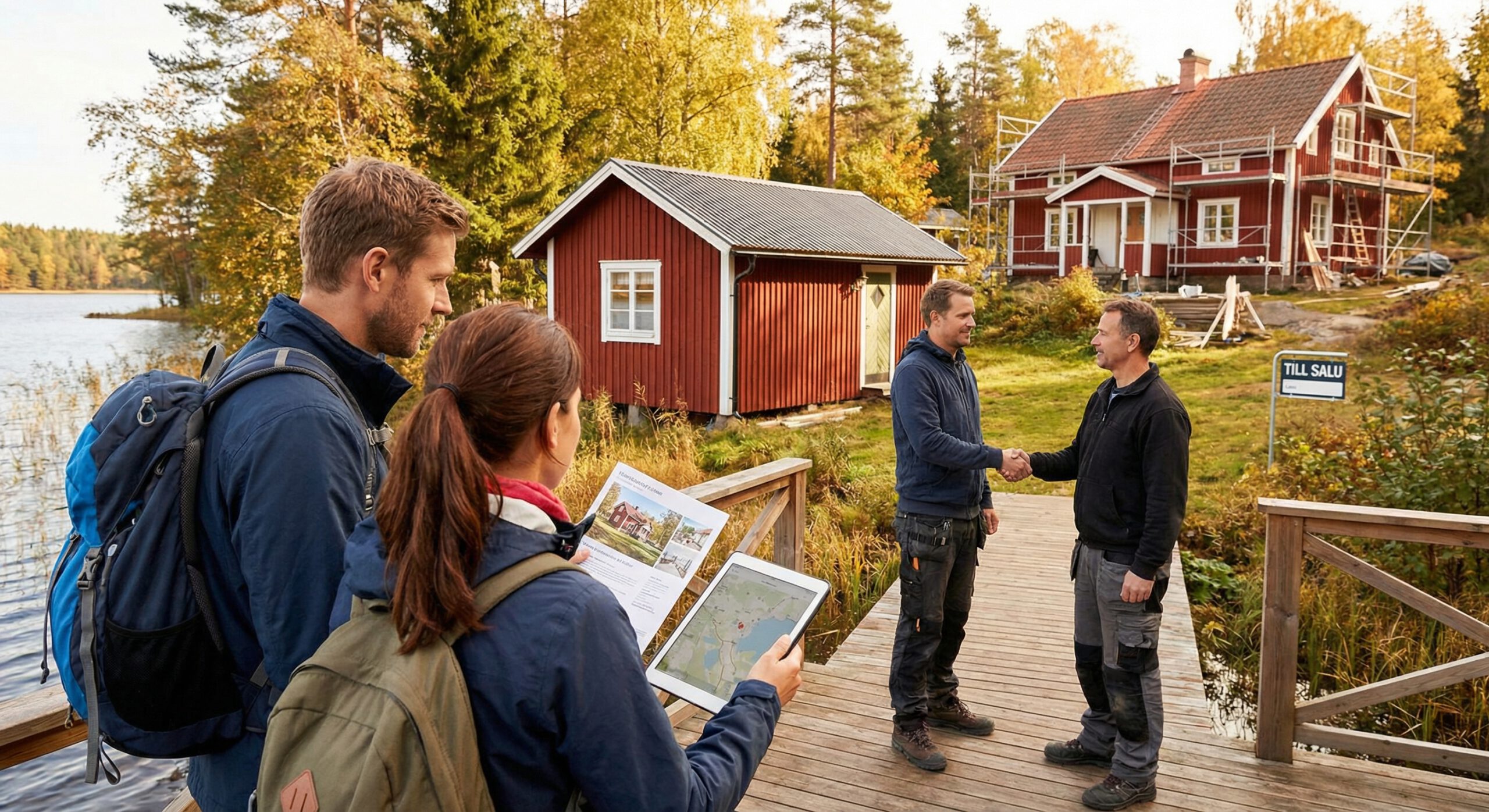
Sweden is not the most obvious destination for international property buyers.
It does not have Spain’s sun or Greece’s coastline, and it lacks the foreign buyer incentive programs that have driven markets like Portugal or Cyprus. But it draws a specific type of buyer: people relocating for work, Swedes returning from abroad, people with family connections, and a smaller number genuinely attracted to the Scandinavian lifestyle and quality of life.
For all of these buyers, understanding how Swedish property and renovation actually work is worth the time. If you’re also considering a move to Spain, see how the two housing cultures compare in our guide to moving to Spain from Sweden or Greece.
The Swedish Property Market: Key Characteristics for Foreign Buyers
Sweden does not restrict foreign nationals from buying property. EU and non-EU citizens alike can purchase residential real estate without special permits or minimum investment thresholds.
The Swedish property market is structured differently from most of southern Europe in one important respect. The dominant ownership form in Swedish cities is not freehold apartment ownership but bostadsratt, a system where you own a share in a cooperative (bostadsrattsforening, or BRF) that collectively owns the building. Your share entitles you to exclusive use of a specific apartment.
This is functionally similar to apartment ownership but with important differences. The cooperative carries collective obligations, may have shared loans, and has rules about what modifications you can make to your apartment. Understanding the BRF’s financial health and rules before buying matters significantly.
The alternative is aganderatt, straightforward freehold ownership, which applies to detached houses and some apartments. In rural areas and smaller towns, aganderatt detached houses are the typical property type for international buyers.
Swedish Architecture: What You Are Buying Into
Swedish residential architecture has several distinct layers depending on era and location.
The Million Programme (Miljonprogrammet) of the 1960s and 1970s built one million new homes in a decade. This housing is architecturally efficient but often poorly aged. These buildings represent renovation challenge at the individual apartment level for buyers who want central locations at accessible prices.
Older urban stock in Stockholm, Gothenburg, and Malmö includes substantial late 19th and early 20th-century buildings, Jugendstil (Art Nouveau), National Romantic, and Classical Revival styles that produce apartments with generous ceiling heights, original parquet floors, tiled stoves (kakelugnar), and the particular quality of proportioned rooms that this era produced. Renovation of these apartments is the Swedish equivalent of renovating a Madrid finca or an Athenian neoclassical building. For what that renovation process involves in Stockholm specifically, see our guide to renovating an apartment in Stockholm as an international buyer.
Swedish villas. The detached villa culture is strong in Sweden, particularly in suburban Stockholm and coastal archipelago areas. Traditional Swedish wooden houses have their own construction logic, renovation requirements, and heritage sensitivity.
Archipelago properties. Summer houses (sommarstugor) on the islands of Stockholm’s archipelago are deeply cultural. These range from modest wooden cabins to substantial year-round residences, and demand for well-appointed archipelago properties is consistently strong. How to design a home that performs well across both summer and winter seasons is covered in our guide to designing for summer and year-round living.
Swedish Building Permits and Renovation Regulations
Swedish building regulation is administered through the Plan and Building Act (Plan- och bygglagen, PBL) and overseen by municipal building committees (byggnadsnamnden). Sweden’s regulatory system is generally efficient by European standards.
For significant renovation work, structural changes, extensions, or changes to the building envelope, a building permit (bygglov) is required. The application goes to the municipal building committee and includes technical documentation prepared by a qualified architect.
For interior renovations that are not structural, a building permit is typically not required, though a notification (anmalan) may be required for certain works, particularly in wet rooms (bathrooms and laundry) where building standards for waterproofing are strictly regulated.
The Swedish Energy Performance Certificate (Energideklaration) is required for buildings at the point of sale, giving buyers clear information about the property’s energy performance before committing. What that performance standard looks like in detail is explained in our guide to energy-efficient homes in Sweden.
What Swedish Renovation Standards Actually Look Like
Swedish building standards, particularly for wet rooms, are among the strictest in Europe.
The requirements for waterproofing (tatskikt) in bathrooms and laundry rooms are highly regulated and must be executed by contractors with documented qualifications (behorighet). Renovation work that does not meet these standards creates insurance liability issues and problems at resale.
This matters for international buyers who might be tempted to cut corners on specification or use uncertified contractors. In Sweden’s transparent property market, where building inspection history and insurance claims are accessible to buyers, a poorly executed renovation with non-compliant wet room installation will surface at resale.
Swedish insulation standards are also demanding for the obvious climatic reason. Renovation that involves opening up walls or replacing windows should always take the opportunity to bring insulation and air sealing up to current standards. The energy and comfort return is significant in a Swedish winter. The climate-responsive architecture principles that apply across all three countries are directly relevant here.
The Swedish Construction Quality Expectation
Swedish clients and buyers have a high baseline expectation of construction quality. Precision in execution, material honesty, and functional performance are expected rather than aspirational.
This creates a renovation culture where the process is taken seriously and professional involvement is considered normal rather than a luxury for big projects. The design methodology that underpins this quality standard is explained in our piece on Scandinavian design principles and why they travel well.
The implication for international buyers renovating Swedish properties: cutting corners in specification or contractor selection is more likely to create problems in Sweden’s transparent, quality-conscious market than in markets where documentation and inspection are less thorough.
Planning to buy or renovate property in Sweden? Tell us about your project using the form below and we will respond within 48 hours.