


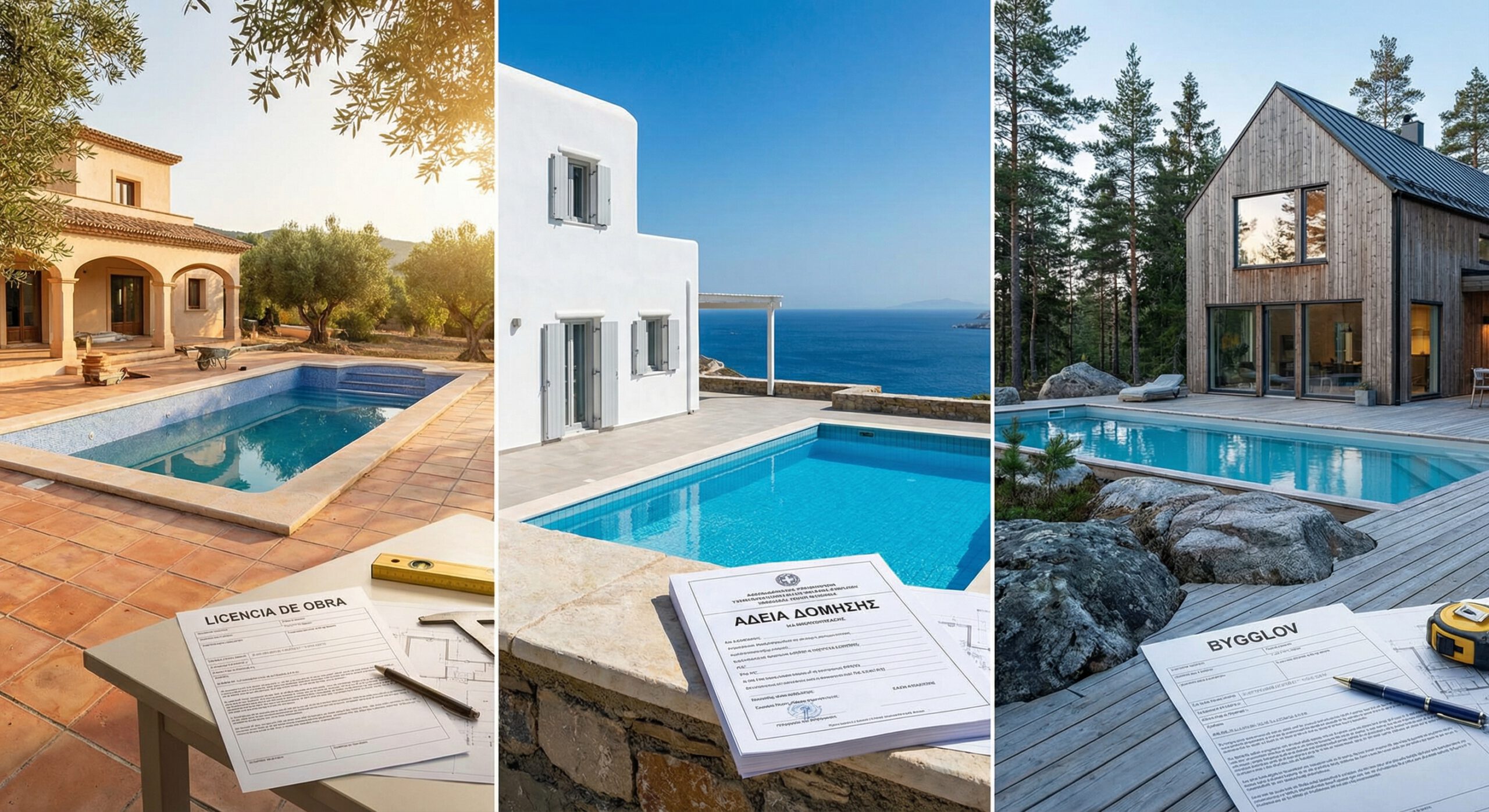
A pool is one of the most common requests in renovation and new build projects across all three of the countries Wolfblanc works in. It is also one of the features with the widest gap between what clients expect the process and cost to be, and what it actually turns out to be.
This guide covers the permit reality, the cost reality, and the design thinking that makes a pool a genuine asset rather than an expensive maintenance obligation. For costs in context, our guide to the true cost of building in Spain covers how pool costs fit into the overall project budget.
The Permit Process for Pools in Spain
In Spain, a swimming pool on a private residential plot requires a building permit (licencia de obras) in almost all municipalities. The specific permit type, Obra Mayor or Obra Menor, depends on the pool’s volume, the construction method, and whether it involves any other site works.
For most standard residential pools, the permit application requires: a technical project prepared and stamped by a licensed architect, plans showing the pool location and dimensions within the plot, structural and waterproofing calculations, drainage and water management documentation, and in many municipalities a certificate confirming that the pool water will be managed through an approved system.
Permit timelines for pools in Spain: typically 2 to 4 months for an Obra Menor-equivalent permit, 4 to 6 months for Obra Mayor applications. Some municipalities are faster. The full permit process is explained in our guide to Madrid building permits.
There are important planning constraints to check before designing:
Setback distances from the plot boundaries. Most Spanish municipalities require a minimum setback of 1.5 to 3 meters from plot boundaries for any permanent structure including a pool. Check the specific PGOU for your municipality.
Total coverage ratios. Spanish planning regulations typically specify the maximum percentage of a plot that can be covered by impermeable surfaces. A large pool plus surrounding terrace can bring a plot close to or over these limits.
Coastal and heritage area restrictions. Properties near the coast may be subject to Ley de Costas restrictions. Properties in protected heritage zones may have additional restrictions on earthworks and construction.
The Permit Process for Pools in Greece
In Greece, pools fall under the category of works requiring either a full Building Permit or a Small-Scale Works Approval, depending on the volume of the pool and whether any construction of pool-related structures (enclosures, mechanical rooms, terracing) is involved.
Greek planning regulations also impose setback distances from plot boundaries for pools, which vary by zone and municipality.
An additional complication in Greece that does not exist in Spain: in areas designated as traditional settlement zones (particularly on the islands), the visual impact of a pool on the character of the traditional settlement is a consideration that the permit process evaluates. Pools in certain Cycladic island locations require careful siting and design to be approved, and in some cases specific finishes (natural stone surround rather than white ceramic tile, for example) are conditions of approval. What island renovation involves overall is covered in our guide to Greek island property renovation.
The Permit Process for Pools in Sweden
Sweden is the outlier here. For Swedish detached houses, a below-ground pool typically requires a building permit (bygglov) because it involves excavation and permanent construction. Above-ground pools in smaller sizes may fall below the permit threshold in some municipalities.
The more significant consideration in Sweden is the heating question. An unheated pool in Sweden’s climate has a usable season of roughly 8 to 10 weeks at best. Most Swedish private pools are either heated (a meaningful operating cost) or covered with an enclosure (a meaningful capital cost). A well-designed Swedish pool considers the thermal strategy as part of the initial design, not as an afterthought when you discover in late August that the water is 18 degrees Celsius and nobody wants to go in. Designing for year-round use in Sweden’s climate is covered in our guide to designing homes for summer and year-round living.
The Real Cost of Building a Pool
Here are honest current figures for residential pool construction across the three countries (2025/2026):
Spain: A standard residential concrete pool of 8×4 meters, including excavation, structure, waterproofing, tiling, filtration and pump system, and a simple surrounding terrace: 25,000 to 50,000 euros depending on finish quality and site conditions. Adding a pool house, automated cover, or premium heating system adds to this substantially. Annual maintenance costs for a Spanish pool: 1,500 to 3,000 euros, including chemicals, equipment servicing, and opening/closing the pool seasonally.
Greece: Comparable construction costs to Spain, with island projects typically 20 to 40% higher due to material logistics. A well-finished pool on a Greek island including terrace and equipment room: 35,000 to 70,000 euros.
Sweden: Construction costs are higher, and the heating infrastructure adds significantly to the capital cost. A heated, covered pool for year-round use: 80,000 to 150,000 euros including the enclosure structure.
Design Thinking: Making a Pool Add Value Rather Than Complexity
The pools that add most value to properties are not necessarily the largest ones. They are the ones that are correctly proportioned for the plot, well-integrated with the indoor-outdoor relationship of the house, and easy to maintain.
Proportion and siting. A pool that takes up the entire garden leaves no usable outdoor space around it. The best-proportioned residential pools leave room for a planted area, shade structures, and outdoor dining that is not immediately adjacent to the pool edge. How to design usable outdoor space around a pool is covered in our guide to outdoor space design in Spain.
The indoor-outdoor connection. A pool that is visible and accessible from the main living area is more used and adds more perceived value than one tucked away at the end of a garden. The sight line from the kitchen or living room to the pool is a genuine quality-of-life and resale value consideration.
Materials and finish. Natural stone surrounds, dark-tiled pools that photograph dramatically, or simple white finishes all make different visual statements. The choice should be consistent with the architectural character of the house, not chosen in isolation.
Water management. In Spain and Greece, water is a resource that is increasingly managed carefully. A pool without a cover loses significant water to evaporation. An overflow pool without a recovery tank wastes water. These are design decisions with running cost implications.
Thinking about adding a pool to a property in Spain, Greece, or Sweden? Tell us about your project using the form below and we will respond within 48 hours.
 English