




Construction without permits in Spain is one of the most consistent ways that a manageable renovation turns into a serious and expensive problem.
Yet it happens regularly, either because property owners did not understand the requirement, because someone told them their work was below the permit threshold, or because they were trying to save time and money.
This guide explains how Madrid’s permit system actually works, what you need for different project types, how the process unfolds, and where the common pitfalls are. For a broader picture of the Madrid renovation process including costs and timelines, see our Madrid renovation guide 2026.
The Two Main Permit Categories for Renovation in Madrid
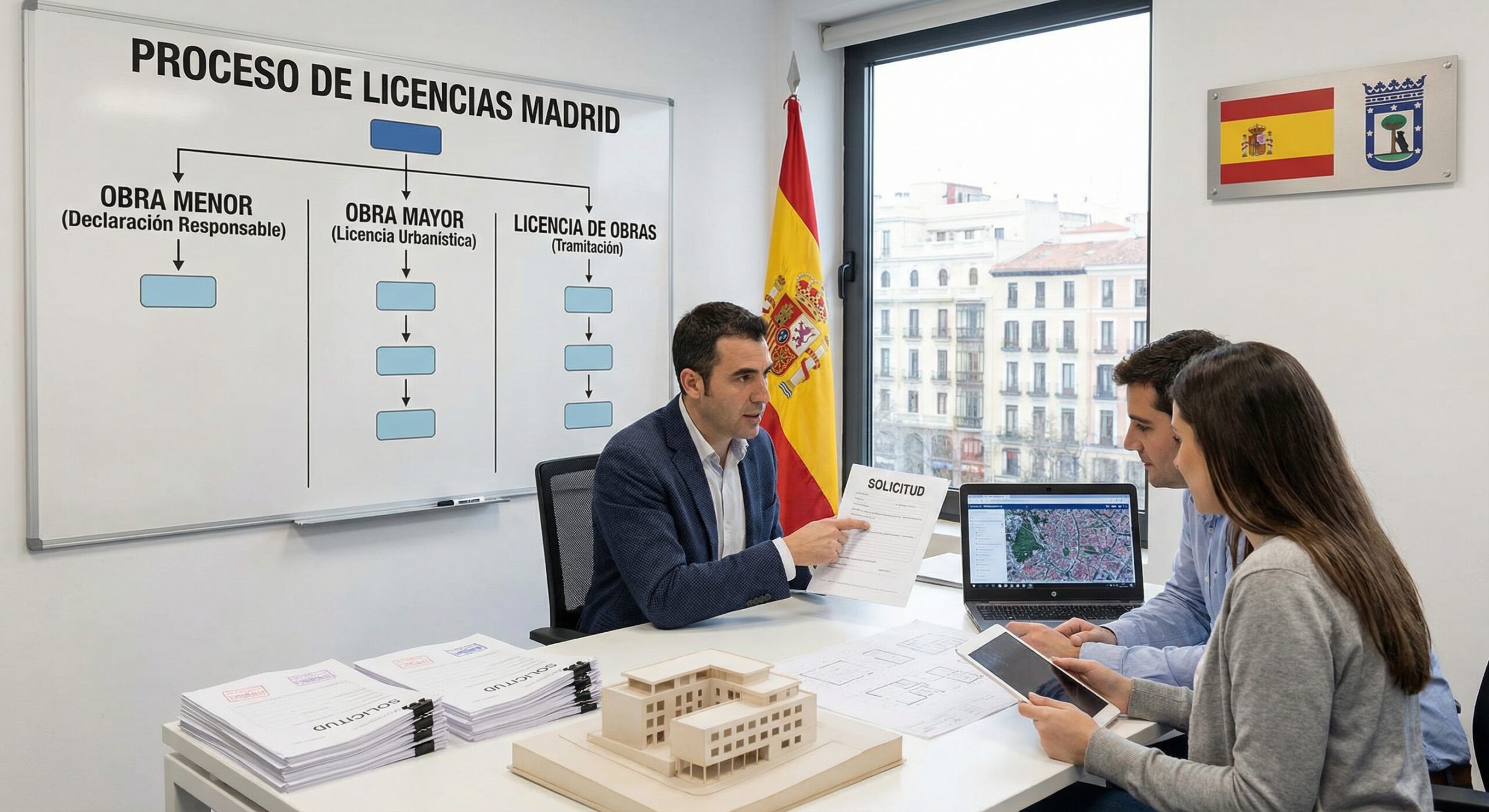
Madrid uses two primary permit categories for residential renovation and construction work, plus a simpler notification regime for minor works.
Licencia de Obra Mayor, or Major Works License, is required for any work that is structural, affects the exterior or common elements of a multi-unit building, exceeds a certain surface area threshold, involves a change of use, or affects protected heritage elements. This is the more complex permit. It requires a full technical project stamped by a licensed architect, and it goes through a full municipal review process. Approval timelines typically run 3 to 6 months, sometimes longer for complex or heritage-related applications.
Licencia de Obra Menor, or Minor Works License, covers interior non-structural renovations within a single residential unit where no structural changes are made, no facade work is involved, and the building is not subject to heritage protection. This includes bathroom and kitchen renovations, flooring replacement, non-structural partition modifications, and similar works. Requires architectural documentation but not a full technical project. Approval is typically faster, sometimes within a few weeks for straightforward applications.
Comunicación Previa, or Prior Notification, applies to very minor works below a defined threshold. Painting, simple fixture replacement, minor repairs. A prior notification to the Ayuntamiento is required rather than a formal license.
What Requires an Obra Mayor Permit in Madrid
The following works almost always require a Major Works License in Madrid:
Removal of any structural walls or columns. Structural modification including new openings or alterations to load-bearing elements. Changes to the building’s facade or exterior elements. Work on common elements of the building such as the roof, main staircase, or shared services. Change of use of a space. Any work in a heritage-protected building at Nivel 1 or 2. Construction of new structures within a property. Work exceeding a surface area threshold, currently 80 square meters in Madrid for standard residential interior work.
If your project involves any of these, assume you need an obra mayor and plan your timeline accordingly. Heritage buildings carry the most complex requirements — our guide to renovating a protected historic building in Madrid goes into the heritage-specific rules in detail.
What the Full Technical Project Must Include
For an obra mayor, Madrid’s Ayuntamiento requires a proyecto técnico that includes:
A descriptive memory explaining the project scope, existing building conditions, and how the proposed works comply with applicable regulations. Site plans showing the building’s location and relationship to neighboring structures. Floor plans, sections, and elevations showing existing and proposed conditions. Structural calculations for any structural modifications, typically prepared by a structural engineer. MEP documentation for any systems work. Energy efficiency justification showing compliance with the national building code (CTE). A safety and health plan for the construction phase. Photography of existing conditions.
For heritage buildings, an additional heritage justification document is required explaining how the proposed intervention respects the protected elements.
This is a substantial documentation package. Preparing it properly takes typically 4 to 8 weeks for a complete residential renovation project. This is one of the phases where BIM-based project documentation significantly speeds up the process by generating accurate drawings and calculations from a single coordinated model.
How Long the Madrid Permit Process Actually Takes
The honest answer is that it varies, and anyone who gives you a precise guarantee is not being straight with you.
Obra menor licenses in Madrid can move in 2 to 6 weeks for simple, well-documented applications. Obra mayor licenses typically take 3 to 6 months. For projects with heritage involvement, 6 to 9 months is a realistic expectation, and complex cases can take longer.
The most important factor in timeline, beyond the inherent complexity of the project, is the quality of the initial documentation. Applications that are complete, clearly organized, and anticipate the technical questions reviewers will ask progress faster than those that arrive with gaps or ambiguities. This is where experienced local architects add concrete value because they know what Madrid’s technical services look for.
Building community approval, if required for your project type, is the second important factor. Getting the comunidad to schedule a meeting, achieve quorum, vote, and provide formal documentation can add weeks to the pre-application process. Start this process early. The rules of your comunidad are set by the Spanish horizontal property law — worth understanding before you begin any renovation that involves common elements.
The Most Common and Expensive Permit Mistakes in Madrid
Starting work before the permit is granted. This is the most common and most serious mistake. Work done without a valid permit can be subject to a work stoppage order (paralización), fines, and in serious cases mandatory demolition and restoration to the prior condition. Even if your application is in process, works cannot legally start until the license is issued.
Underestimating the project scope. Projects that begin as an obra menor and then scope-creep into structural territory require upgrading to an obra mayor mid-project, which pauses construction and adds significant cost and time.
Not checking building community requirements. Even for interior works that clearly only require an obra menor, many building communities have their own internal regulations about notification, working hours, and protection of common areas. Ignoring these creates neighbor conflicts that can become genuinely disruptive.
Heritage building surprises. Discovering mid-project that an element you planned to remove is protected is expensive. The solution is thorough pre-application research and ideally preliminary consultation with the relevant bodies before finalizing the design. Our guide to working with an architect in Spain explains how this pre-design research phase should work.
Have a project in Madrid and not sure which permit route applies or how to navigate the process? Wolfblanc manages the complete permit process as part of our project service. Tell us about your project using the form below and we will respond within 48 hours.