


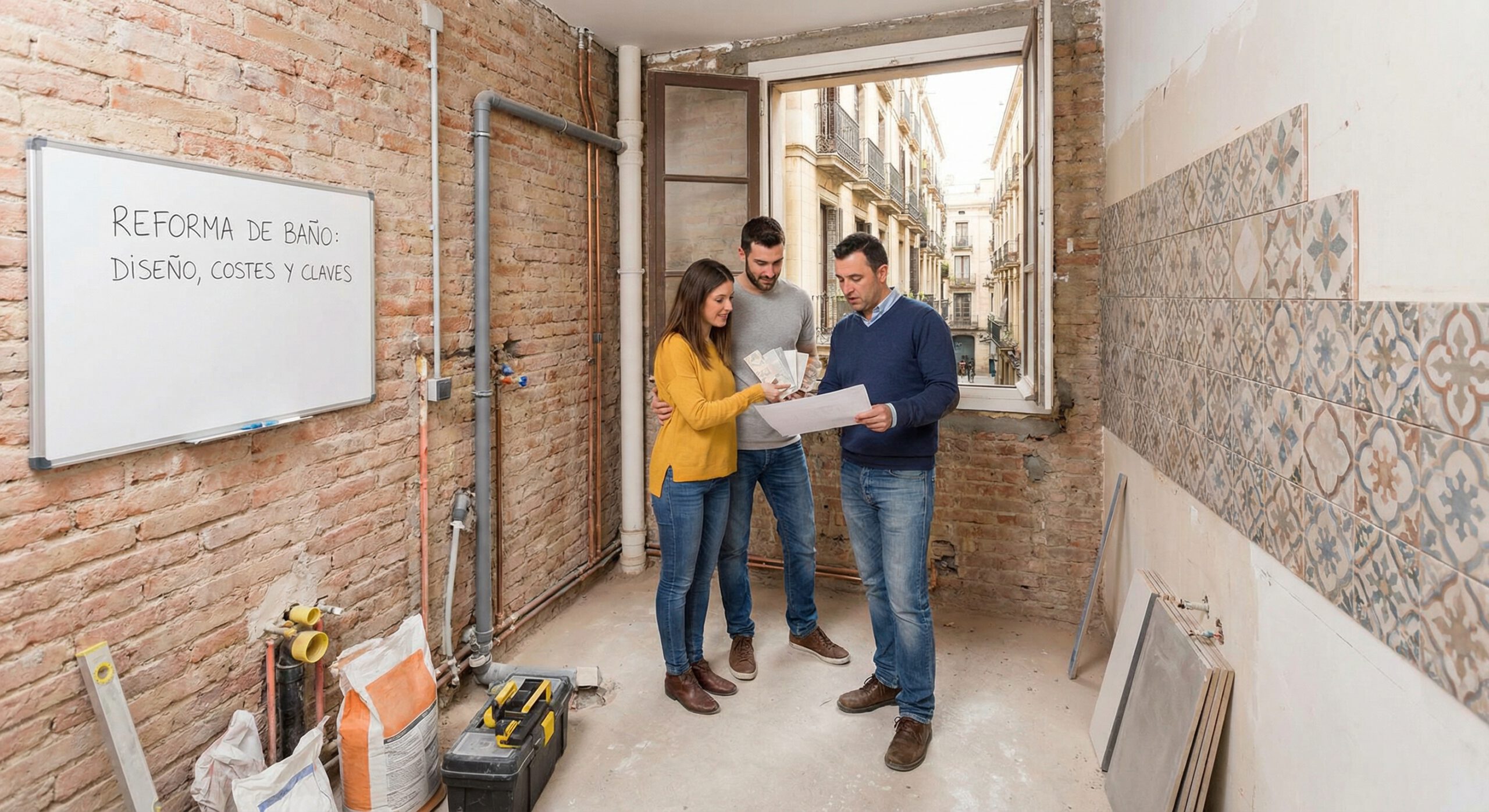
The bathroom is consistently among the highest-return renovation investments in Spanish residential property. A dated, poorly functioning bathroom is one of the first things buyers and renters discount. A beautifully designed, well-functioning bathroom is one of the first things that makes a property stand out. How design decisions affect property value more broadly is covered in our guide to Madrid real estate investment and architecture.
It is also a space where getting the technical details wrong, particularly waterproofing, creates expensive problems that are invisible until they are serious.
What Bathroom Renovation in Spain Involves
A full bathroom renovation in Spain involves: demolition of existing fixtures, tiles, and typically the screed floor; new waterproofing of all wet surfaces; new plumbing where existing layout changes; new electrical works (lighting, shaver socket, heated towel rail); new tiles to walls and floor; new sanitaryware (toilet, basin, bath or shower); and new joinery (mirror cabinet, vanity unit or furniture if specified).
Even in apartments where the bathroom layout does not change, a full bathroom renovation involves all of these elements because the existing waterproofing has typically reached end of life in any bathroom that is more than 15 to 20 years old.
The permit situation: a bathroom renovation within the existing bathroom footprint with no structural changes typically qualifies for a comunicación previa or Obra Menor in most Spanish municipalities. Changes that affect the building’s shared drainage, significant structural changes, or works in heritage buildings escalate to Obra Mayor. See our full guide to building permits in Madrid for a detailed breakdown of the permit categories.
The Waterproofing Conversation
Waterproofing is the most technically important part of bathroom renovation and the most commonly underspecified.
The standard in Spain requires tanking (a continuous waterproof membrane) on all surfaces in the shower area and bath area up to a minimum height of 2 meters, and across the entire floor of the bathroom with turned-up edges. The membrane needs to be continuous with no breaks or inadequately overlapped joints.
In Swedish practice, this is strictly regulated and must be done by certified contractors. In Spain, the regulation exists but verification is less consistent. The practical consequence is that improperly waterproofed bathrooms are not uncommon in Spanish renovation work, and the damage from moisture penetration into floor and wall structures typically does not become visible until 5 to 10 years after installation.
When commissioning bathroom renovation, require written confirmation of the waterproofing specification and the contractor’s process for verifying it before tiling over. A site visit by the architect before tiling begins is the practical check. Our guide on finding and managing a contractor in Spain explains how to structure these expectations from the start.
Layout Decisions That Matter
The bathroom layout determines comfort independently of the quality of the fittings.
The shower area: a shower that is large enough to turn around in without touching the walls, with a head positioned so that water does not spray directly at the entrance, and with a seating option (built-in shower bench or a small stool), is significantly more comfortable than a compact shower cube. The minimum useful shower enclosure is 90x90cm. 120x80cm is significantly better. A walk-in shower with a wet-room floor and no door is the most comfortable and the easiest to keep clean.
The toilet position: the toilet should have wall space on at least one side to allow future installation of a grab rail. 40 to 50cm of clearance at the side is the accessible standard. For homes designed to age well, see our guide to designing a home for long-term accessibility.
The basin: a countertop basin on a vanity unit with storage below is the most functional combination for a bathroom that needs to serve daily use. Freestanding basins and wall-hung basins with exposed plumbing are visually strong but offer no storage.
What Bathroom Renovation Costs in Spain
Honest 2025/2026 figures for Madrid and major Spanish cities:
Basic renovation (same layout, standard fixtures, standard tiles): 4,000 to 8,000 euros.
Mid-range full renovation (good quality tiles, quality sanitaryware, frameless glass shower): 8,000 to 16,000 euros.
High-quality renovation (premium tiles, bespoke furniture, premium sanitaryware, heated floor): 16,000 to 30,000 euros.
Premium with bespoke stone, designer fixtures, and full architectural specification: 30,000 euros and above.
The main cost drivers: the tile choice (large-format and natural stone tiles are significantly more expensive to supply and install than standard ceramic), the quality of the sanitaryware (Duravit, Villeroy & Boch versus standard brand), heated flooring (typically adds 1,500 to 3,000 euros to a bathroom project), frameless glass shower enclosures (significantly more expensive than framed alternatives), and custom furniture versus standard off-the-shelf vanity units.
Planning a bathroom renovation in Spain and want an architect’s perspective on the design and specification? Tell us about your project using the form below and we will respond within 48 hours.