





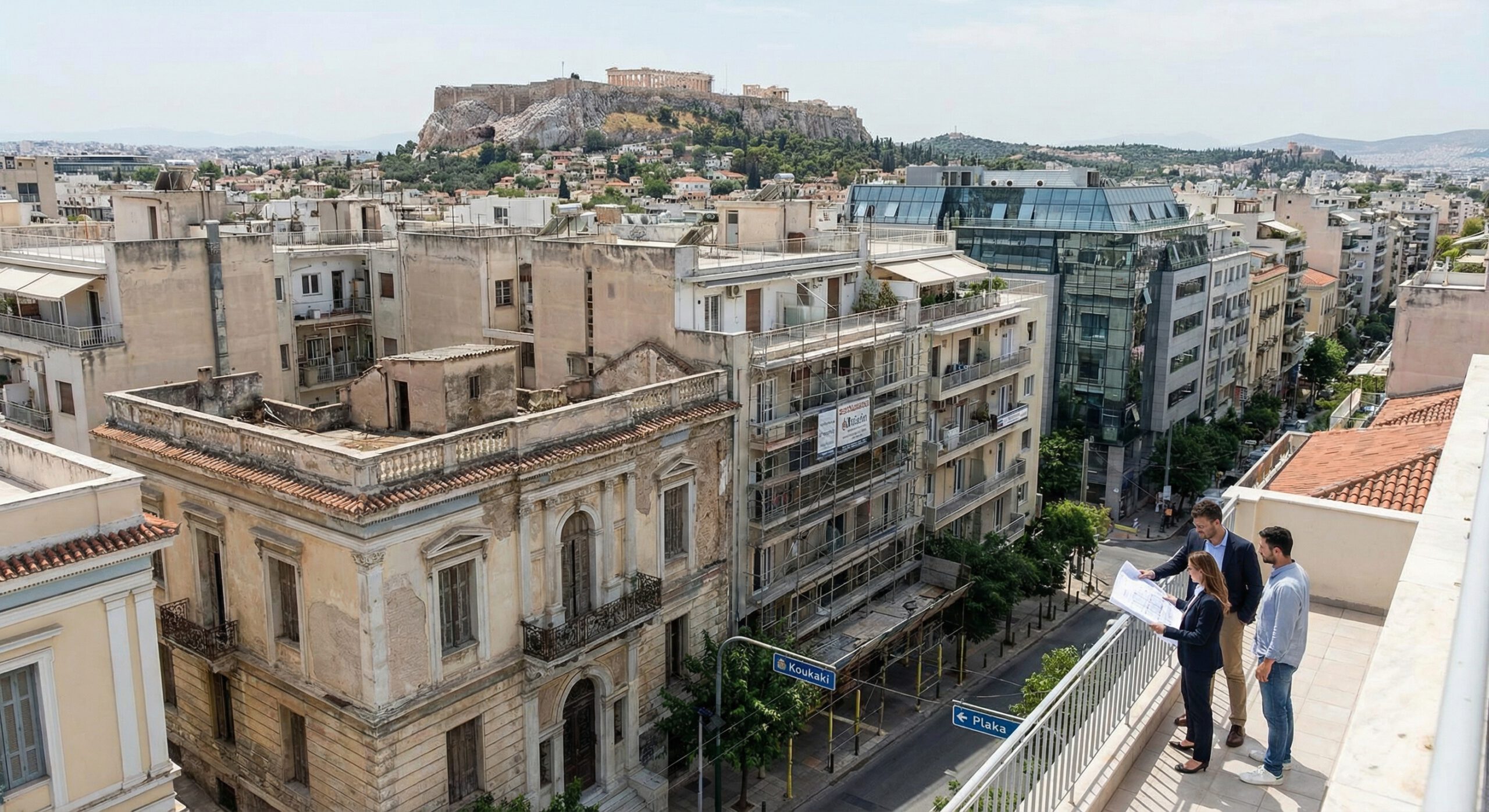
Athens does not have the obvious architectural consistency of Barcelona or Madrid.
It is, in many ways, a chaotic city from a planning perspective. Centuries of history layered under a post-war building boom that left its mark on every neighborhood. But for the person who looks past the surface chaos, Athens contains remarkable residential renovation opportunities and some genuinely interesting building stock.
This is a guide to understanding the city from an architectural and renovation perspective. For the practical side of the renovation process itself, see our guide to renovating property in Greece as a foreign buyer.
The Polykatoikia: Athens’ Defining Residential Building Type
The overwhelming majority of Athens’ residential stock is made up of polykatoikia, multi-story apartment buildings constructed primarily between the 1950s and 1980s.
This building type emerged from a specific legal and economic mechanism called antiparochi, through which landowners exchanged their land with developers in return for apartments in the resulting building rather than cash. It was efficient, relatively egalitarian by the standards of the time, and it built a city very quickly.
The polykatoikia is underappreciated as a building type. At its best, well-proportioned floor plans, solid reinforced concrete construction, generous balconies, and often excellent natural light from multiple orientations, it provides a very good base for renovation.
Athens apartments of this era often have floor areas that would be considered generous by Madrid or Stockholm standards, ceiling heights that leave room for creative intervention, and structural systems robust enough to accommodate significant interior reconfiguration.
The challenges: energy performance is almost universally poor, single-glazed windows, no insulation, and inefficient heating systems are the norm. Internal finishes in unrenovated apartments are dated at best. Bathrooms and kitchens that have not been touched since the 1970s are common.
These are renovation challenges, not dealbreakers. The gap between unrenovated and well-renovated in Athens is significant, which creates real opportunity. How design decisions drive rental yield and resale value applies equally in Athens as in Madrid.
Athens Neighborhoods Worth Knowing for Renovation Investment
Kolonaki is Athens’ most established affluent residential neighborhood, centered around Kolonaki Square and climbing toward Lycabettus Hill. Properties here are among the city’s most expensive, and the renovation market is mature. Strong demand from professional residents and international buyers.
Koukaki and Mets, adjacent neighborhoods south of the Acropolis, have seen significant gentrification in the past decade driven partly by tourism and partly by a younger professional resident base. Pre-war neoclassical buildings sit alongside mid-century polykatoikia. Prices have risen but remain below Kolonaki. Strong short-term rental performance for quality renovated properties.
Pangrati is a residential neighborhood east of Mets with genuine neighborhood character. A good mix of older and mid-century construction, a local commercial street, and a feeling of living in a neighborhood rather than a tourist zone. Less visible on the international buyer radar than Koukaki, which means prices are still reasonable.
Exarcheia has a complex reputation but is a genuinely interesting neighborhood. A hub of alternative culture, booksellers, and bars. Property prices are among the most accessible in central Athens. The renovation opportunity is clear. If residency programs factored into your purchase decision, see our guide to the Golden Visa in Greece and Spain.
Kifisia and Psychiko are northern Athens suburbs with a different residential profile: detached villas and low-rise apartment buildings in leafy, relatively affluent surroundings. Less suited to short-term rental and more relevant for buyers seeking a genuine family residence or long-term investment property.
Pre-War Neoclassical Buildings in Athens: The Heritage Renovation Market
Athens has a layer of pre-war construction that predates the polykatoikia era, typically neoclassical or eclectic buildings from the late 19th and early 20th centuries. These are rarer and more expensive when they exist, but they offer what the polykatoikia cannot: architectural character derived from an era when buildings were designed with individual attention.
Many of these buildings have heritage protection status, which means renovation follows rules broadly similar to those in Madrid’s historic districts: exterior preservation, limitations on structural modification, and careful consideration of original elements. Madrid’s equivalent is covered in our guide to renovating protected historic buildings in Madrid.
When well-renovated, pre-war Athenian buildings are among the most compelling residential properties in Southern Europe.
The Athens Short-Term Rental Market and What It Means for Design
Athens has experienced significant growth in short-term rental activity, primarily through Airbnb. The market is strong in central neighborhoods close to the Acropolis, the Monastiraki-Psirri area, and parts of Koukaki and Mets.
For buyers considering Athens as a rental investment, specific design decisions matter. Properties that perform best in the Athenian short-term rental market have views (of the Acropolis where possible, of the city otherwise), outdoor space that is genuinely usable, and a renovation quality that photographs well and holds up to continuous occupancy. Our guide to designing homes around light is directly relevant to what makes a property photograph well and feel spacious.
Acoustic considerations are more important in Athens than buyers sometimes expect. The city is noisy, and guests who cannot sleep because of street noise will say so in reviews. Good secondary glazing on street-facing elevations is a practical investment for any serious rental property in central Athens.
Renovation Costs in Athens: What to Budget
Athens renovation costs are generally lower than Madrid or the major northern European capitals, but not as dramatically lower as some buyers assume. Quality materials and quality contractors are not cheap anywhere, and the cost of good craftsmanship has risen in Athens as renovation activity has increased.
Rough ranges for Athens in the current market: light refresh including paint, floors, and fixtures, EUR 250 to EUR 400 per square meter. Standard renovation covering kitchen, bathrooms, flooring, and systems, EUR 600 to EUR 1,000 per square meter. Complete high-quality transformation with layout changes, all systems, and premium finishes, EUR 1,000 to EUR 1,600 per square meter.
Professional fees including architecture, engineering, and permits typically run 8 to 12% of construction cost. The most common renovation mistakes that end up costing the most are just as relevant in Athens as anywhere else.
Considering a property in Athens or planning a renovation there? Tell us about your project using the form below and we will respond within 48 hours.