






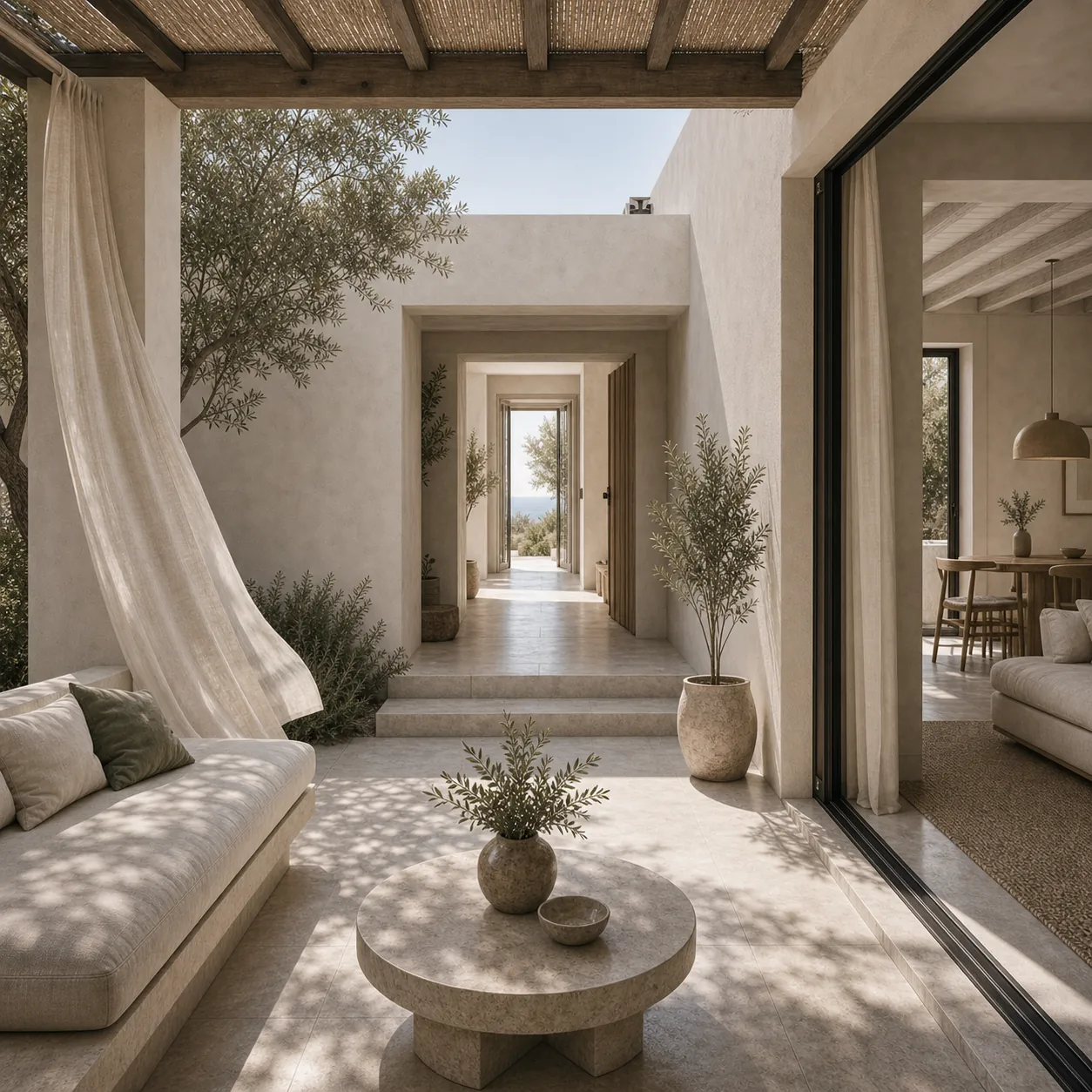
Architecture that responds intelligently to its climate is not a modern invention. This cross-country knowledge is central to how Wolfblanc works across Spain, Sweden, and Greece — each office draws on the traditions of its context.
Traditional buildings in every region accumulated, over centuries, detailed responses to local conditions: the orientation, the wall thickness, the roof form, the window placement. These were the product of generations of trial and refined practical knowledge.
Before mechanical heating and cooling made it possible to build anywhere and impose any climate regardless of what was happening outside, architecture had to earn its comfort through design.
The interesting thing about working across Mediterranean and Nordic contexts is how different the problems are, and yet how much the design thinking required to solve them has in common.
How Traditional Spanish and Greek Architecture Managed the Mediterranean Climate
In Madrid and Athens, the primary summer challenge is excess. Excess solar radiation, up to 6 hours of intense direct sun hitting south and west facades during peak summer. Excess heat, urban temperatures that regularly exceed 38 degrees Celsius in August. Excess brightness, glare that makes unshaded south-facing rooms uncomfortable.
Traditional Spanish and Greek architecture addressed this through a coherent set of strategies that are as relevant now as they were centuries ago.
Thermal mass. The thick masonry walls common in both Spanish and Greek traditional construction absorb heat slowly during the hot day and release it slowly at night. The interior of a well-built traditional house stays significantly cooler than the outside air during peak afternoon heat, without any mechanical cooling. The thermal mass of 50cm of stone or brick wall moderates temperature swings that a lightweight partition cannot.
Shading. Traditional Mediterranean architecture uses deep overhangs, covered loggias, narrow alleyways between buildings, and interior courtyards to shade surfaces from direct solar radiation during the hottest part of the day while allowing lower-angle winter sun to penetrate. See how this applies practically in our guide to outdoor space design in Spain.
Natural ventilation. The traditional Mediterranean courtyard (patio in Spanish, αυλή in Greek) was not primarily ornamental. It was a ventilation device. Hot air rising from the heated courtyard created a negative pressure that drew cooler air through the building.
Orientation. Traditional Mediterranean buildings strongly preferred south and southeast orientations for principal rooms, avoiding west-facing windows and shielding north elevations from cold winter winds.
These strategies remain effective and are being rediscovered in contemporary sustainable architecture under terms like bioclimatic design and passive solar design. Our guide to sustainable renovation in Madrid covers how to apply these principles to existing buildings.
How Traditional Swedish Architecture Managed the Nordic Climate
Sweden’s climate is the opposite problem. Winter sunlight is scarce. In Stockholm, the sun rises after 8:30am and sets before 3:30pm in December. Winter temperatures stay below freezing for months.
Traditional Swedish building responses to this included: heavy timber frame construction with good insulating value, steep roofs that shed snow, small windows sized to limit heat loss rather than maximise solar gain, and strategic use of the available south facade for principal rooms.
Modern Swedish building science has taken these principles and amplified them with precision. Highly insulated envelopes with carefully calculated U-values. Triple-glazed windows optimised for solar heat gain coefficient as well as thermal insulation. Thermal bridge-free construction details that eliminate the cold pathways through the envelope that traditional construction left. Mechanical ventilation with heat recovery that maintains indoor air quality without the energy loss of simply opening windows. The full picture is in our guide to energy-efficient homes in Sweden and the Nordic building standard.
The result is buildings that are genuinely comfortable through a Swedish winter at very low energy cost, not because of heroic heating systems, but because the building is designed to hold onto the heat it has.
What Each Architectural Tradition Can Offer the Other
From Sweden to the Mediterranean: The envelope-first approach.
Mediterranean renovation practice often focuses on heating and cooling system upgrades while leaving the building envelope essentially unchanged. Swedish practice starts from the envelope: insulate first, make it tight, then right-size the systems. Applied to a Madrid or Athens apartment, this approach produces better comfort outcomes with lower operating costs.
The discipline of measurability is also valuable. Swedish practice of modelling energy performance, calculating thermal bridge contributions, and verifying airtightness through testing produces results that can be predicted before construction. Mediterranean practice often relies on experience and intuition, which produces good results in familiar conditions but can miss important factors in unusual projects. This is also why BIM-based design and coordination matters particularly for cross-border projects.
From the Mediterranean to Sweden: The outdoor space philosophy.
Swedish architecture has historically been somewhat reluctant about outdoor space. The climate is the obvious explanation. But climate change is extending Sweden’s outdoor season, and the Mediterranean tradition of designing outdoor spaces as genuine rooms, with shade, seating, cooking capability, and a natural indoor-outdoor relationship, is influencing how Swedish architects think about terraces, balconies, and gardens.
The material warmth and character of Mediterranean construction also offers a counter to Swedish minimalism when it becomes too austere. The use of terracotta, natural stone, textured plaster, and traditional ceramic is a material vocabulary that brings warmth and place-specificity to interiors in a way that clean white walls and pale wood sometimes cannot. How these two design traditions combine is explored in our piece on Scandinavian design principles applied to homes in Spain and Greece.
From Greece specifically: Historical depth.
Greek architectural culture brings an awareness that buildings exist in layers of time, that a site carries history even when the current building does not. This encourages a more nuanced approach to renovation than treating every project as a blank slate. This is valuable in Madrid, where 19th-century buildings carry stories worth listening to, and in Swedish cities, where older urban fabric deserves more respect than pure functionalism offers.
Designing for a Changing Climate Across All Three Countries
All three countries are experiencing the effects of climate change in ways that matter to residential architecture.
Spain and Greece face increasing heat stress, longer drought periods, and more intense summer conditions that make buildings designed for historical climate averages progressively less comfortable. Sweden faces milder but wetter winters, more variable weather patterns, and summer heat events that its building stock was not designed for.
The design response to climate change is fundamentally conservative in the architectural sense: build well, design for thermal performance, avoid dependence on mechanical systems that require energy to run, design for passive cooling and ventilation, and use the accumulated wisdom of traditional climate-responsive design rather than assuming that modern technology alone can solve what physics is creating. How this plays out for homes used across seasons is detailed in our guide to designing homes for both summer and year-round living.
Interested in climate-responsive design for a project in Spain, Greece, or Sweden? Tell us about your project using the form below and we will respond within 48 hours.