






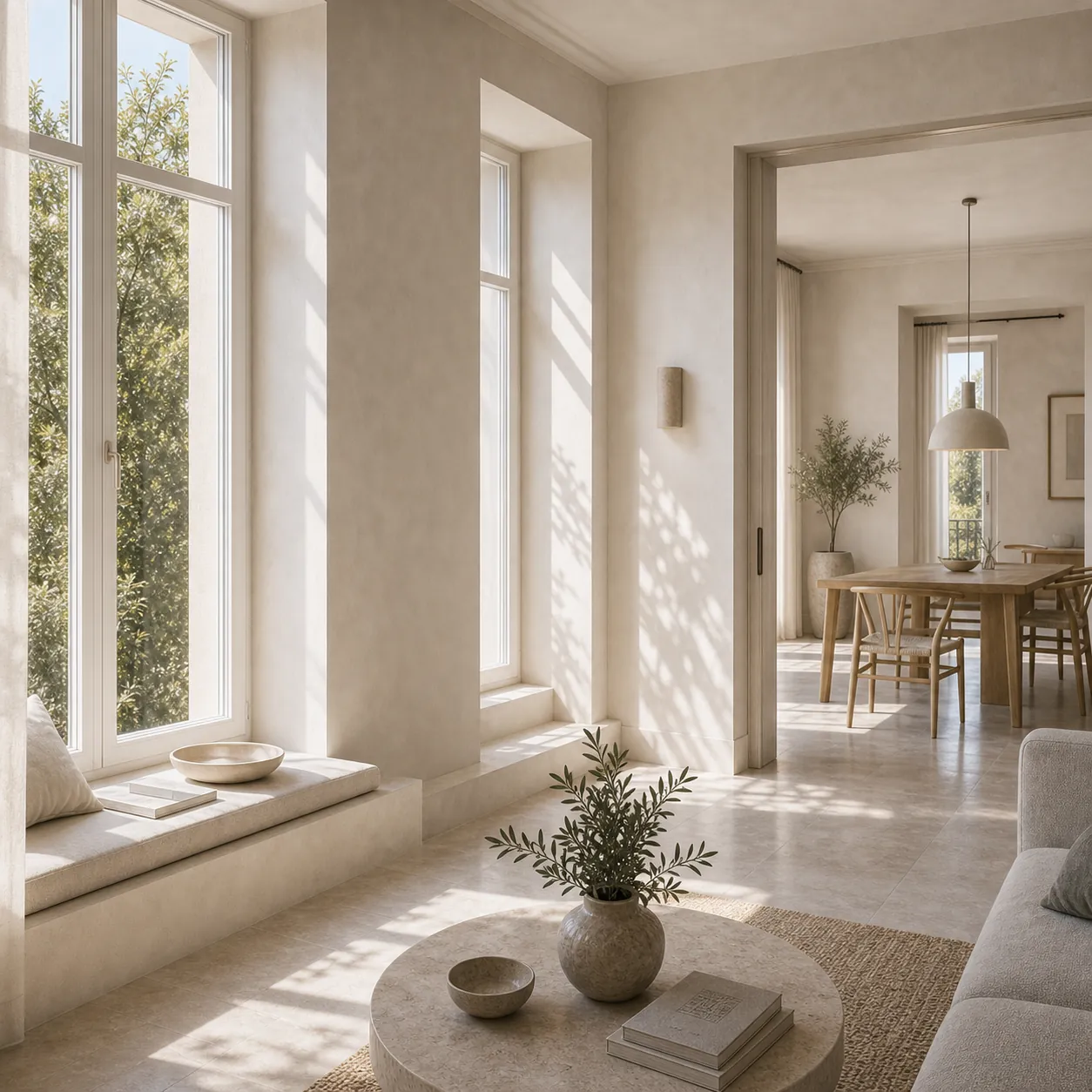
Ask people what they most want in a home and light comes up almost every time. Bright. Open. Natural. These are not abstract preferences. They reflect a genuine physiological response to the built environment. Light is not decorative. It is functional. How light affects health and mood is explored in depth in our guide to wellbeing by design.
The good news is that light is one of the most designable things in architecture. It responds to decisions that can be made deliberately, and the gap between a dark, heavy home and a light-filled one is often smaller than people assume.
The Four Sources of Light in a Home
Understanding where light comes from in a space is the starting point for designing it well.
Direct sun is the most powerful source. It moves through the space during the day, creating dynamic shadows and changing the character of a room throughout the day. Too much of it, particularly on south and west facades in Mediterranean climates, creates glare and heat gain. Well-managed, it is one of the most pleasurable qualities a room can have.
Sky light is the diffuse light from the sky itself, excluding the direct sun disk. It is what fills a room with daylight even when the sun is not directly shining in. North-facing windows provide consistent, glare-free sky light throughout the day. This is why north-facing rooms are often more evenly lit than south-facing ones even though they receive no direct sun.
Reflected light is what bounces from external surfaces, neighbouring buildings, paved areas, light-coloured walls, into the interior of a space. This is often underestimated. A light-coloured external courtyard wall that reflects morning sun into an east-facing kitchen can transform a previously dark space.
Artificial light supplements all of the above but works best when it responds to the natural light conditions of the space rather than replacing them uniformly. A well-designed artificial lighting scheme layers ambient, task, and accent sources in a way that extends the quality of natural light after dark rather than creating a flat, institutional substitute.
The Design Moves That Actually Bring More Light In
Rethink the internal partitions. The single most effective intervention in most existing apartments and houses is removing or modifying the walls that block light from travelling through the building. In a typical Madrid apartment, the kitchen and back bedrooms are dark because the corridor and partition walls prevent daylight from the street-facing rooms from reaching them. Glass internal partitions, glass in doors, or simply opening up the corridor allow light to travel. The spatial result is often transformative. Whether to open the plan fully is covered in our guide to open-plan renovation in Madrid apartments.
Use the full height of the room. Bookcases and storage walls that stop at 2.1 meters in a room with 3-meter ceilings leave a dark zone above them and feel heavy. Storage elements that run floor to ceiling, with open or glass-fronted upper sections above 2.1 meters, maintain the sense of height and allow light to move across the ceiling plane rather than being blocked by horizontal surfaces.
Reflective surfaces are not a design trend. High-gloss paint on a ceiling reflects light downward. A glossy or highly polished floor reflects light upward. Together, they double the perceived light level in a room. This is physics, not aesthetics. The choice between a matte floor finish and a polished one has a measurable effect on how bright the room feels, particularly in spaces that receive limited direct daylight.
Mirrors placed strategically, not decoratively. A large mirror on a wall that faces or is at 90 degrees to a window reflects the light source and the view, making the space feel larger and brighter. A mirror on a wall that does not face a light source reflects the dark side of the room and makes it feel smaller. The placement of mirrors for light is completely different from their placement for reflection.
Skylights and roof lights where the structure allows. In a top-floor apartment or a house, a roof light brings in direct sky light to rooms that no window placement can serve. It is the highest quality source of daylight: overhead, consistent, glare-free (if diffused), and invariant of the surrounding built environment. The addition of a single roof light to a dark kitchen or bathroom is often the single highest-impact intervention for improving natural light in a difficult space. Madrid building permit requirements for skylights are covered in our guide to Madrid building permits explained.
Managing Light Rather Than Just Maximising It
In Mediterranean climates, more light is not always the goal. The goal is better light: light that is comfortable, appropriately directed, and not excessive or uncontrolled in summer. This is a central theme in our guide to climate-responsive architecture across Spain, Greece, and Sweden.
Overhangs sized to the latitude block summer sun while allowing lower-angle winter sun to penetrate. External louvres or brise-soleil allow light to enter while breaking up direct sun into a softer, more distributed quality. Translucent rather than transparent glazing in south-facing positions diffuses light, eliminating glare while maintaining brightness.
Light from multiple directions in a single room always feels better than light from one direction only. A room with windows on two walls, even if both are small, feels more alive than a room with one large window. This is because light from two directions reduces the shadow contrast and illuminates the space more evenly.
Artificial Lighting That Extends Natural Light Quality
The mistake in artificial lighting design is treating it as a separate system from the natural light design of the space. It is the same system, extending into the hours when daylight is not available.
A room designed around diffuse natural light needs artificial lighting that provides the same quality of diffuse, shadow-minimising light after dark. A room with dramatic, directional natural light from a skylight can be matched by a single dramatic artificial source in the same position at night.
The technical specifications that matter: colour temperature (warm white at 2700 to 3000K for living spaces, slightly cooler at 3000 to 3500K for work areas), colour rendering index (CRI above 90 so materials and faces look natural), and the ability to dim. Dimmable circuits are not a luxury. They are what allow a living room to function as a dining room, a reading room, and a social space without requiring different fixtures for each use. How a well-designed home office handles task and ambient lighting separately is a good practical example of layered lighting in action.
Want to understand how light design could transform your home or renovation project? Tell us about your space using the form below and we will respond within 48 hours.