


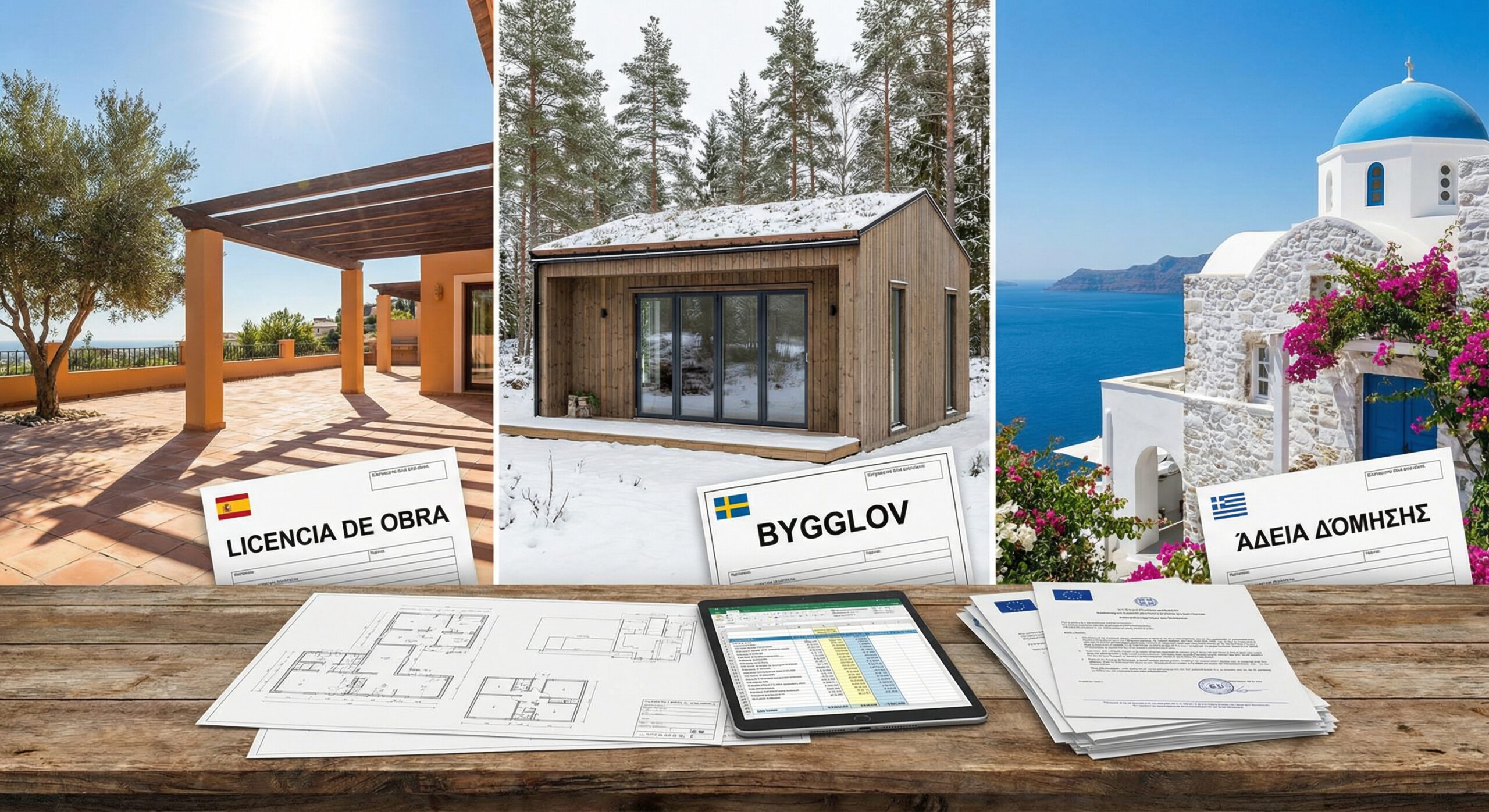
One of the most common requests in residential architecture is extending a property outward: a terrace to make the most of a garden, a glazed extension that connects the living space to the outdoors, a garden room or studio that creates a usable space away from the main house.
These projects often look modest on paper but deliver significant improvements in how a home works. They are also, in many cases, more regulated than clients expect. Understanding how Madrid’s building permit system classifies these works is the essential first step.
What Triggers a Permit for Extensions in Spain
In Spain, any permanent construction outside the existing building footprint requires a permit. This includes:
Terraces with a floor structure resting on the ground (as opposed to a simple paved area at ground level, which typically does not require a permit).
Glazed extensions (cerramientos de terraza) that close off an existing terrace with glass or other fixed materials. These are extremely popular in Spain and represent a significant area of regulatory activity, since many have been constructed without permits.
Garden rooms, studios, or any structure with a roof and walls outside the main building footprint.
Pergolas with a fixed roof structure (open pergolas with a lattice or shade structure rather than a solid roof are sometimes permitted under simplified notification in some municipalities, but this varies).
The relevant planning constraints for extensions in Spain:
The urban planning regulations (PGOU) for your municipality set the maximum buildable area on your plot, the maximum building coverage ratio, and setback distances from plot boundaries. Any extension proposal needs to fit within these parameters, and many plots are already close to their maximum permitted coverage.
Heritage protection rules apply to extensions on protected buildings. Adding an extension to a heritage-rated building requires a much higher level of justification and approval than adding one to a standard residential building. The rules for protected Madrid buildings are covered in our guide to renovating a protected historic building in Madrid.
Glazed Terrace Enclosures: A Special Case in Spain
Closing off an open terrace or balcony with glass is one of the most common residential extensions in Spain, particularly in apartment buildings where residents want to create a more protected outdoor space.
The permit route for this depends on whether the terrace is common property (part of the building’s shared structure) or private property (part of your individual apartment). In most Spanish apartment buildings under horizontal property law, the structure of the terrace is common property even if you have exclusive use of it, meaning that enclosing it requires community approval as well as a building permit. The comunidad rules are explained in our guide to Spanish horizontal property law.
Getting community approval for a terrace enclosure can be straightforward if the building has a standard policy or if other residents have already enclosed their terraces. It can also be difficult if the building is heritage protected, if the community has previously decided not to allow enclosures, or if your proposed enclosure would be visually inconsistent with existing ones.
This is an area where many clients encounter surprising complexity. If you are buying an apartment specifically because of a large terrace that you intend to enclose, check the community rules and precedents before completing the purchase.
Extensions in Greece: The Same Logic, Different Rules
In Greece, extensions to existing buildings require a building permit (or Small-Scale Works Approval for minor extensions) and must fit within the building ratios (syneteles domisis) applicable to the specific zone. The broader context for renovating in Greece is covered in our guide to renovating property in Greece as a foreign buyer.
Greek planning zones calculate permitted building volume on the basis of the plot area and the applicable building coefficient. If the existing building already uses all of the permitted buildable volume, no extension is possible without applying for a variance, which is difficult to obtain.
As with Spain, extensions in traditional settlement zones on the islands require additional scrutiny, and the materials and design of any extension must be consistent with the character of the protected area.
One specific complexity in Greece that differs from Spain: many older properties have αυθαίρετα (unauthorized additions) that have been partially legalized but not fully integrated into the property’s official building permit. Before designing an extension, it is essential to establish the exact legal building volume currently on the plot, including any legalized or semi-legalized structures, so that the extension proposal can be correctly assessed against the permitted limits.
Small Structures and Garden Rooms: What Can Be Done Without Full Permits
In Spain, small prefabricated or demountable structures in gardens are sometimes argued to fall below the permit threshold. The reality is that in most Spanish municipalities, any permanent structure, even a small garden room or studio, requires at minimum a prior notification and in many cases a full permit.
In Sweden, the Attefallsåtgärder rules allow certain small building measures without a full building permit, including attefallstillbyggnad (a building extension up to 15 square meters) on most single-family houses. This is genuinely useful and allows modest garden rooms, studio spaces, or storage buildings to be added without the full permit process, subject to design requirements. For Swedish property buyers, how renovation works in practice is covered in our guide to buying property in Sweden as a foreigner.
In Greece, small utility structures on rural plots sometimes fall under simplified categories, but urban properties generally require permits for any permanent structure.
The safest approach: always ask your architect to check the specific rules for your plot before commissioning designs. The cost of finding out that your planned garden room requires a full permit after the design is complete is always higher than checking in advance.
Design Principles That Make Extensions Work
Continuity with the main house. Extensions that feel like they belong to the same building are better than those that feel bolted on. This means: floor levels that align or transition smoothly, ceiling heights that relate to the main building, and materials that either match or deliberately contrast in a considered way. A glass and steel extension against a stone wall can be excellent. A plastic-and-timber conservatory against a classical façade rarely works.
Light management in glazed extensions. A fully glazed south-facing extension in Spain or Greece becomes a greenhouse in summer without adequate shading. Overhangs, external louvres, or switchable glazing are not optional extras. They are essential to making the space usable in the season when you most want to use it. How to make the most of outdoor space in the Spanish climate is covered in our guide to outdoor space design in Spain.
The threshold experience. How you move between the main house and the extension matters. A wide, unobstructed opening that makes the transition feel effortless is better than a narrow door that makes the extension feel separate. The threshold design is often where the success or failure of the indoor-outdoor connection is determined.
Want to add an extension, terrace, or outdoor space to a property in Spain, Greece, or Sweden? Tell us about your project using the form below and we will respond within 48 hours.